


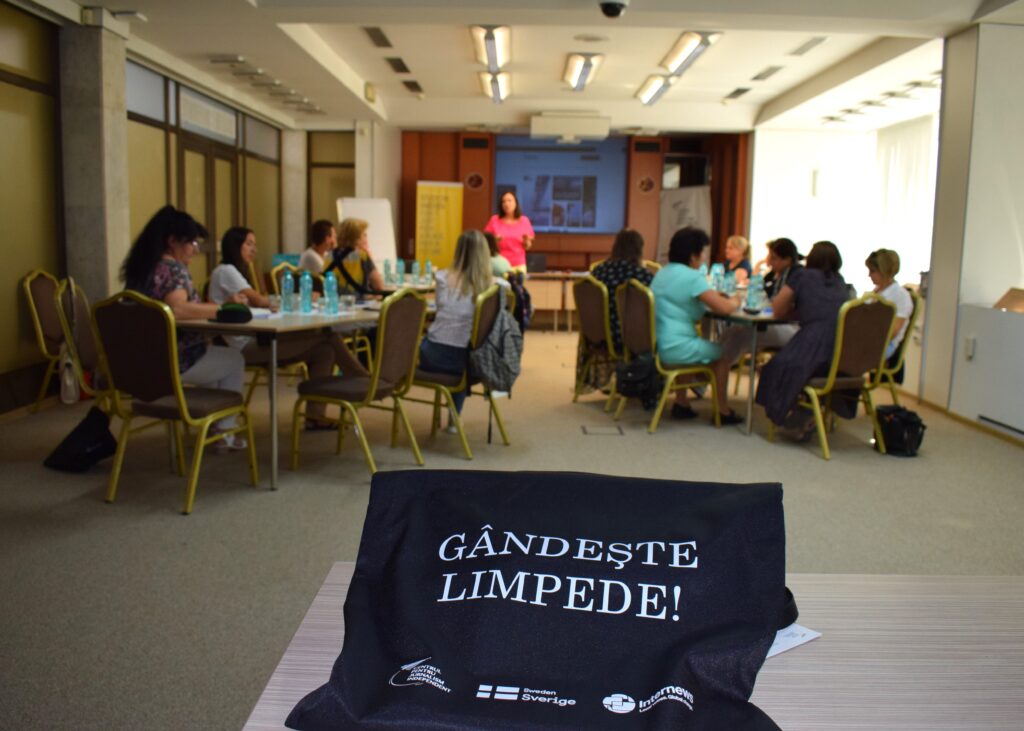
17 middle school teachers were taught in media education as part of a new training program organized by the Independent Journalism Center (IJC) from August 14-16, 2024.
The training was based on the curriculum for the optional Media Education course at the middle school level, as well as the updated version of the Media Education textbook, published in 2024. The textbook was written taking into account digital innovations and changes that have occurred in recent years, incorporating new examples that will help students better understand the field of media education, develop critical thinking skills, and consume information responsibly.
The course trainers were Loretta Handrabura and Natalia Grîu, authors of the curriculum and the Media Education textbook for 7th and 8th grades.
At the beginning of the training, Mariana Tabuncic, IJC program manager, emphasized that the IJC places significant importance on the field of media education, thereby contributing to the development of a society that thinks critically. “The previous Media Education textbook was published in 2018, and since then, much has changed in the field – new virtual platforms and tools for online interaction have emerged, and methods of disinformation have become far more subtle. This year, we were able to update the content of the middle school textbook, and this training is designed to help you better understand how to teach the subject at the middle school level,” said Mariana Tabuncic.
Over the course of the three-day training, the teachers developed their skills in teaching Media Education at the middle school level, based on the curriculum content and the updated version of the textbook of the same name.
The teachers were introduced to the textbook, familiarized themselves with the terminology of the field, and discussed the components of balanced news reporting, online etiquette, the art of photography, and the role of images in conveying a message. Online safety and digital well-being were other topics that received significant attention. The learning process was facilitated by various interactive methods, which helped participants better understand how they can convey information to students.
The trainers of the training program, Loretta Handrabura and Natalia Grîu, emphasized the important role that teachers play in the educational process, urging them to be mindful of their behavior, which could lead to situations of aggression or abuse in the online space.
The teachers appreciated the value of the training program, recognizing that in the 21st century, it is imperative to have knowledge in the field of media education.
Tatiana Cătănoi, teacher at Ursoaia Middle School, Căușeni District:
During the training, we learned to distinguish credible sources of information from unreliable ones, to identify the intentions behind media messages, and to assess their impact on society. In addition, we highlighted working techniques to help students develop effective communication skills, whether it involves expressing opinions on social media platforms or creating their own media content. Starting in September, together with our eighth-grade students, we will demonstrate that media literacy is not only an important component of modern education but also an essential step in shaping responsible citizens capable of navigating a complex information environment with discernment.
Tatiana Tabaranu, teacher at “Traian” Theoretical High School, Chișinău:
Thanks to this course, terms such as ‘deepfake,’ ‘news aggregator,’ and ‘clickbait’ are no longer foreign to us, but have become compasses in the digital world, guiding us toward a clearer understanding of virtual reality.
Rodica Eșanu, teacher at “Gheorghe Ghimpu” Theoretical High School, Colonița village, Chișinău:
I needed to participate in this training to learn how to teach Media Education in 7th grade. The training provided us with answers regarding both the course content and teaching methodology. We learned how to properly consume any media information, how to protect ourselves from online violence (cyberbullying), and how to verify the accuracy of a news story. The media literacy skills developed in this course will certainly facilitate the teaching-learning process in any school subject.
At the end of the training, the IJC distributed 350 Media Education textbooks for middle school to teachers who have already decided to teach the subject in the 2024-2025 school year.


Until recently, the IJC has trained 253 primary school teachers, 191 gymnasium teachers, and 277 lyceum teachers. The Media Education optional course has been taught in schools in the Republic of Moldova since 2017, and is included in the Framework Program of the Ministry of Education and Research of the Republic of Moldova for all three levels of education, i.e. primary school, gymnasium, and lyceum. The IJC developed the Media Education curriculum and textbooks which are issued to teachers and pupils free of charge.
This activity is part of the project supported by Sweden “Media Literacy Advancement and Support to Moldovan Media” and implemented by Internews, which aims to contribute towards the growth of a diverse, independent and financially viable media landscape in Moldova, and to empower Moldovan youth to navigate their complex information environment.

