



In the second half of July, the Moldovan TikTok information space abounded in a mixture of recurrent and emerging disinformation narratives relevant in the pre-election context, which aimed to undermine the public’s trust in the authorities, to instill fears about involving the Republic of Moldova into the war, to question European integration issues, and to de-legitimize the elections.
- Monitoring 46channels which belong to a number of politicians, bloggers/influencers, and media sources, or are anonymous pages, on July 16-31, illustrates that, in addition to the ongoing insistent promotion of many “classic” narratives, they were intensified by recent events discussed publicly, such as Vlad Plahotniuc’s detention in Greece, the MEGA conference organized in Chisinau, and the decision to open a certain number of polling stations for the diaspora.
- Another tendency which has already consolidated in this information space isAI integrated in generating manipulative content, which amplifies harmful impact of such narratives and makes detecting them more complicated.
- The videos published by the 46accounts during the two weeks of monitoring had over 55.5 million.
|
WHICH CHANNELS WE MONITORED We analyzed the content published on 46 TikTok accounts including: – 10 channels owned by politicians; – 14 channels owned by bloggers/influencers; – 12 anonymous pages; – 10 channels owned by media outlets. The most popular accounts owned by politicians were Renato Usatii (over 216000 followers and 94 million views); Igor Dodon (over 95000 followers and 27 million views); Irina Vlah (over 73000 followers and 31 million views), Victoria Furtuna (over 54000 followers and 15 million views), and Vasile Tarlev (over 21000 followers and 5.8 million views). The list of bloggers/influencers includes Grigore Manoli (over 462000 followers and 404 million views); Caras (over 183000 followers and 152 million views); Sandeluu (over 168000 followers and 61 million views), Petr online (over 78000 followers and 90 million views), and Sergiu de Moldova (over 72000 followers and 36 million views). The most popular anonymous pages are @fantastic1007 (over 145000 followers and 87 million views); @alpha2betaomega (over 106000 followers and 38 million views); @poseidon_008 (67000 followers and 116 million views), @politicamoldoveneasca25 (over 52000 followers and 58 million views), and @imiplacemd (over 42000 followers and 42 million views). The most popular media sources are ТСВ Приднестровье (over 267000 followers and 289 million views); TV6 (over 211000 followers and 298 million views); Первый Приднестровский (over 61000 followers and over 37 million views), Moldova 2.0 (over 48000 followers and 18 million views), and Primul in Moldova (over 45000 followers and 26 million views). |
Let us provide an analysis of the most prominent narratives in the content published by the monitored channels.
- Moldovan soldiers who “lost their lives” in Ukraine: a fake that gathered over 1million views
The fake about the “death of Moldovan soldiers in Ukraine” which we also mentioned at the beginning of the previous month was seen by hundreds of thousands of TikTok users since July 15. In spite of the fact that the Ministry of Defense disproved this information, it continued to appear both on the politicians’ pages and on a network of anonymous accounts.
Initially, it was a single video which quickly gained over 222000 views: it stated that “they have already sent our soldiers to Ukraine. The consequences are tragic, Moldovan soldiers have lost their lives.” In mid-July, we detected at least 50 more videos promoting this hoax on TikTok, all of them included the hashtag #мынехотимумирать (i.e. “we do not want to die”), which clearly demonstrates that this manipulative content was spread in a coordinated way. Together, these videos gathered over 1.3 million views before they were deleted from the platform by the administrators or by those who had published them.
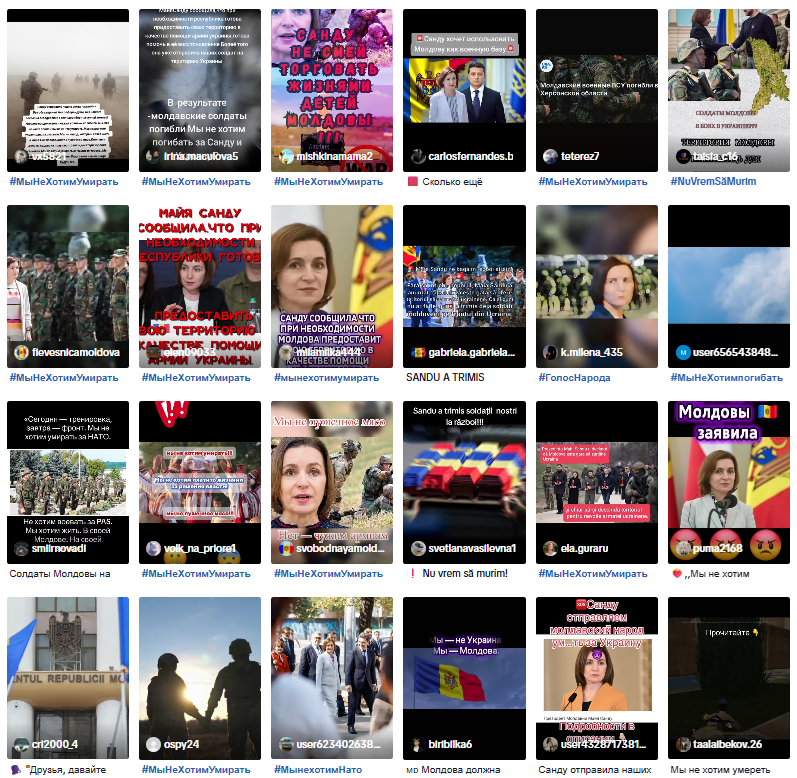

Some of the videos included AI-generated elements as well as manipulative images dating back, for instance, to 2020.
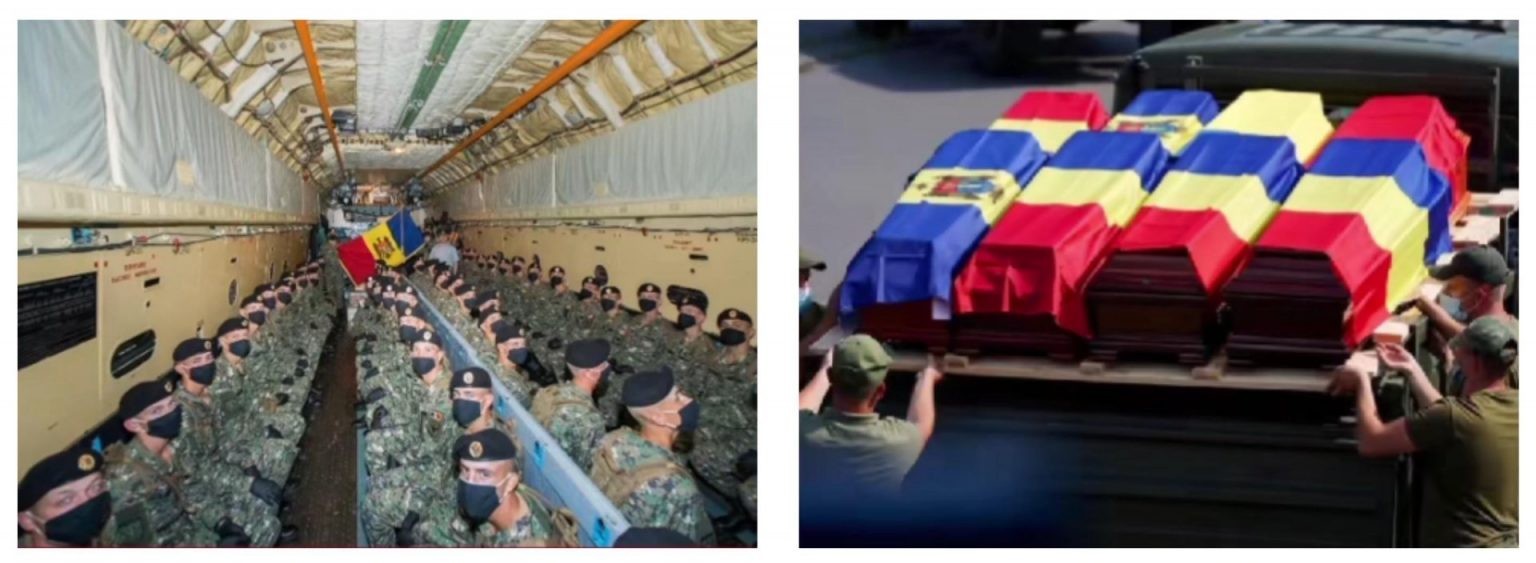

On July 16, Vasile Tarlev, President of the Viitorul Moldovei Party, published two statements (in Romanian and in Russian) on TikTok claiming that the Republic of Moldova was being “involved into a foreign war.” According to him, this conclusion was based on the information from “numerous media publications and online resources with millions of subscribers” which had reported on the alleged “death of 10 Moldovan soldiers in Ukraine.”
The narrative regarding the war is a common topic in the speeches by the pro-Russian politicians. For instance, ex-President Igor Dodon, in his speech published on TikTok declares that he formed an electoral bloc for the 2025 parliamentary elections in order to “save the country from poverty, death, and war.”
2. Opening polling stations for the diaspora and the narrative according to which the diaspora in Russia suffers from discrimination
The narrative about the alleged election fraud has been relaunched, this time under the pretext of “discrimination against Moldovan citizens in the Russian Federation.” After the Central Election Commission (CEC) published the preliminary list of eventual polling stations to be opened for the September 28 elections for public consultation, a number of critical reactions emerged on TikTok. Some blamed the authorities for opening only two polling stations in Russia for “political” reasons.
The videos on this topic were often presented in contrast to the alleged privileges granted to the diaspora in the West, thus spreading a narrative of social polarization. In this way, they create an impression that citizens are divided into two categories (some are privileged, while the others are being discriminated against) and treated unfairly by the state.
It is important to mention that a similar number of polling stations were opened in 2024, including in Russia, Ukraine, and Israel, the countries affected by armed conflicts. The authorities in Chisinau justified this decision by explaining that it was difficult to provide logistical and security conditions in the other cities of the Russian Federation.
@sergiu_de_moldova, an account with over 70000 followers and 1.9 million likes, belongs to a person involved in propaganda activity and promoting the narratives of the Russian Federation on a permanent basis. His messages are often in line with those published by other content creators with a similar agenda. In a video published on July 24, Sergiu erroneously affirms that, according to the authorities, “about 390000 Moldovans reside in the Russian Federation, and they enjoy the same full rights.” In addition, he emphasizes that “hundreds of polling stations will be opened in Europe,” whereas Moldovans in Russia are allegedly discriminated against.
It should be noted that there is no exact data on the actual number of Moldovan citizens residing in Russia. However, during the first round of the 2024 elections, approximately 8000 persons voted at the two available polling stations in Moscow.
Another estimate of the number of Moldovan citizens residing in the Russian Federation (approximately 500000) was mentioned by Nina Dimoglo, an activist affiliated with the former Sor Party. According to her, “there are no relevant reasons for reducing the number of polling stations in Moscow,” and “Moldovans’ voting in Russia leaves the PAS no chance of winning.”
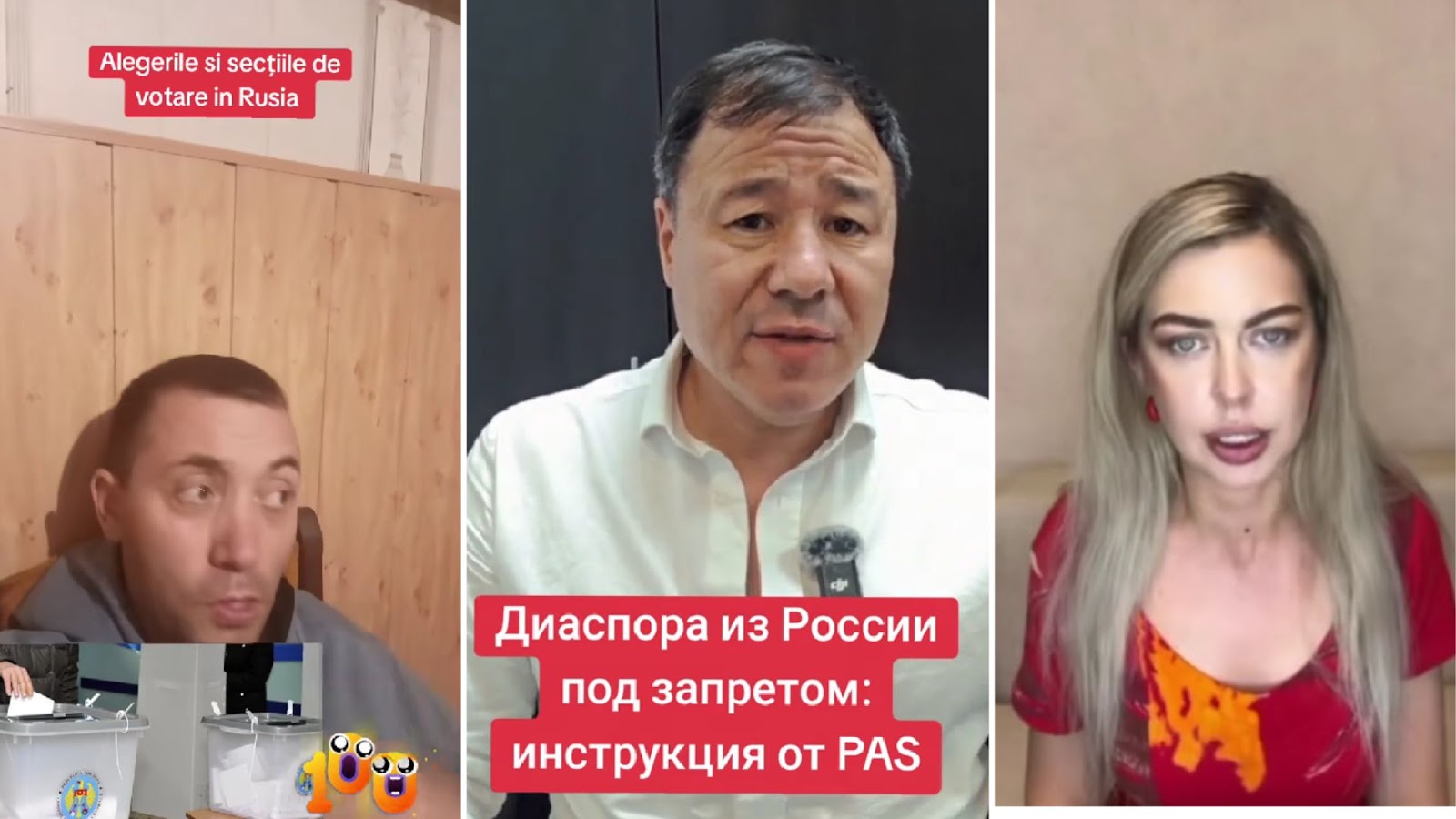

Bogdan Tirdea, a socialist deputy promoting pro-Kremlin narratives, claims in this connection that the PAS is preparing a “provocation” due to which Moldovans from the Western diaspora would allegedly declare that they were illegally registered on the electoral lists in Russia.
Suspicions concerning such registrations actually existed in 2024. At that time, Angelica Caraman, President of the CEC, spoke about suspicious requests for voter registration in the Russian Federation, multiple requests sent from the same email address, and appearances of email addresses with similar names.
In a video published by @fantastic10007, an anonymous channel with over 145000 followers, a woman apparently representing the diaspora from Russia, recites a poem in which she emphasizes that the diaspora in Russia is also valuable. She says that, due to the political context, this diaspora is regarded in a different way, and that its financial support and contributions are not sufficiently valued in the Republic of Moldova. At one point, she compares choosing between Moldova and Russia to choosing between the mother and the father.
In another video on the same channel which has over 46000 views, a sequence from a news broadcast by Moldova 24 is presented: it reports on Moldovan citizens’ protest in Moscow, at the Embassy of the Republic of Moldova. The protesters are dissatisfied with the intention of the authorities in Chisinau to open only two polling stations in the Russian Federation. The reporter on the spot seems to be acquainted with the persons who are invited to speak and offers them the microphone in a selective manner. Those interviewed affirm that their right to vote is restricted, saying that they would like to see a total change of the current governance, stating, “We’d like to change everything, absolutely everything.” One of the participants claims that the situation in Moldova keeps deteriorating, that “LGBT is what matters most,” and family values are disregarded, concluding that “Moldova has no future.” Another woman mentions that she would like to return to the country freely, but currently, it is impossible. Another protest participant says that the current government is afraid of the diaspora, and that, though she does not expect the authorities to take their requests into account, she has heard from some other Moldovans abroad (including from those residing in the West) that they no longer support Maia Sandu, and that they are eager to vote for those who can “defend Moldova,” so that Moldovans could return to their country and have a better life at home. At the end of the report, the journalist remarks that, according to data provided by the Russian Federation, approximately 500000 Moldovans reside there, whereas the Embassy of the Republic of Moldova indicates a number of about 350000. In this context, she asks a rhetorical question, “What about the other 150000?”
In another video published on @primulinmoldova, the channel with over 45000 followers, a woman expresses her opinion about the voting rights of the Moldovan diaspora in Russia. According to her, Moldovans in Russia are not inferior to those residing in Europe; they have the same rights as everyone else, and are eager to vote. The central message is that the Moldovan diaspora in Russia feels marginalized and discriminated against compared to that residing in Europe. The woman also describes life in Russia, especially in the Kursk Oblast near the border with Ukraine as relatively calm, and says that the locals do not suffer from any bombings or alarms, despite the general perception. In addition, she emphasizes that many Moldovans choose Russia because of historical, cultural, and linguistic connections and because they find it easier to adapt.
3. The diaspora’s disappointment with the European countries and the narrative that the EU exploits them
The narratives related to the diaspora in Russia are accompanied by stories and opinions regarding the Western diaspora’s disappointment with the government in Chisinau and the statement that the European Union is merely using Moldovans’ labor and taxes to support Moldova superficially.
A video with over 186000 views published by @fantastic10007, an anonymous account, shows a meeting attended by a number of people. A man starts speaking and tells the audience about an alleged previous meeting with President Maia Sandu, during which, according to him, he asked her several questions, but no answers followed. Some of these questions were related to the high price for gas in Moldova and having to pay for obtaining a driver’s license in Germany in spite of the fact that driving licenses were supposedly equivalent. It is not clear who he is exactly addressing or which sources of information he refers to. However, according to him, he was told at that meeting that “it’s Putin who is to blame,” which causes laughter among the audience. The video, taken out of context, emphasizes the idea of the diaspora’s dissatisfaction the current governance.
The same narrative was developed by @sergiu_de_moldova, Nina Dimoglo, and Bogdan Tirdea, with the “support” of a manipulative article published by Affaritaliani, an Italian daily newspaper. Its text, together with the basic Kremlin narratives, mentions that Maia Sandu is a dictator who bans political parties associated with Ilan Sor from taking part in the elections, also putting pressure on Evghenia Gutul who is likely to become the “opposition leader.” Besides, citing some “anonymous sources close to Maia Sandu,” the author of the publication makes direct speculative and biased accusations against the head of the state.
The author’s controversial point of view was presented by @sergiu_de_moldova “as an opinion of a part of Europe, probably the majority.” The same idea is emphasized by Bogdan Tirdea who affirms that “the Europeans already understand who Maia Grigorievna is,” and Nina Dimoglo, summarizing the article, affirms that, “with Maia Sandu, we’ll have to kiss Europe goodbye.”
In another video with over 15000 views, which includes a fragment of a show hosted by Gheorghe Gonta, Vasile Costiuc invited as a guest is asked whether the diaspora in the West could be the decisive factor during the upcoming elections. He replies that he has personally discussed this issue with Moldovans residing in France and says that they should not be blamed for the fact that they left the country many years ago, and they find it difficult to assess the current realities in the Republic of Moldova. At the same time, Costiuc shares the idea that the “PAS infrastructure” presumably exists in the Western diaspora: according to him, it is a system via which Moldovans in the West obtain exclusively the information favorable to the current governance. He considers that they supposedly read nothing but pro-government content and, therefore, idolize Maia Sandu. The messages he expresses reinforce a narrative of polarization among citizens, opposing the Eastern diaspora to the Western one, and questioning the discretion of those who vote from abroad.
In another video with over 133000 views published by @poseidon__008, an anonymous account, Igor Cujba, a representative of Partidul Nostru (Our Party), makes a series of statements during a broadcast. He mentions that the European Union’s donations to Moldova are insignificant, saying that Moldovans from the diaspora have to pay taxes in the European countries, from which, according to him, the funds granted to Moldova are allocated. According to his estimates, Moldovans annually contribute about 10 billion Euros to the budgets of the European countries, whereas Moldova, in its turn, receives the financial support equal to approximately 250 million Euros. He speaks ironically about the European leaders, saying, “After that, Ursula von der Leyen or another ‘honored artist’ of the European Union appears and throws us some crumbs from the 10 billion they pocket from our Moldovans, and forgiving us those crumbs, they want us to kneel saying, ‘Thank you very much, Europe!’ from morning till night.”
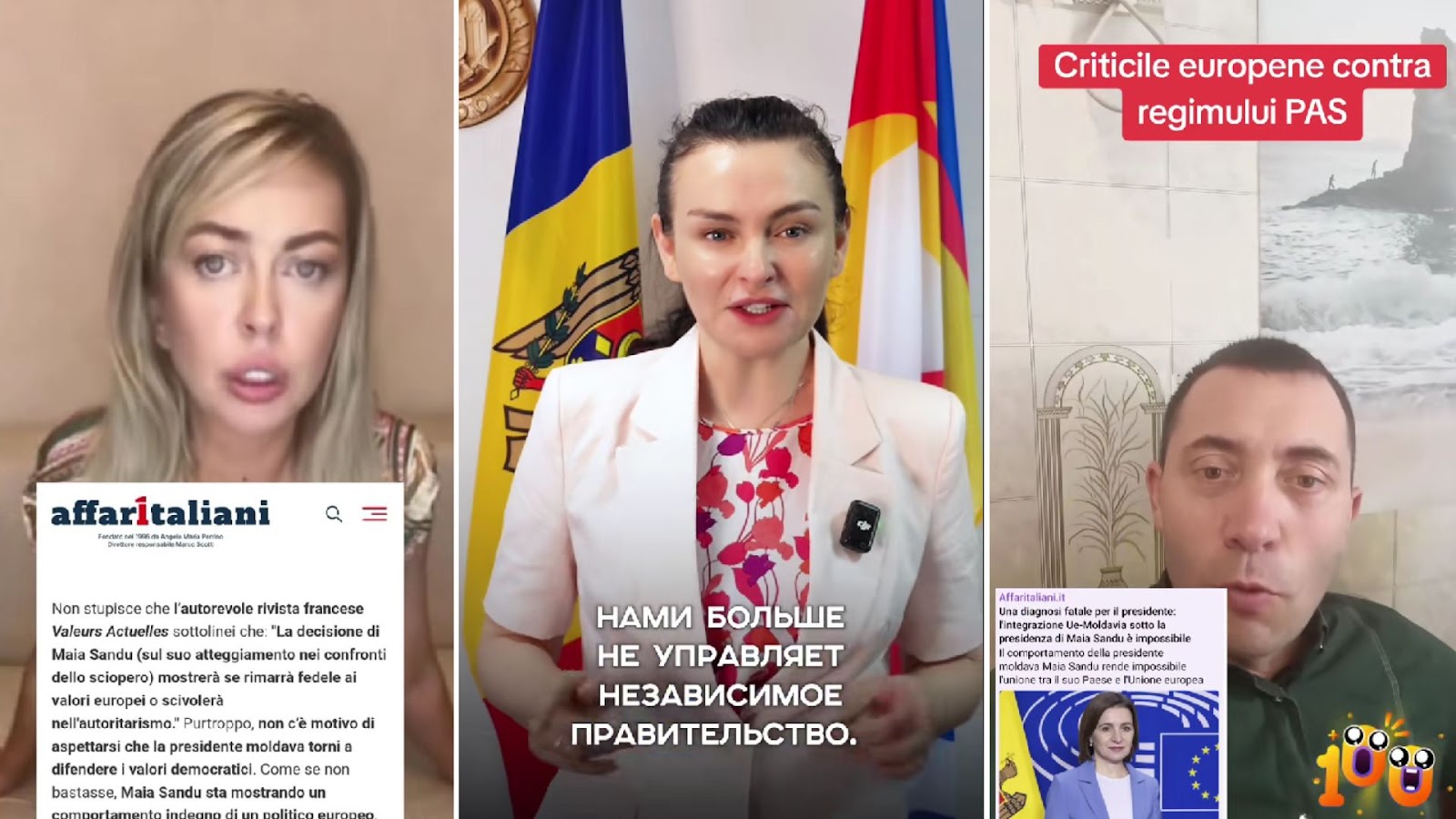
In a video with over 50000 views, Victoria Furtuna criticizes the European Union’s sanctions against her. She affirms that “we are no longer headed by an independent Government, instead, we are being managed like a colony,” saying that the state institutions have transformed into “tools” for foreign interests.
- Vlad Plahotniuc’s arrest in Greece
A number of conspiracy theories and assumptions related to news about Vlad Plahotniuc’s arrest in Greece have started circulating recently.
In one of them, presented by Vasile Costiuc in a fragment of the broadcast hosted by Gheorghe Gonta (a video with over 21000 views), the guest claims that Plahotniuc’s arrest was allegedly part of his own personal plan. Costiuc affirms that the former democratic leader intentionally allowed arresting himself in order to return to the Republic of Moldova and to reintegrate into political life. According to him, this chain of events is quite inconvenient for the current governance which did not contribute to arresting him, but would be in an awkward position if this controversial political figure returns.
The same idea is apparently shared by an account named @petronlinemd owned by a person who regularly attends the political events organized by the pro-Russian forces in the Republic of Moldova. His account has almost 80000 followers and over 2.7 million likes.
Another narrative published by Ion Bulgac, the counselor of Mayor Ion Ceban, suggests that there is an alleged secret cooperation between the PAS and Vlad Plahotniuc. He refers to a conversation he allegedly had before the oligarch’s detention, in which it was mentioned that Plahotniuc supposedly intended to reappear in public and to support the PAS by means of attracting votes. Bulgac suggests that his detention was part of a well-planned scheme intended for bringing electoral advantages to the governing party.
Another theory in a video channel (over 42000 views), suggests that Vlad Plahotniuc presumably owns some compromising information concerning various political entities in Moldova. This hypothesis supports the idea of the political class having generalized discomfort about his eventual return.
In another video published by the same channel (@primulinmoldova), with over 17000 views, a lawyer expresses doubts about Plahotniuc’s eventual quick extradition. The lawyer mentions that, in Greece, extradition procedures usually last much longer (2-3 months or even more), and a shorter term could be a sign of political intervention at the level of the European Union. “That’s why I doubt there will be a decision within the next 2-3 months, unless there is an intervention at the level of the European Union and, let’s say, the European Union’s political decision for Greece to extradite him faster.”
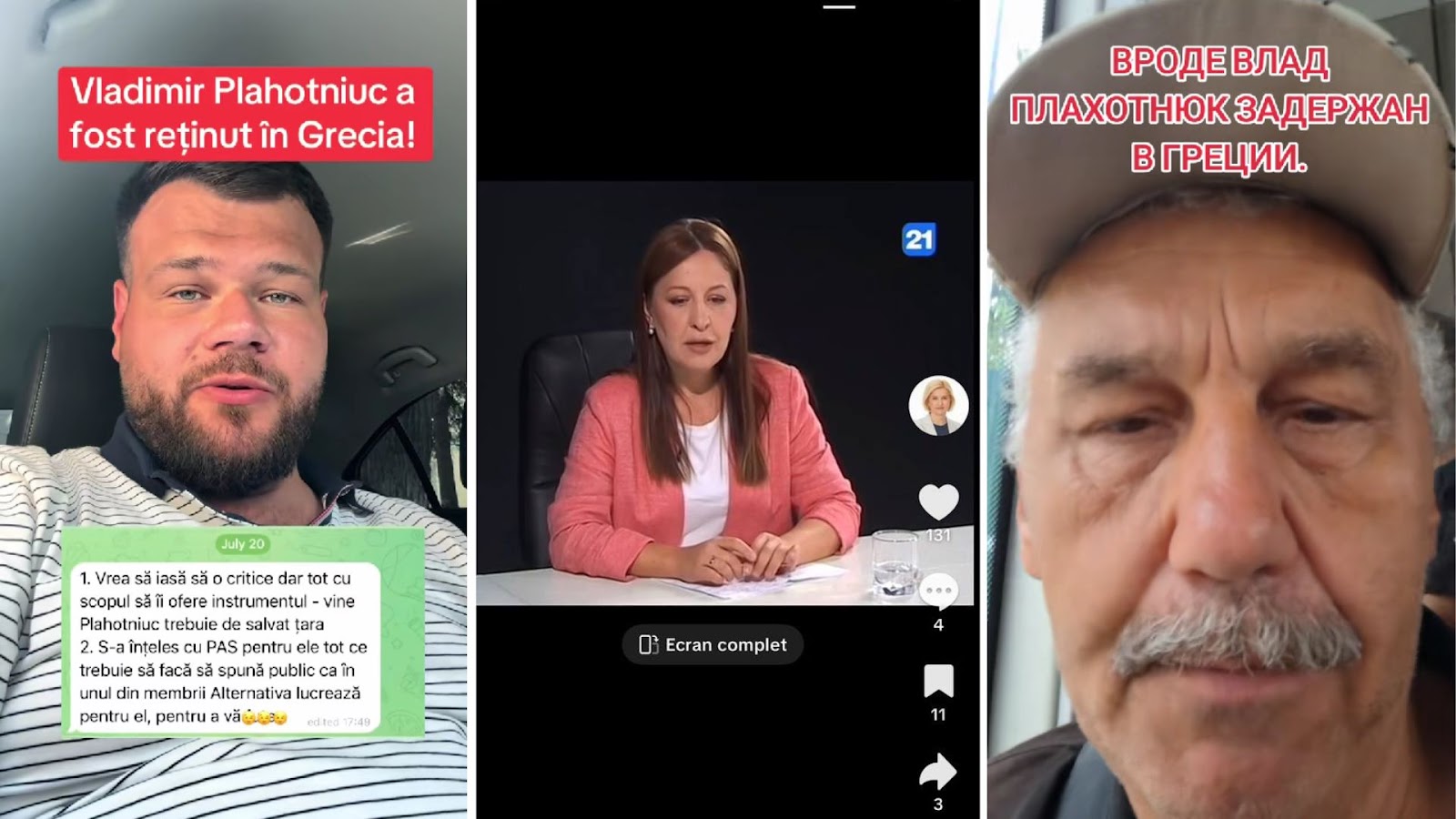
At the same time, in a video published by Irina Vlah, a woman insinuates that Plahotniuc’s arrest was supposedly fabricated to distract attention from forming “the largest [political – author’s note] bloc that will exist after the elections.” It is also mentioned that there is no clear evidence of the oligarch’s detention, except the statements made by the authorities, which is likely to decrease citizens’ trust in the state structures.
- MEGA Conference in Chisinau
Victoria Furtuna dedicates several videos to the “MEGA 4th edition – Make Europe Great Again” conference (a meeting of conservative politicians and activists held in Chisinau in late July) and expands several of her previous narratives on this occasion. For instance, the politician criticizes the values of the European Union and remarks that “our Moldova should not choose between the EU and its own values, it should remind Europe what Europe means.” By using this manipulative method, Furtuna creates a false contradiction between European integration and keeping national identity, and presents the European Union as a threat to the traditional family and faith.
She also praises the MEGA conference as an example of “true democracy” as opposed to the current governance which she describes as dictatorial and repressive. Furtuna accuses the authorities of banning particular officials from entering the Republic of Moldova, warning that “tomorrow, we, the citizens, are likely to be banned from entering our own country.” In this way, she appeals to the narrative about establishing a dictatorship and the international isolation of Moldova.
Along with Victoria Furtuna, Bogdan Tirdea covers and develops the same conspiratorial and alarmist topics. He criticizes the bans imposed on some conservative European deputies, affirming that the PAS prevents “Trump’s friends” from entering Moldova. Ironically, he hints that the American activist Brian Brown’s opposition to LGBT is the real reason why he could be regarded as dangerous by the governance: “Brown is against LGBT, and this is probably why he’s a danger to Maia Sandu.”
Gabriel Calin formulates a more alarmist and conspiratorial message as he accuses the governance of blocking access to some conservative guests at the MEGA conference for ideological reasons. He claims that the real reason for banning them is that the event was supposed to address such an issue as the “paradigm between sovereignty and George Soros,” and that the head of the SIS, whom he considers a “Sorosist,” ordered to restrict their access. Calin also considers that this gesture leads to Moldova’s international isolation, especially in the relations with the US.
In addition to the politicians’ and bloggers’ TikTok accounts, the MEGA conference was also covered by the media sources affiliated with Ilan Sor. A video channel covers a wave of criticism of the authorities of the Republic of Moldova. The main source of indignation is the government’s decision to deny entry to the country to the foreign delegates, including the deputies from the EU member states and the US citizens, who intended to take part in the conference The interviewed participants accuse Maia Sandu’s government of breaching the democratic principles, suppressing pluralism of opinion, and worsening the country’s international image: “This is the face of Maia Sandu, and there’s nothing else to say about it. It’s because we were building a free country, and what we have received is a dictatorship.”
- More AI-generated content
An observation resulting from monitoring the above TikTok channels concerns inserting a greater number of AI-generated sequences without providing a specific context or perspectives related to particular events.
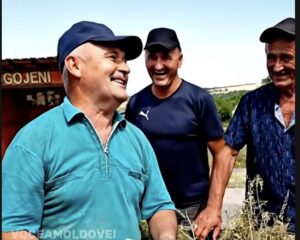
For instance, an AI-generated video with over 21000 views published on the @gagauzmoldova page demonstrates several people from the countryside who comment on receiving a PAS brochure. They laugh and mock the party, saying: “Don’t you idiots from the PAS even look at those you give your brochures about Europe to? You’ve taken from the farmers the last things they had. Well, little girl, you deserve to be trampled with a hoof according to Euro 5 standards.”

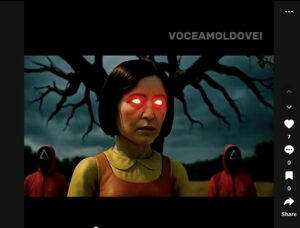
Another AI-generated video published by the same channel reinterprets the scene from the popular TV series titled Squid Game where a dummy eliminates people who fail to comply with the game’s requirements. The dummy’s appearance resembles Maia Sandu, and at the end, a coffin with the word “Democracy” written on it is shown, suggesting that it is dead.

CONCLUSIONS
1. Persistence of classic narratives and their amplification due to the new events. Well-known narratives are still intensely promoted, and they get adapted to the recent events; it demonstrates the disinformation ecosystem’s resilience and adaptability to the current political and geopolitical events.
2. Disinformation is supported by a heterogeneous network of entities and is often coordinated. Synchronized use of hashtags and recurrent topics suggest that coordinated influence campaigns are being conducted.
3. Disinformation exploits identity and geographical tensions, fueling polarization among citizens. The narratives concerning discrimination against the diaspora in Russia vs. favoring the diaspora in the West cause a false opposition between the East and the West, fueling supposed injustice, marginalization, and the sense of abandonment. These messages contribute to polarization of public space and have a negative impact on social cohesion.
4. AI-generated content is used for spreading manipulative messages. A larger number of manipulative videos include AI-generated images and narration without any signs of transparency or contextualization, which contributes to persuasiveness of disinformation and makes it viral in some cases. This trend hinders identifying fake content and efficiently countering it.
The monitoring was carried out within the project “Resilient Media, Informed Voters: Safeguarding Moldova’s Elections from Disinformation”, funded by the Embassy of the Kingdom of the Netherlands in Moldova. The views expressed are those of the authors and do not necessarily reflect the position of the donor.
Access to the TikTok monitoring tool was provided as part of the project “ProElect – Promote accountability in Electoral processes in EaP through increased participation and capacity of civic actors” implemented by the Center for Research and Advocacy in European Affairs with the financial support of the European Union and Equal Rights & Independent Media (ERIM).

