



During the first two weeks of the parliamentary election campaign in the Republic of Moldova, we identified both identity and conspiracy narratives, as well as using particular episodes for creating an image of arrogant and abusive governance in the information space on Facebook. At the same time, such foreign figures as George Soros were used in the political and media discourse, consolidating previously known messages based on fear and polarization.
- The narratives identified on 117 Facebook pages and public groups from August 29 to September 14 demonstrated no preference for particular topics: any topic which has polarization potential is used to the fullest, regardless of its essence.
- In all the cases, similar techniques can be observed: collective victimization, appealing to fear, conspiracies, documentary or audio fake items, ridicule, and identity-based manipulation.
- During the analyzed period of time, 1783 problematic posts which caused a considerable impact online were identified: over 388000 views, 47000 comments, and over 200000 likes and shares.
|
WHAT WE MONITORED We analyzed the content shared on 117 public Facebook pages which belong to several parties and party leaders, media sources and influencers, as well as thematic public groups with the audience ranging from 1000 to over 88000 members. The most popular public pages are Democrația Acasă (over 529000 followers), Renato Usatîi (over 338000 de followers), Point.md (219000 followers), Igor Dodon (over 192000 followers), Типичная Молдова (190000 followers), TV6 (174000 followers), Unimedia (137000 followers), Morari.live (130000 followers), and Primul în Moldova (125000 followers). The most popular public groups are Moldova, trezeşte-te! (approximately 89800 members), Свежие новости из Республики Молдова / Stiri din Republica Moldova (88500 members), ADOPTĂ UN VOT! (approximately 80000 members), and Știri din Moldova (37000 members). |
IDENTIFIED ESSENTIAL NARRATIVES
- An endless argument: Romanian vs. “Moldovan”
This year, the starting stage of the election campaign coincided with the weekend when the Romanian Language Day was celebrated. It was quite an “appropriate” opportunity for “competing” in spreading the narratives regarding the Moldovan language,” the topic which has been insisted on in different forms since the beginning of the last century. On the pages and in the groups monitored by us, we detected at least 75 posts and 44 shares on this topic, which had over 40000 views, 3500 comments, and over 18000 likes.
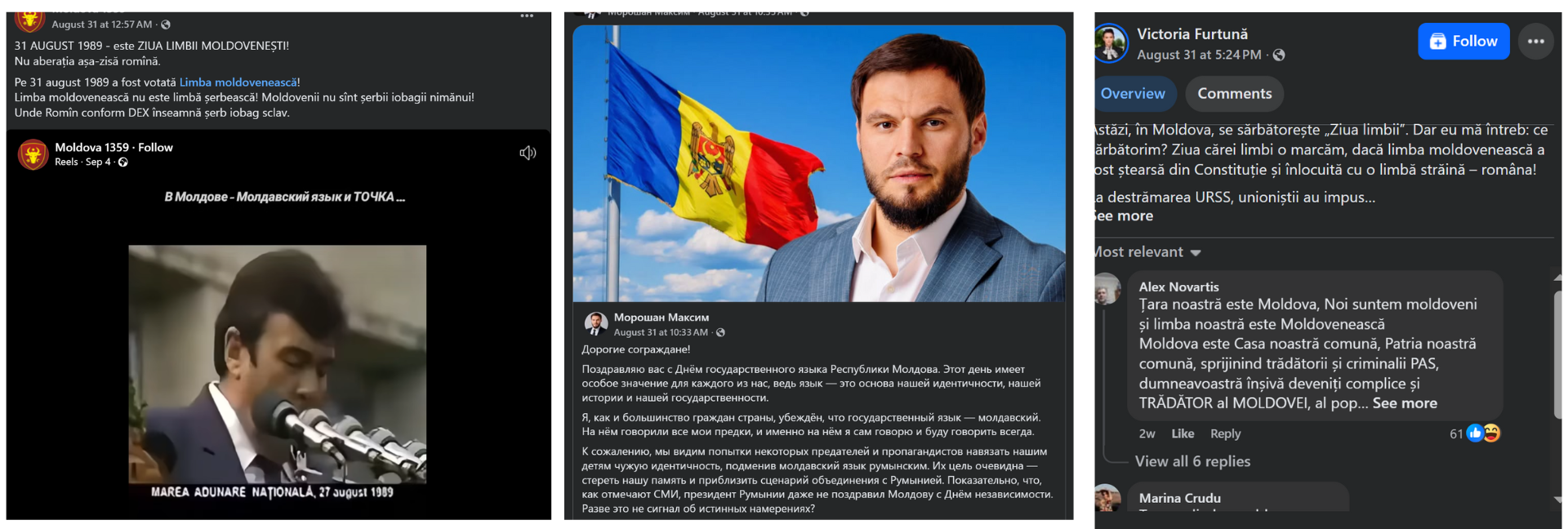
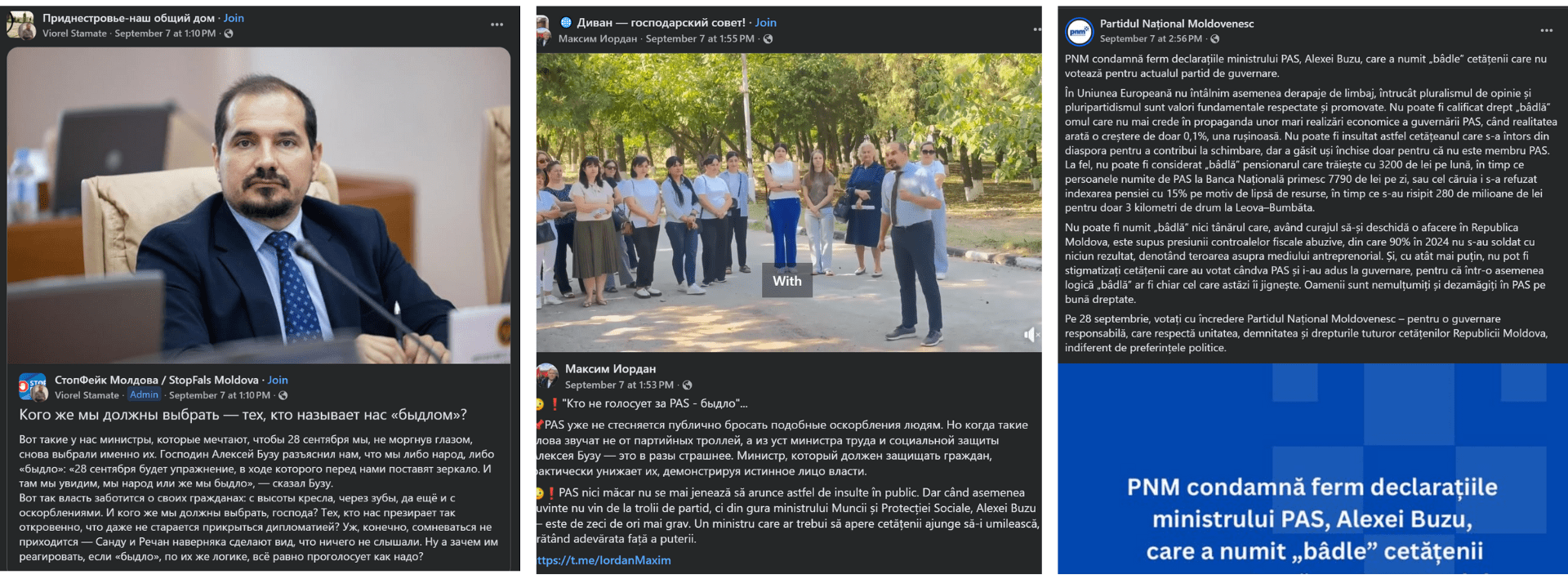
On August 31, the Moldova 1359 page affiliated with the organization headed by Nicolae Pascaru mentioned that “AUGUST 31, 1989, IS THE MOLDOVAN LANGUAGE DAY! It’s not the day of the so-called Romanian aberration. On August 31, 1989, we voted for the Moldovan language! The Moldovan language is not a language of servants! Moldovans aren’t anyone’s servants! In fact, the word ‘Romanian,’ according to DEX, means ‘servant’ or ‘slave.’” This day was also used by Maxim Iordan, a Patriotic Electoral Bloc (PEB) activist, as a pretext for attacking the governing party. In a post in the Moldova News group, he refers to celebrating the Limba Noastră (“Our Language”) Holiday and mentions that, “still, there is another ‘language’ that some people too often try to impose on society – the language of force. It is used by the PAS governance when it chooses pressure instead of dialogue. This language scares people. It is important to keep in mind that the PAS language of force should be forgotten, and the Moldovan language of culture, memory, and human dignity should be preserved and transmitted to our descendants.”
The other politicians amplified the Moldovan message by means of associations with geopolitical and anti-Romanian issues. Maxim Morosan, the ex-candidate for the post of mayor of Balti from the Party of Socialists, mentioned in a message written exclusively in Russian: “Like the majority of the country’s citizens, I’m convinced that the official language is the Moldovan language. All of my ancestors spoke this language, I speak it, and I always will. Unfortunately, we see the traitors’ and propagandists’ attempts to impose a foreign identity on our children by replacing the Moldovan language with the Romanian one. Their goal is obvious: they intend to erase our memory and to approach the scenario of unification with Romania. It is important to mention that, as the media notes, the President of Romania did not even congratulate Moldova on the Independence Day. Isn’t it a signal of their true intentions?” In addition, the mayor of Orhei from the Sor group mentions in the video footage from the celebration in the city aired by TV6 that, “unfortunately, the current governance has been trying to eliminate the Moldovan language by amending the Constitution and using a specific term ‘Romanian language.’ We are Moldovans, and we would like to bring up the younger generation in our mother tongue inherited from our ancestors. Moldova had existed before Romania appeared, and the first dictionary was the Moldovan one, hence, we can’t accept Romanianism imposed on us.”
Similarly, Victoria Furtuna (Moldova Mare/The Great Moldova Party) takes advantage of the celebration to attack the governance and to introduce some conspiratorial narratives about the “globalists”: “Due to the PAS deputies and Maia Sandu, in 2023, the Romanian language was registered instead of the Moldovan language. This is another act of betrayal. The globalists and unionists in power tell us: ‘The Moldovan language doesn’t exist.’ However, 56% of the citizens who took part in the census declared that the Moldovan language was their mother tongue. This is the truth of the nation, and it can’t be silenced.”

- The narrative regarding the diaspora’s voting and “electoral fraud”
Another element of disinformation recurring during the election campaigns concerns the diaspora’s voting, especially the situation of Moldovans in Russia. According to the central narrative, the PAS governance discriminates against the diaspora from the Russian Federation, which is underrepresented during the voting, and prepares to falsify the election results, or, despite the fact that it is the largest one on the globe, it is not included in the postal voting. We identified 52 posts on the topic, which were shared at least 969 times.
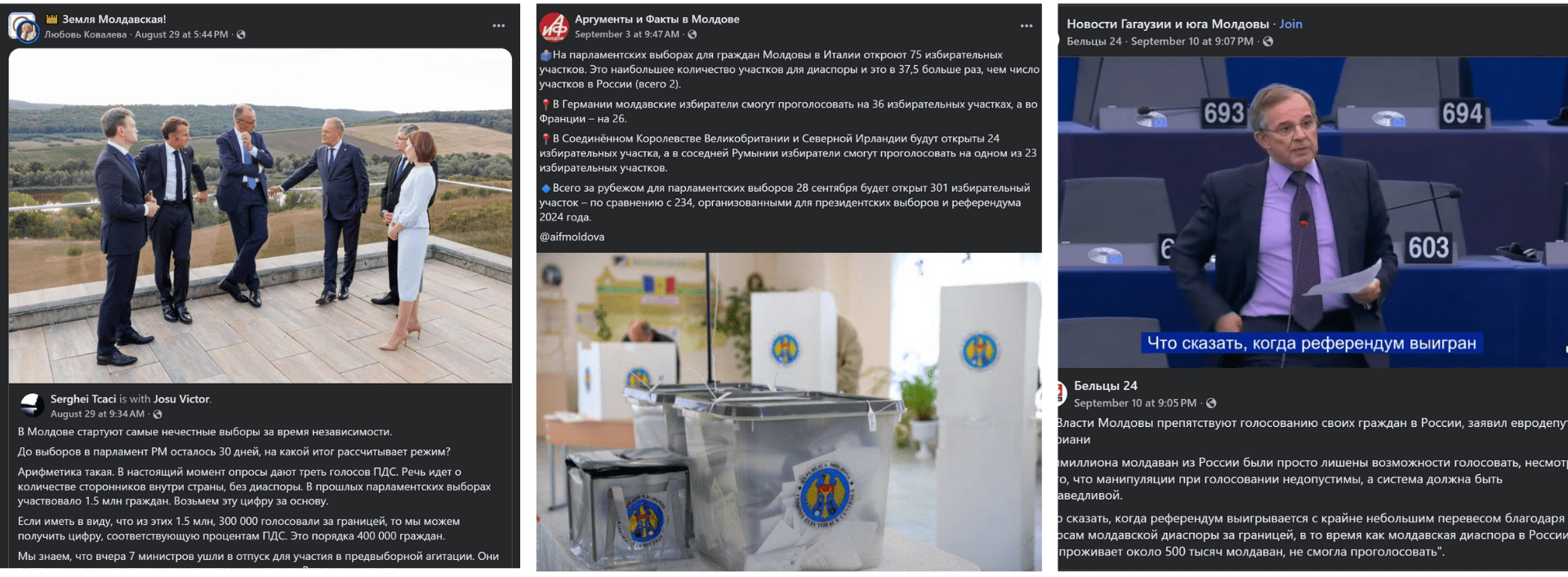
TV6 mentions while covering the topic of ballots printed for polling stations for the diaspora that “this procedure is not used in the Russian Federation where the largest number of our compatriots reside. The Moldovan diaspora in this country collected approximately 100000 signatures on a petition addressed to the authorities in order to increase the number of polling stations and to introduce postal voting; however, the Moldovan governance ignores this appeal. Only two polling stations will be opened in Russia (both in Moscow), though hundreds of thousands of our compatriots reside far from the Russian capital. The Ministry of Foreign Affairs of the Republic of Moldova explains this approach by ‘security reasons,’ though Moscow did not issue any official warnings regarding this issue.”
The problem of the number of polling stations in Russia was also covered by Argumenty i Fakty v Moldove. The authors did not cover the CEC’s explanations related to security issues in this case, mentioning only that “75 polling stations for the parliamentary elections will be opened for Moldovan citizens in Italy. This is the largest number of polling stations for the diaspora, and it is 37.5 times larger than the number of stations in Russia (only 2).”
In a post about the meeting of the PSRM leaders, Vlad Batrincea and Olga Cebotari, and the Communist Nicolae Fomov with the representatives of the ENEMO international election observation mission, the socialists emphasized that, “during the discussions, several serious breaches were detected, including the drastic reduction of polling stations for citizens from the left bank of the Dniester, unbalanced distribution of polling stations for the diaspora, preventing the opposition from appointing its members of electoral offices abroad, and using administrative resources in favor of the governing party”; they also demanded from the observers to “prevent abuse.”
Besides, during the meeting held in support of the head of Gagauzia at Penitentiary No 13, unaffiliated deputy Vadim Fotescu who is part of the Sor group, made the following statement quoted by the same TV channel, “We can see preparations for electoral fraud: opening too few polling stations for the diaspora and in Transnistria, and excluding the main competitors, such as the Victorie Bloc. The Canadian sanctions mentioned by Iuri confirm political interference and orientation: not only individuals are included in them, but also the Victorie Bloc, though it is not a legal entity.”
In the opposition-affiliated groups, such activists as Serghei Tcaci resort to conspiracy speculations: they claim the PAS supposedly aims to obtain 750000 votes, of which 250000–280000 would be the falsified ones from the diaspora obtained with the help of the “special services from the EU countries.” “Thus, will the governing party be able to get 250000 votes from abroad again? Taking into account they are opening new polling stations and have the total ‘support’ of the special services from the EU countries, accumulating 280000 votes seems quite possible. Macron, Merz, and Tusk flew there on the Independence Day for a certain reason, and the President of Romania will arrive on August 31, on the Romanian Language Day! It’s not easy to campaign for Sandu and the PAS. It’s more important to discuss how to ensure an electoral victory for the regime in the country that has become an important part of the Russian and Ukrainian conflict and which plans to continue it.” Mentioning the limited number of polling stations in Russia in this context, he emphasizes that “these are the most fraudulent elections ever.”
The online space was also filled with hostile messages aimed against the Western diaspora: they present it as “having nothing to do with the reality of Moldova” and guilty of the “unfair” decisions imposed on people who remain in the country. “The diaspora is once again eager to have its impact on the future of Moldova. But let’s be honest: how could they understand real life here if they have been residing abroad for a long while and only see Moldova in the newscasts and during the vacation? You vote, and after that, you return to your comfortable apartments in Italy, France, or Germany the next day. After that, we will have to clean up the consequences of your ‘correct’ decisions for decades.”
The narrative was also supported by the personalities popular in the media. Analyst Corneliu Ciurea quoted in Natalia Morari’s project accuses the PAS of preparing “to stuff ballots at polling stations abroad. Printing the necessary [i.e. too large – author’s note] number of ballots for the diaspora will give the authorities enough room for maneuvers.” In his turn, Dumitru Ciubasenco presented as a political analyst by TV6 and Canal5, affirms that the governance ignores the “real diaspora” from Russia, where over 400000 Moldovans reside, offering them “actually a single polling station” because the two stations in Moscow “are located in the same building.”
The same rhetoric was shared by several foreign opinions. A statement made on September 10 by the Member of the European Parliament Thierry Mariani, part of the National Rally Party, was shared by several publications in the Republic of Moldova. “Half a million Moldovans in Russia were simply deprived of the chance to vote, in spite of the fact that manipulations during the voting procedure are unacceptable, yet the system is supposed to be fair. What can be said when a referendum is won by a very small difference due to the votes of the Moldovan diaspora abroad, while the Moldovan diaspora in Russia where approximately 500000 Moldovans reside could not vote,” the Member of the European Parliament is quoted as saying, including in a number of Facebook groups.

- The narrative regarding the diaspora’s voting and “electoral fraud”
Another element of disinformation recurring during the election campaigns concerns the diaspora’s voting, especially the situation of Moldovans in Russia. According to the central narrative, the PAS governance discriminates against the diaspora from the Russian Federation, which is underrepresented during the voting, and prepares to falsify the election results, or, despite the fact that it is the largest one on the globe, it is not included in the postal voting. We identified 52 posts on the topic, which were shared at least 969 times.
TV6 mentions while covering the topic of ballots printed for polling stations for the diaspora that “this procedure is not used in the Russian Federation where the largest number of our compatriots reside. The Moldovan diaspora in this country collected approximately 100000 signatures on a petition addressed to the authorities in order to increase the number of polling stations and to introduce postal voting; however, the Moldovan governance ignores this appeal. Only two polling stations will be opened in Russia (both in Moscow), though hundreds of thousands of our compatriots reside far from the Russian capital. The Ministry of Foreign Affairs of the Republic of Moldova explains this approach by ‘security reasons,’ though Moscow did not issue any official warnings regarding this issue.”
The problem of the number of polling stations in Russia was also covered by Argumenty i Fakty v Moldove. The authors did not cover the CEC’s explanations related to security issues in this case, mentioning only that “75 polling stations for the parliamentary elections will be opened for Moldovan citizens in Italy. This is the largest number of polling stations for the diaspora, and it is 37.5 times larger than the number of stations in Russia (only 2).”
In a post about the meeting of the PSRM leaders, Vlad Batrincea and Olga Cebotari, and the Communist Nicolae Fomov with the representatives of the ENEMO international election observation mission, the socialists emphasized that, “during the discussions, several serious breaches were detected, including the drastic reduction of polling stations for citizens from the left bank of the Dniester, unbalanced distribution of polling stations for the diaspora, preventing the opposition from appointing its members of electoral offices abroad, and using administrative resources in favor of the governing party”; they also demanded from the observers to “prevent abuse.”
Besides, during the meeting held in support of the head of Gagauzia at Penitentiary No 13, unaffiliated deputy Vadim Fotescu who is part of the Sor group, made the following statement quoted by the same TV channel, “We can see preparations for electoral fraud: opening too few polling stations for the diaspora and in Transnistria, and excluding the main competitors, such as the Victorie Bloc. The Canadian sanctions mentioned by Iuri confirm political interference and orientation: not only individuals are included in them, but also the Victorie Bloc, though it is not a legal entity.”
In the opposition-affiliated groups, such activists as Serghei Tcaci resort to conspiracy speculations: they claim the PAS supposedly aims to obtain 750000 votes, of which 250000–280000 would be the falsified ones from the diaspora obtained with the help of the “special services from the EU countries.” “Thus, will the governing party be able to get 250000 votes from abroad again? Taking into account they are opening new polling stations and have the total ‘support’ of the special services from the EU countries, accumulating 280000 votes seems quite possible. Macron, Merz, and Tusk flew there on the Independence Day for a certain reason, and the President of Romania will arrive on August 31, on the Romanian Language Day! It’s not easy to campaign for Sandu and the PAS. It’s more important to discuss how to ensure an electoral victory for the regime in the country that has become an important part of the Russian and Ukrainian conflict and which plans to continue it.” Mentioning the limited number of polling stations in Russia in this context, he emphasizes that “these are the most fraudulent elections ever.”
The online space was also filled with hostile messages aimed against the Western diaspora: they present it as “having nothing to do with the reality of Moldova” and guilty of the “unfair” decisions imposed on people who remain in the country. “The diaspora is once again eager to have its impact on the future of Moldova. But let’s be honest: how could they understand real life here if they have been residing abroad for a long while and only see Moldova in the newscasts and during the vacation? You vote, and after that, you return to your comfortable apartments in Italy, France, or Germany the next day. After that, we will have to clean up the consequences of your ‘correct’ decisions for decades.”
The narrative was also supported by the personalities popular in the media. Analyst Corneliu Ciurea quoted in Natalia Morari’s project accuses the PAS of preparing “to stuff ballots at polling stations abroad. Printing the necessary [i.e. too large – author’s note] number of ballots for the diaspora will give the authorities enough room for maneuvers.” In his turn, Dumitru Ciubasenco presented as a political analyst by TV6 and Canal5, affirms that the governance ignores the “real diaspora” from Russia, where over 400000 Moldovans reside, offering them “actually a single polling station” because the two stations in Moscow “are located in the same building.”
The same rhetoric was shared by several foreign opinions. A statement made on September 10 by the Member of the European Parliament Thierry Mariani, part of the National Rally Party, was shared by several publications in the Republic of Moldova. “Half a million Moldovans in Russia were simply deprived of the chance to vote, in spite of the fact that manipulations during the voting procedure are unacceptable, yet the system is supposed to be fair. What can be said when a referendum is won by a very small difference due to the votes of the Moldovan diaspora abroad, while the Moldovan diaspora in Russia where approximately 500000 Moldovans reside could not vote,” the Member of the European Parliament is quoted as saying, including in a number of Facebook groups.

- The return of Vladimir Plahotniuc
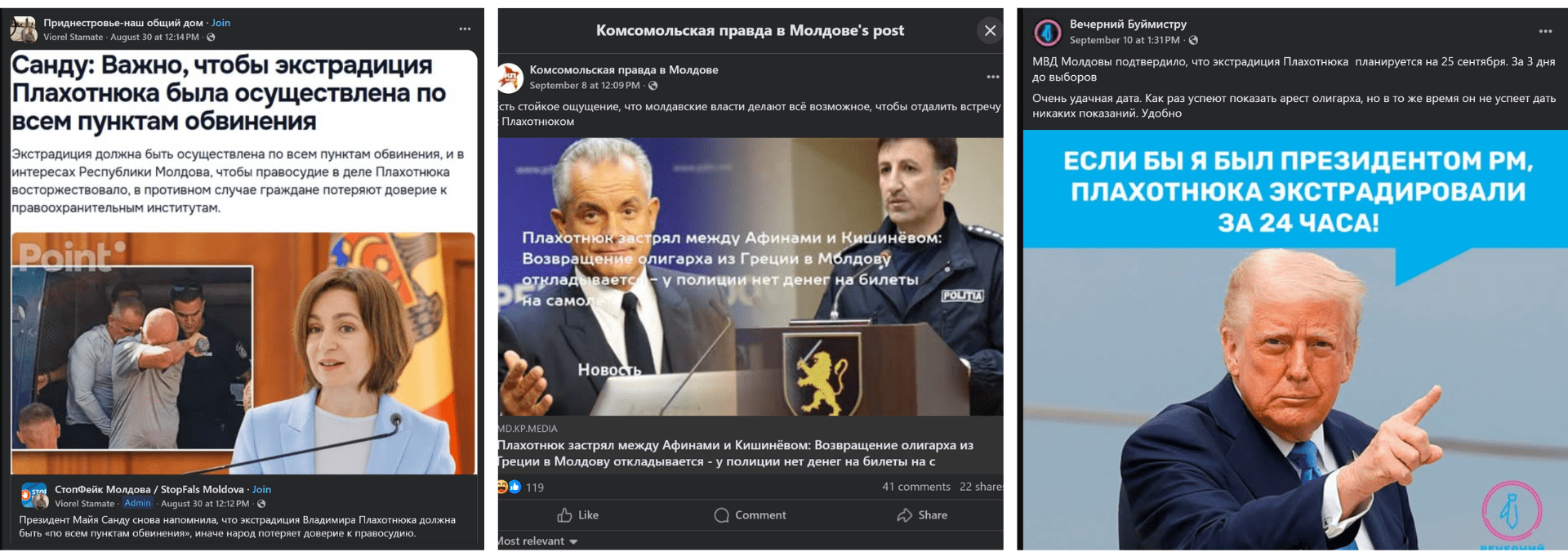
During the previous monitoring stages, the topic of Vladimir Plahotniuc’s extradition was used in order to spread the narrative according to which “the governance does not need his extradition until after the parliamentary elections are over.” The message also dominated at the beginning of the election campaign: “There is a strong feeling that the Moldovan authorities keep taking every possible step to postpone their meeting with Plahotniuc,” Komsomolskaya Pravda remarks in a post, while, according to TV6 and Canal 5, “the critics claim that the governance avoids bringing the ex-democratic leader to the country before the elections.”
Simultaneously with the authorities’ announcement that the extradition could still take place on September 25, a few days before the elections, the emphasis changed – it was presented as an “electoral present.” On the evening of September 8, politician Renato Usatii invited to TV8 revealed the date of Plahotniuc’s return. Shortly afterwards, Telegraph Moldova published a headline according to which, “as a result of Cernauteanu’s influence, Vlad Plahotniuc will arrive in Chisinau in the morning of September 25, 2025, and this event will be used by the PAS for the election purposes. Renato Usatii has announced the date of the ex-DPM leader’s return.”
“The Ministry of Internal Affairs of the Republic of Moldova has confirmed that Plahotniuc’s extradition is planned for September 25. This is three days before the elections. Quite an opportune date. They will manage to show the oligarch’s arrest, but at the same time, he will not be given enough time to provide any testimony. It’s convenient,” vlogger Dumitru Buimistru wrote as soon as this date was confirmed by the authorities. His post included a picture of US President Donald Trump and the message saying, “If I were the president of the Republic of Moldova, Plahotniuc would have been extradited within 24 hours.”
A few days later, he also specified that “it is still not clear why they keep delaying this process.” “Either the authorities are doing this in order to prevent Plahotniuc from divulging certain compromising materials, or it was Plahotniuc himself who intended to prolong his stay in Athens, or probably the authorities did this on purpose so that Plahotniuc’s name could be seen in the news every day during the campaign,” the vlogger recently sanctioned by several Western states speculates.
The extradition issue has served several political stakeholders as a reason to speculate about “political barter” between the PAS and Plahotniuc, about the governance’s “constant failures,” and the “dictatorship that paralyzes all the branches of power” saying that “the extradition is being delayed on purpose, because those in power would like to take every possible advantage of these circumstances.”

- The figure of Soros as a useful “bogeyman” for both extreme sides: pro-Russians and unionists
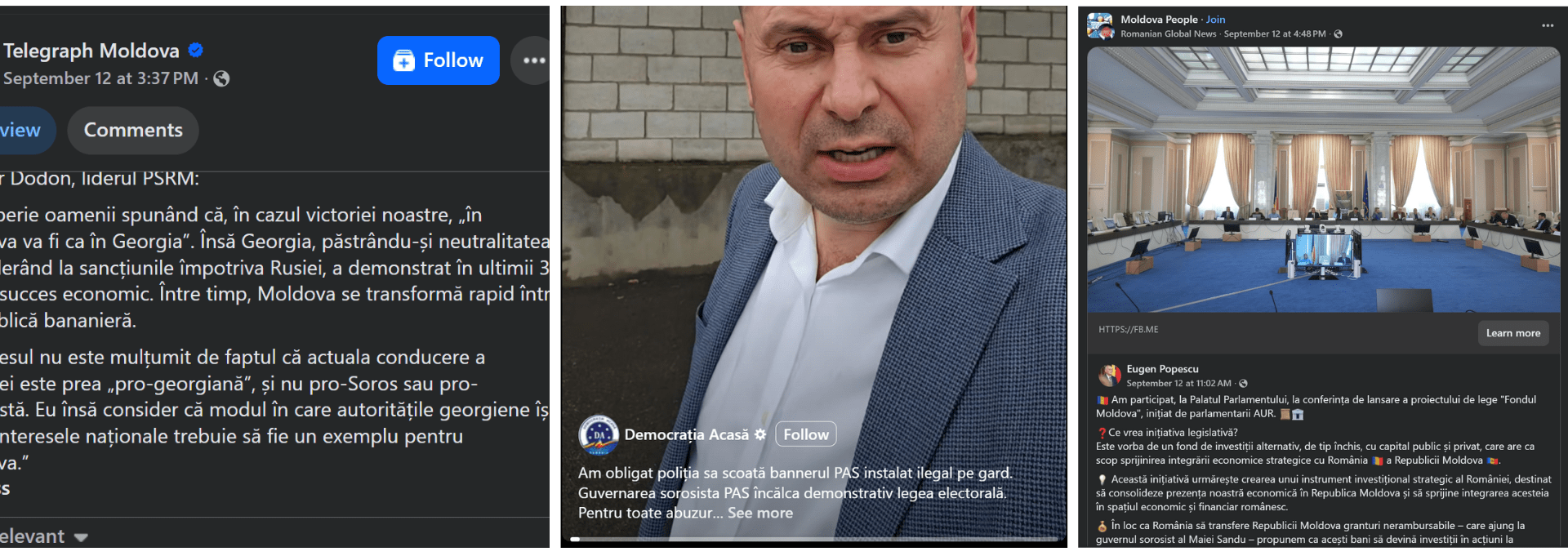
During the first stage of the election campaign monitoring, a convergence was observed: both the stakeholders from the Patriotic Electoral Bloc (Igor Dodon, Vladimir Voronin, Irina Vlah, and Vasile Tarlev) and those supporting Victoria Furtuna, as well as the political entities from the opposite side of the spectrum, such as AUR Moldova and the Democrația Acasă (Democracy at Home) Party headed by Vasile Costiuc frequently referred to businessman George Soros. These recurring topics are intended for labeling the governance as “Sorosist” and to attribute foreign agendas or concealed interests to them, and posts on this topic are particularly abundant in comments – at least 11000 of them were identified.
For instance, a news item about the legislative initiative known as the “Moldova Foundation” (a suggestion discussed at the Bucharest Parliament by the AUR parliamentarians) was shared in the groups in the Republic of Moldova with the following comment: “Instead of transferring non-reimbursable grants from Romania to the Republic of Moldova which end up in Maia Sandu’s Sorosist government, we suggest using this money as investments in shares in the companies from the Republic of Moldova.” This reformulated suggestion takes advantage of the discourse regarding foreign aid in order to shape a narrative concerning economic and political takeover.
Vasile Costiuc has repeatedly used such phrases as the “Sorosist governance” in his public posts, attributing illegal actions to the authorities and positioning himself as an exposer of that alleged influence. The following messages can serve as examples in this regard: “we forced the police to remove the PAS banner illegally installed on the fence. The PAS Sorosist governance is demonstratively breaching the electoral legislation” (in the video dated September 12) or the accusations according to which “we are being stalked and persecuted by the Political Police obeying the orders of the PAS Sorosist governance.”
On the opposite side, Victoria Furtuna and her supporters, in their turn, criticize Soros’ influences worldwide, connecting the international rhetoric to the domestic agenda. In the context of the attack against Charlie Kirk, an American activist, Furtuna states that “political violence is being intensively promoted by Soros’ criminals no matter where they are – in the United States, in Ukraine, in Georgia, or in the Republic of Moldova.” Previously, she also supported Donald Trump’s actions aimed against Soros by saying: “We support Donald Trump as the leader who has had the courage to tell the whole world the truth: Soros is a dictatorship disguised as ‘democracy’… George Soros should be first be extradited to Chisinau!”
The same rhetorical speeches are also published by the Patriotic Electoral Bloc. Igor Dodon uses comparative examples (Georgia vs. Moldova) suggesting that pro-European pressures and “pro-Soros” influences could shatter the country’s sovereignty and economic prosperity. Besides, while the protests of Ilan Sor’s supporters were taking place, the representatives of the bloc were publishing triumphant messages about “shaking” the networks of European influence: “There isn’t much left from it, and the Soros structure is shaking all over. France is protesting, Romania is protesting, and all Maia Sandu’s criminal partners are leaving. It is an ominous signal for them, but a very good one for us, because the entire line of European corruptionists is about to disappear.” The messages were insistently circulating in the sources affiliated with these political entities.

CONCLUSION
Identity issues still remain a catalyst for polarization. The dispute regarding the “Romanian language” vs. the “Moldovan language” keeps being used for the election purposes. On the other hand, the diaspora’s voting is still being discussed as a structural factor of fraud, and this rhetoric is amplified by foreign voices in order to consolidate the perception according to which the diaspora is a source of foreign political interference. In addition, the episodes of some officials’ or functionaries’ communication blunders are quickly taken advantage of. Besides, the image of George Soros has been reactivated in public discourse and is used as a “symbol” of obscure foreign influence.
The monitoring was conducted within the “Resilient Press, Informed Voters: Protecting the Elections in Moldova against Disinformation” project financially supported by the Embassy of the Kingdom of the Netherlands in Moldova. The opinions presented in the analysis belong to their authors and do not necessarily reflect the position of the donor.

