



In contrast to traditional media, which preserved a balanced and professional tone in their reporting on politics and the elections during the last two weeks of the campaign, the election silence, and election day itself, disinformation-prone Telegram channels were actively promoting a parallel reality. Between September 13 and 28, followers of these channels “learned the truth”, which was often contradictory, about the elections, in particular:
- Moldovan citizens have begun receiving mobilization notices, suggesting the country is preparing for war.
- The election results will supposedly be falsified or even canceled;
- If the PAS does not win, Ukraine will allegedly launch a military strike on Moldova after the elections;
- A plane is reportedly standing by to evacuate Maia Sandu;
- The diaspora has supposedly refused to support the PAS, and turnout at polling stations on election day is minimal;
- Further disinformation alleged that the diaspora vote had been falsified, with Moldova instructing European officials on the numbers to record in the minutes, etc.
| Between September 13 and 28, we analyzed content from 70 Telegram channels. The sample included both the most popular thematic resources in Moldova’s segment of the platform and channels with a documented history of spreading disinformation.
30 channels belong to media outlets/influencers: Luchianiuc.com (54,812 subscribers), Point.md (53,566 subscribers), Ungureanu 112 (42,680 subscribers), Dumitruciorici.com (38,316), KP Moldova (36,174), Știri.md (26,849), Gagauzia24 (14,944), Бельцы 24 (15,703), Gagauznews (13,024), Noi.md (11,404), TV6 Moldova (11,238), etc. The owners of 40 channels are not specified, including: Приднестровец (73,108 subscribers), Moldova News (45 640 subscribers), Moldova Liberă (39,906), Молдова сейчас (33,524), Гагаузская Республика (30,921), Молдавский Крот (30,169), Треш Киш (30,024), Insider Moldova (28,897), Флуераш (26,405), etc. |
During the penultimate week of the campaign, disinformation activity decreased, as a significant number of the monitored channels were preoccupied with covering police investigations and arrests related to electoral corruption, as well as the exclusion of “Inima Moldovei” and “Moldova Mare” political parties from the electoral competition. Toward the end of the monitoring period, however, most notably on the election silence and election day itself, the production of disinformation intensified into a steady flow. Familiar narratives, such as depopulation of Moldova under the PAS government or the affirmation that Moldova had fallen into a “debt pit” due to the authorities, resurfaced, but only sporadically and with reduced frequency compared to previous cycles.
Synthesis of key narratives
- Moldovan citizens have begun receiving mobilization notices, suggesting the country is preparing for war
The claim, which represented a continuation of narratives disseminated earlier in September, was actively promoted between September 24 and 26. It relied on a video collage with English subtitles, framed as “evidence” that European journalists had allegedly noticed the issue of mobilization notices distributed to Moldovan citizens. The accompanying text asserted: “The authorities are attempting to deny the leak regarding the distribution of notices, but the evidence is overwhelming, and it has already drawn attention in Europe. Journalists speak of thousands of notices (…). Earlier, it was reported that Sandu, in a meeting with UK Prime Minister Keir Starmer, agreed to a Ukrainian military operation in Transnistria in spring 2026.” Similar narratives were reproduced across multiple channels such as Молдова Сейчас, Политика Молдова 1 and 2, Приднестровец 1 and 2, Insider Moldova, Флуераш, Молдавский Инсайд 1 and 2, Без цензуры 1 and 2, Подслушано в Молдове 1, 2, 3, 4, Молдавская Политика 1 and 2, Бельцы 24 within two posts.
These publications gathered a total of 140,277 views.


2. If the PAS fails to win, Ukraine will launch a military strike against Moldova
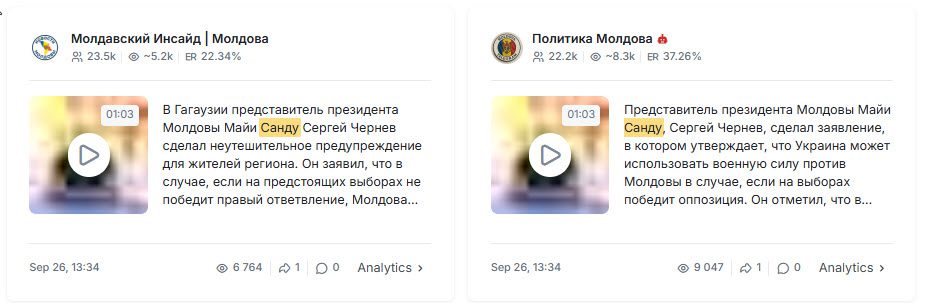
The initial narrative was intertwined with a falsified excerpt from an interview attributed to Serghei Cernev, a representative of the State Chancellery in Gagauzia. According to this claim, a victory for pro-Russian forces would mean that Moldova could be used by Russia as a military hub to “stab Ukraine in the back,” thereby provoking an attack on Ukraine and exposing Moldovan territory to bombardment. In Telegram, the statement was framed as a threat of a direct invasion of Ukraine following the elections. This piece of disinformation circulated on channels including Молдавский Инсайд, Политика Молдова, Обзор Молдовы, Moldova Live, Insider Moldova, Gagauznews, КП в Молдове, and gathered 48,018 views.

3. Electoral authorities are preparing to rig/falsify the election results
This disinformation was disseminated through various channels. On September 26, it was framed as a “revelation” by the “Dikgazete” Turkish outlet, a source often referenced on Telegram for purportedly exclusive information, though it is known for publishing disinformation. Such channels as Moldova Live, Новости Молдовы, Insider Moldova, Молдавская Политика and Молдова онлайн echoed the claim almost verbatim: “Elections in the Republic of Moldova are under threat due to violations identified by the “Dikgazete” Turkish newspaper. Internal documents from the Central Election Commission (CEC) of the Republic of Moldova show serious discrepancies in the number of ballots allocated to citizens living abroad.”


Similarly, on September 26, Gagauznews released three publications addressing the “specter of stolen elections.” These posts outlined an alleged fraud scenario and implied that comparable irregularities had taken place in the November 2024 presidential elections.
Altogether, the posts generated 63,360 views.
4. Authorities are preparing to annul the election results
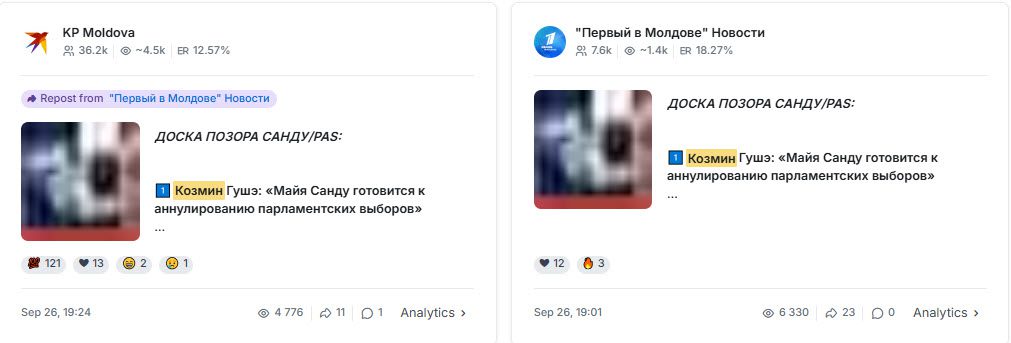
This narrative was actively promoted throughout the monitoring period of these channels (July 29 to September 28, see previous analyses), repeatedly voiced by various figures and attracting public attention. Its aim was to portray the government as totalitarian and fearful of the people’s voice. Claims that the authorities were allegedly preparing to annul the election results appeared in posts citing specific political figures: Cosmin Gușă, a Romanian political analyst, mainly quoted by channels such as Primul în Moldova and КП в Молдове; Igor Dodon, quoted by Morarinews; and manipulative statements attributed to President Maia Sandu, published by channels including Молдавская Политика, Подслушано в Молдове, Insider Moldova, Приднестровец 1 and 2. Altogether, the posts generated 51,336 views.

5. The Moldovan diaspora is ignoring the elections, resulting in minimal turnout at polling stations
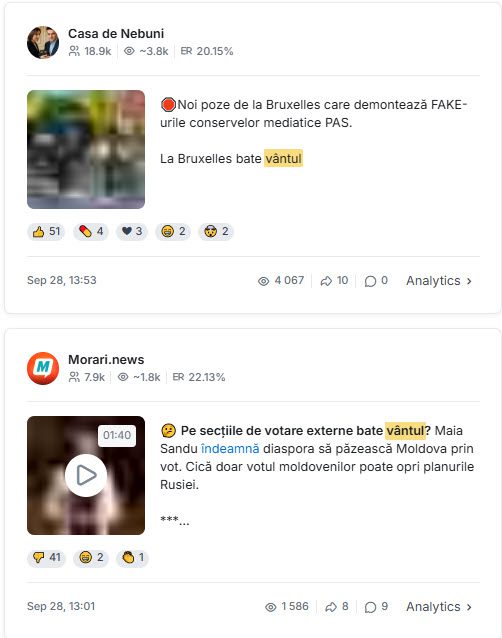
In the first hours after polling stations opened on election day, several channels published photos of entrances to certain polling stations showing no voters. These images were accompanied by comments such as “the diaspora is disappointed” or “the diaspora no longer votes for the PAS.” For example, Gagauz News wrote: “Polling station no 38/58 in Berlin is quiet – not a single voter. As you can see, the only person who voted here was Prime Minister Natalia Gavrilita. Local observers note that official reports will likely show thousands of voters, but in reality, the polling stations are empty.” Similar posts appeared on Гагаузская Республика, reporting on a polling station in Frankfurt, and on Casa de nebuni, which showed a polling station in Brussels with the comment that “there is no one there.”
The Morarinews channel also published a post titled “Are the polling stations empty?”, alongside with Maia Sandu’s address to the diaspora on September 28. The channel WTF Moldova?! shared a photo of people holding Moldovan flags while standing in line outside a building, with the caption: “Telegram channels are publishing photos from polling stations in Stratford (London). Voter turnout is low. Is there anyone supporting the PAS?” In a similar vein, Morarinews cited voter turnout data among the diaspora published by the Central Election Commission and added a comment from Andrei Ionita, a Moldovan living abroad: “The diaspora that raised them is now ignoring them.”

Several channels shared a post by politician Vlad Filat, who also presented Central Election Commission data on diaspora turnout before noon. He wrote: “By 12.00, the picture is clear: mobilization in the country is lower than in 2024, and abroad, the PAS is experiencing a historic moral defeat. Those who brought them to power are now punishing them with their absence. The moral voice of the diaspora has now turned into the bitter silence of disappointment.” This post was additionally shared by channels including Primul în Moldova, Ungureanu 112, КП в Молдове, Пэкалэ ши Тындалэ and Telegraph. Altogether, the posts generated 33,854 views.
6. Votes among the diaspora are being falsified. On the eve of the elections, officials received directions on what numbers to enter in the minutes
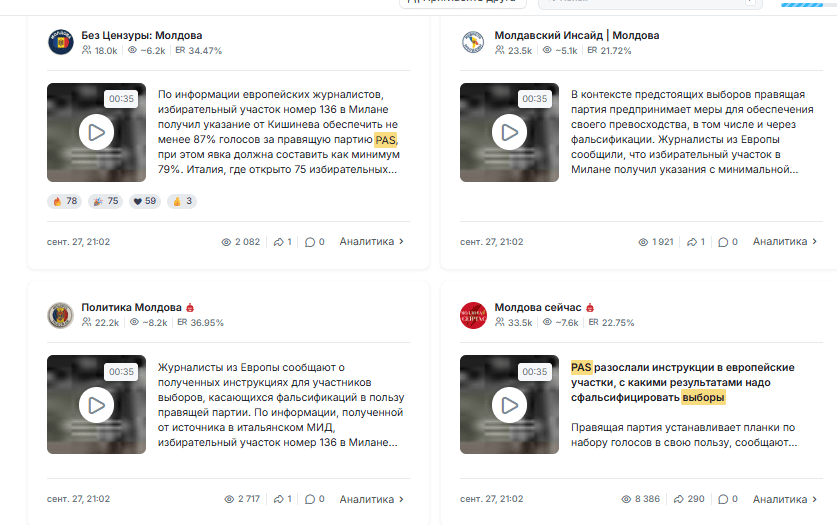
On September 27, the day before the elections, a collage of photos appeared on several monitored channels, accompanied by the following message: “According to European journalists, polling station no 136 in Milan received instructions from Chisinau to ensure at least 87% of votes for the ruling party (PAS) with a turnout of at least 79%. Italy has the most polling stations for Moldovan citizens living abroad, with 75 stations open. Experts and politicians are concerned that polling stations abroad will become centers of fraud, as it is difficult to monitor the elections there and opposition observers will not be able to be present at all polling stations. This scheme may be linked to the PAS low ratings and the party’s fear of losing the upcoming elections.” This post appeared simultaneously at 09.02 p.m. on such channels as Без цензуры Молдова, Молдавский Инсайд, Молдова Сейчас and Политика Молдова, and later on Gagauz News and Канал5. Altogether, the posts generated 15,695 views.

7. “Evidence” of election rigging in the country
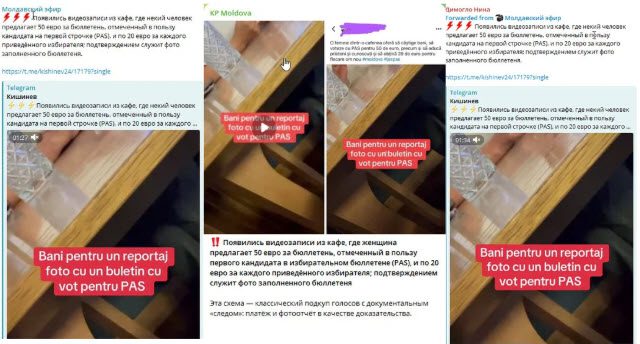
Offering money for votes. As in previous elections, video clips purportedly showing evidence of fraud were actively promoted on Telegram on election day. For example, at 9.55 a.m., the “Кишинев” channel posted an audio recording in which a woman tells her interlocutors that she is willing to give EUR 50 if they vote for the PAS the next day and take a photo of their ballot, and EUR 20 if they bring someone else to do the same. The source and location of the recording were not provided, yet it was presented as evidence of vote-buying. This material was immediately shared by channels including Гагаузская Республика, Нина Димогло, Primul în Moldova, Gagauz News, КП в Молдове, Бельцы 24, Молдова Сейчас and Молдавский эфир. Altogether, the posts generated 44,476 views.

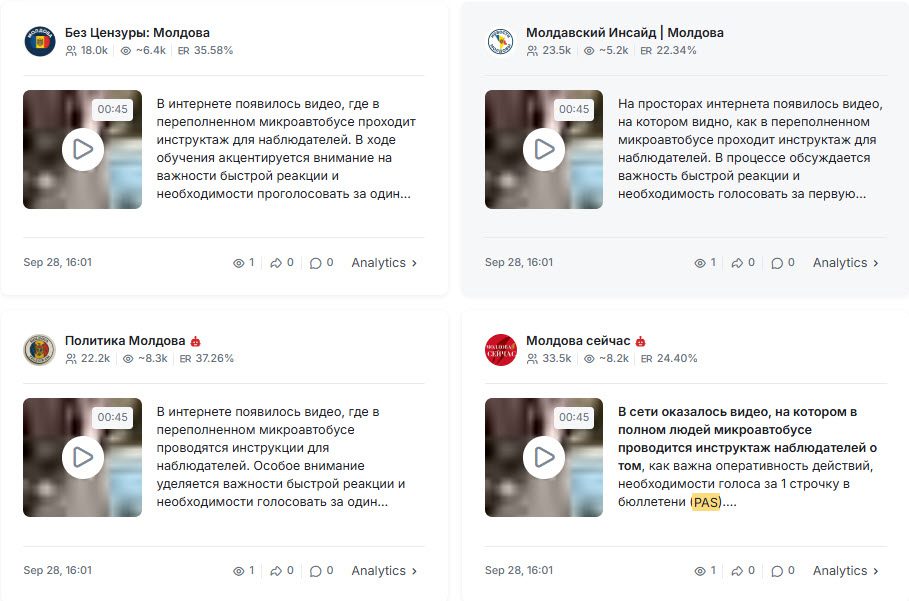
Observers were told to vote for the PAS and provide photographic proof of their ballots. In the afternoon of the election day, another video began to circulate widely. It showed the feet of numerous minibus passengers, including elderly people dressed in warm clothing, while an off-camera voice explained the details of the trip, urging them to vote for “the first” candidate on the ballot and to send photos of their ballots. The obviously fabricated material was promoted by channels such as Без цензуры Молдова, Молдавский Инсайд, Политика Молдова and КП в Молдове. Meanwhile, Молдавский крот and Новости Молдовы presented the material as “instructions” for voters rather than observers. Altogether, the posts generated 32,826 views.

CONCLUSIONS
The abundance of contradictory disinformation indicates that these channels were primarily focused not on promoting a candidate, but on discrediting pro-European candidates and the democratic electoral process as a whole. Strategically, this tactic served to create confusion and weaken confidence in democratic institutions and mechanisms, suggesting that manipulating election results was almost standard practice among the authorities.
If the videos allegedly depicting fraud were authentic and shared in good faith, they would have been sent to the Central Election Commission (CEC) for investigation, a step that likely would have been noted on Telegram. Yet, none of the channels publishing these materials reported any such action.
By regularly presenting opinions as facts, Telegram creates a “parallel reality” for part of its audience, especially dangerous for those who rarely verify information elsewhere. Based on the evidence and earlier analyses, users are advised not to rely on Telegram as their main news source and to turn to more reliable channels instead.

