


Plahotniuc, Supreme Security Council meeting and alleged censorship on networks: The main disinformation narratives on Telegram
At least 5 Telegram channels known for spreading disinformation and pro-Russian content in Moldova have been identified as having the same control center, which periodically provides them with texts, and identical posts are placed simultaneously. Such a practice, characteristic of troll factories, was fixed during the monitoring of 59 Telegram channels from July 15 to 31.
- Based on a set of keywords, we watched how the 59 channels – either anonymous or belonging to some media sources – dealt with the following topics: the detention of the former Democratic leader Vladimir Plahotniuc in Greece; the information presented by the Supreme Security Council on Russia’s plans to interfere in the elections; the fake about the closure of some social media platforms.
- The monitoring demonstrated the perpetuation of several recurring manipulation or disinformation narratives, spread intensively by these channels on any new occasion that appeared on the public agenda. The views amounted to millions.
| WHICH CHANNELS WE MONITORED We analyzed the content distributed on 59 Telegram channels that have the largest audiences in the Moldovan information space on this platform, including: – 28 channels of media sources/influencers – 31 anonymous channels The most popular channels of media sources/influencers are: Ungureanu 112 (42,521 followers); KP Moldova (35,469 followers); Gagauzia24 (14,745 followers); Luchianiuc.com (13,246 followers); Gagauznews (13,137 followers); TV6 Moldova (11,325 followers); MD24 (10,802 followers); Telegraph Moldova (9,922 followers); Sputnik Moldova 2.0 (8,026 followers). The most popular anonymous pages we monitored are: Moldova News (45,813 followers); Moldova Liberă (39,843 followers); Молдова сейчас [@moldova_acum] (39,367 followers), Треш Киш [@trech_kich] (35,662 followers); Молдавский Крот [@md_krot] (33,035 followers); Гагаузская Республика [@Republic_Of_GaGauZia] (31,279 followers); Insider Moldova (30,324 followers); Флуераш [@Fluieras] (28,494 followers); Молдова онлайн [@onlinemd24] (27,578 followers); Молдавский телескоп [@Telescopul_moldovenesc](25,309 followers). |
THE TOPIC OF PLAHOTNIUC
Between July 15 and 31, the 59 channels published 1,068 posts about Plahotniuc, which gathered 2,331,338 views. Some of them concerned news from the police, the prosecutor’s office or foreign media regarding the fake passports found during the search; the extradition request; the villa where he lived; etc. Another part contained the “political framing” of the facts, when exclusively anti-government views were selected for publication.
The following narratives were thus set up:
- Detention and arrest are pre-electoral political actions, orchestrated by Europeans or pro-Europeans from Chisinau, and not a natural operative measure of the legal system
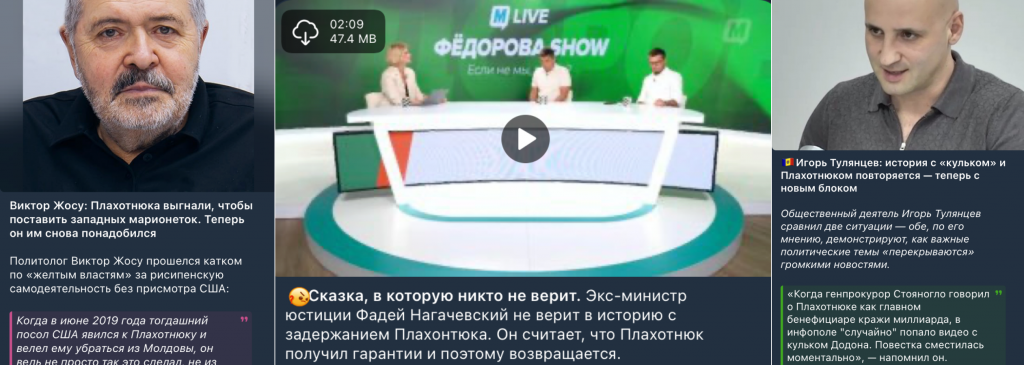
From the very first day of Vladimir Plahotniuc’s detention in Athens (July 22), some channels posted and shared among themselves opinions that claimed that the detention is a political act. For example, Nina Dimoglo’s channel quoted socialist MP Bogdan Țîrdea: “They arrested Platon, whom they couldn’t find for four years, although he was photographing himself in London and making live broadcasts. And suddenly, three months before the election, they detained him. Today – the same thing with Plahotniuc. Elections have already started, and he gets detained. That speaks of one thing – the country really has switched to the regime of manual control from outside.” The next day, MorariNews presented the detention as “a story that no one believes,” arguing this idea by giving the opinion of ex-Minister of Justice Fadei Nagacevschi, who believes that Plahotniuc “received guarantees, and that is why he is coming back.” A day later, another channel quoted Bogdan Țîrdea again, saying that “after long torments, the European Union decided to return Plahotniuc to us.”
In a week, this narrative gained strength again, and we could find it on several other channels: Enews and WtfMoldova conveyed the opinion of “political scientist Victor Josu”, who talked about a political stratagem, stating that in 2019, Plahotniuc was banished so as to be replaced by “puppets of the West, and now they need him again.” On the same day, the channel of the TV station Primul în Moldova, which had had its license suspended, delivered a similar opinion of the “ex-Deputy Prime Minister Alexandru Muravschi”, who said that there is a reason why “they remembered Plahotniuc before the elections” and that the return of the Plahotniuc topic on the daily agenda shortly before the elections is “a well thought out political plan.”
- The detention was announced to overshadow the news about the creation of the left-wing bloc consisting of socialists, communists, and the parties Future of Moldova and Heart of Moldova
Among the first people to express such an opinion were PSRM President Igor Dodon, quoted by Rupor: “The news about the detention of Plahotniuc is an attempt to distract attention from the creation of the opposition bloc”; Igor Tuleanțev, presented as a civic activist and quoted by Enews: “As soon as the creation of the left-wing bloc was announced, the news about Plahotniuc’s arrest came. The result is the same – one topic overshadowed another one”; the TV presenter under EU sanctions Dumitru Buimistru: “As soon as the creation of the opposition bloc was announced, the news about Plahotniuc’s detention was thrown into the media field in order to change the agenda. Coincidence?”; Anatolii Dirun, presented as a political scientist, quoted by Sputnik: “They are playing the aces” – this is how Anatolii Dirun commented that Plahotniuc’s detention in Greece “accidentally” coincided with the briefing on the creation of the opposition bloc for the parliamentary elections.
Two days later, other voices expressed the same idea, relayed by Telegram channels. Olesea Tanasoglo of the Heart of Moldova Party was quoted by WtfMoldova saying that Plahotniuc “was brought into the light” in order to overshadow the unification of the opposition, and ex-Minister of Defense Pavel Voicu said, quoted by Cenzura, that “spreading in the public space of the news about the possible detention of Vladimir Plahotniuc is a manipulation meant to distract attention from the failures of the government” and from the fact that “four parties united and created a bloc of the left-wing opposition.” Although the information was officially transmitted by the Greek law enforcement authorities and images also appeared, Voicu, in his statement of July 25, questioned the detention: “Everything that is happening now is a political trick. If Plahotniuc is indeed detained, the authorities are obliged to provide us with information and concrete evidence. But PAS threw a smoke bomb to distract attention.”
- Maia Sandu and PAS do not want Plahotniuc to be extradited to Moldova
Opinions that crystallized this narrative emerged immediately after the detention, on July 23, and were quickly picked up by several channels. Enews and Sputnik preferred to convey the opinion of former Deputy Speaker of Parliament Alexandr Slusari, who wrote on his Facebook page that the current authorities are not happy about Plahotniuc’s return, as he allegedly has “an archive” with compromising material on several politicians, prosecutors, judges, etc. A few days later, Gagauznews reproduced a post by former journalist Gabriel Călin, who said that a possible extradition of Plahotniuc would change the course of the election campaign, as he would make public statements inconvenient for Maia Sandu. Then Sputnik Moldova claimed that “Sandu and her henchmen are now solving a difficult problem – how to make sure that Plahotniuc is not extradited to Moldova,” because “no one from the top leadership of the regime wants Plahotniuc to appear in Chisinau and start opening his mouth.” A similar idea was also promoted by Vesti24.md, citing Fadei Nagacevschi, who believes that the authorities “are doing everything so that Plahotniuc is not extradited.”
Towards the end of the monitoring period, this narrative subtly passed into the posts on the meeting of the Supreme Security Council, at the end of which President Maia Sandu spoke about the Russian Federation’s plans to intervene in the autumn elections. The topic is still being analyzed.
| Conclusions This topic is certainly of major public interest and many details are not known, so it is normal for there to be a public debate and various opinions about it. But the problem arises when: 1) Objective facts are omitted from this debate – the fact that Plahotniuc was detained in Greece with false documents on him, and it is a punishable criminal act regardless of the kind of government there is in Chisinau or Brussels; 2) When only one kind of opinion is selected; 3) When the debate lacks expert opinions, in other words, the opinions of specialists with expertise in the matter. Most of the opinions that circulated belonged to politicians and not to lawyers or other specialists in cross-border crime, extradition, etc. That is indicative of the purpose of the so-called debate – to reduce an act of justice to a political matter, convenient to a party. The interpretations given in this case are at the limit of conspiracy theories, as it has been suggested, like in the case of “classical” conspiracies, that nothing is what it seems to be. The way in which the monitored channels shared posts with each other, often republishing irrelevant or repetitive content, shows that the interest is not to compete for an audience that would bring them commercial benefits (which, in fact, every media wants – to monetize the content) and, even less so, for quality, but to dominate the “Telegram space” with the same narratives, thus making them seem important and credible and giving the impression of a massive phenomenon. It is the effect of formal pluralism – if multiple voices say the same thing, it creates the impression that this is the truth. Another effect is that the multitude of channels with fake or manipulative content discourages the consumer, who is forced to physically browse through multiple channels and thus waste time searching for reliable information. |
SUPREME SECURITY COUNCIL MEETING
On July 30, President Maia Sandu convened the meeting of the Supreme Security Council (SSC) of the country, and at the end she gave a speech, in which she presented the findings of the investigations carried out by state institutions regarding the planned interference of Russia in the parliamentary elections of September 28. Some monitored Telegram channels, very few, briefly transmitted the most relevant theses, but the majority mocked the facts stated, presenting them as “scarecrows” of the government, which allegedly thus are covering their own failures.
The topic was covered in the period of July 29-31, with 189 posts containing the keyword “security” being published in these three days, which had over 311,000 views. Here are the most prominent narratives:
- Maia Sandu convened the SSC meeting to cover the Plahotniuc topic – identical posts
In promoting this narrative, coordinated activity was observed in at least two cases: the same content, which originally appeared on Insider Moldova at 12:13, was placed, 7 minutes later, without citing the original source, on Новости Молдовы [@md_news24]. This shows that the two channels have a common command center, which delivers texts. In the post, the content of the president’s speech was qualified as a manifestation of panic: “Between the lines, we read something else: People in the PAS office fear that compromising information will return together with Plahotniuc.”
A few channels – Enews, Sputnik and Молдавская Политика [@moldovapolitics] – cited the ex-Prime Minister Vlad Filat, who compares the SSC with a “police unit for juvenile delinquents” and accuses Maia Sandu that she herself promotes foreign interference, and all this against the background of the return of Vlad Plahotniuc – “former grey cardinal” – to the country.
- The speech after the SSC meeting is a simple scarecrow and justification to apply restrictions in elections
The Telegram channel of the TV station with suspended license Canal 5 labeled the speech as “a scarecrow without evidence on the eve of the election campaign”; another channel scoffed at the SSC meeting, calling it “enchanting” and suggesting that attempts are being made to “silence” opposition voices. The same idea was conveyed by Gagauznews.
| Conclusions Mockery and ridicule are manipulation techniques that aim to diminish the importance of a topic and to discredit the source of information. Also, this technique has the role of nullifying the importance of objective facts, channeling attention to secondary and irrelevant aspects. |
CENSORSHIP: TELEGRAM AND TIKTOK ARE TO GET CLOSED
Another topic that marked the end of July is the fake that TikTok and Telegram will be blocked before the elections in Moldova. The speculation started from the above-mentioned speech of Maia Sandu. The president said, when referring to “10 main instruments of interference in the political and electoral processes in Moldova,” that Telegram in particular is used in order to “distribute information about rewards for participation in protests and, especially, to organize voter corruption schemes.” She added that, so far, Telegram “has given no answer when state institutions reported falsehoods or voter corruption actions.”
This statement was intentionally presented as an act of censorship, spreading the falsehood that the blocking of platforms would be operated two weeks before the election.
On the topic of Telegram, a total of 98 posts with over 126,000 views were identified on the 59 monitored channels on July 30 and 31. Main narratives:
- The government applies censorship under the pretext of ensuring state security. The decision has already been made
A post with such content was published by the channels Молдова Сейчас [@moldova_acum], Гагаузская Республика [@republic_of_gagauzia_md], Enews, Insider Moldova, Молдавские Ведомости [@vedomostimd], Новости Молдовы [@md_news24]. A quote from a post on @vedomostimd: “Maia Sandu’s fight with Telegram is not a response to Russia’s interference. It is a desperate attempt to purge the critical channels that remain in the country.”
- Government sources say Telegram and TikTok will be blocked two weeks before the elections
This fake was distributed practically at the same time on a number of channels: Cenzura, Wtf Moldova, Păcală și Tândală, Nina Dimoglo, KP Moldova. Even though the government spokesman refuted at 10:15 on July 31 that there was any intention to block the platforms, some channels continued to publish the fake after this hour, ignoring the refutation.
| Conclusions Using a real fact to distort it and generate falsehoods is common practice for sources that aim to disinform. It has been noticed, however, that this technique is becoming more common and aggressive – although the fake was refuted, the channels either did not publish the refutation or continued to distribute it. The large-scale practice of this technique – and we must expect this in the current election campaign, since in campaigns and during crises disinformation takes higher turns – becomes very dangerous, since it creates a general state of chaos in which the boundary between truth and lie can hardly be perceived. |
Strategic posts, prepared in one center and distributed simultaneously through five channels
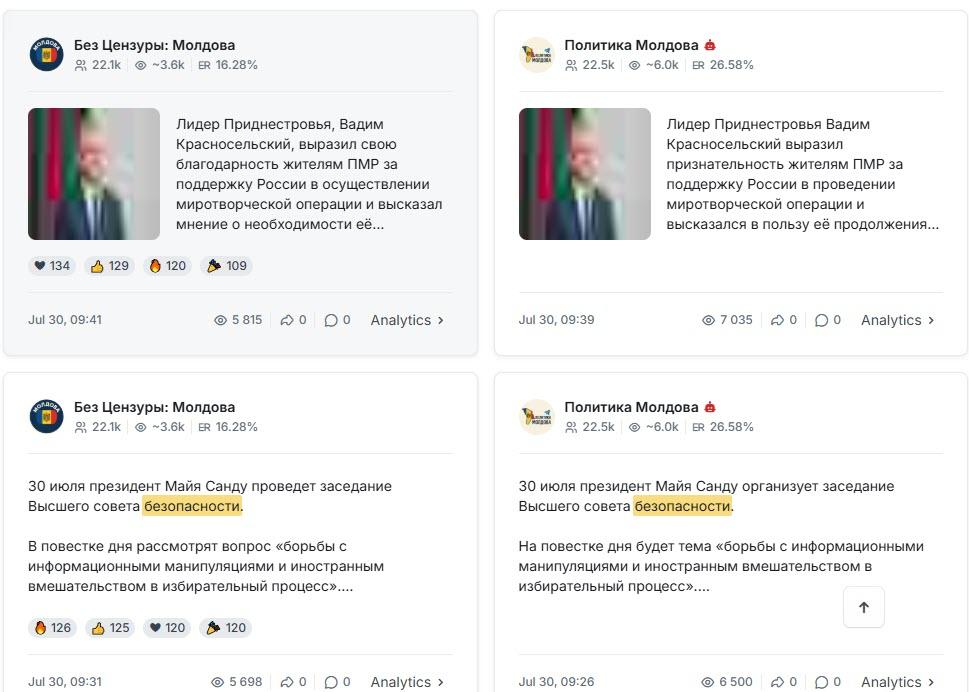
The analysis of the 59 channels revealed a practice characteristic of troll factories – the centralized production of messages and their placement on several platforms at once. Some are placed at the same time, with no difference in minutes. One such post referred to the authorities’ blocking of the newly emerged HaiTV app, which provides access to a number of Russian TV stations. Five channels – KP Moldova, Canal 5, Новости Молдовы [@md_news24], Политика Молдова [md_polit], Gagauznews – published identical content on this topic.


Here are two more examples:
GENERAL CONCLUSIONS
Most of the monitored Telegram channels pursue a keen interest in publishing a lot and unilaterally, in order to dominate the platform. The fact that the content on political topics is the one that appears multiplied on different channels, and not commercial or other content, shows that we have in front of us instruments of political influence, especially on the eve of elections. The effects that it can produce on a consumer little prepared for such an information clutter can be diverse:
- fatigue from looking for the truth or credible sources;
- the belief that everyone lies, so what is the point of choosing sources;
- the habit/addiction to consume information already interpreted and seasoned with irony instead of balanced, neutral and well-documented, but “boring”, content.
In these circumstances, especially in times of crisis, the public should be oriented to use verified media and official sources as the primary source of information, but also to reduce, in general, the consumption of information from social networks.
