


Amplification of Disinformation on Facebook Pages and in Groups: Narratives, Sources, and Techniques Applied before the Elections

In the second half of July, the amount of disinformation and manipulation messages published on Facebook in the pre-election context increased compared to the first two weeks monitored by us previously. In spite of the fact that the main narratives remain the same, the accents change and depend on the political agenda and current events.
- On the 83public Facebook pages and groups monitored by us, it is observed that most of the narratives come from the opposition parties and leaders, and are published directly on their official pages or promoted via their affiliated media outlets.
- Attacks against the PAS and the governance in general intensified; in terms of frequency, they are followed by disinformation concerning the persecuted opposition and an alleged election fraud.
- To obtain greater virality and to increase the impact, such techniques as appealing to fear, victimization, demonization of political opponents, generalization, presenting speculations as facts, manipulative historical analogies, and conspiracy theories are frequently used.
- On the pages of the monitored media outlets, we also observed permanent use of a single source of information, the lack of fact-checking, opinions mixed with factual information, and an obvious biased approach of the editorial boards; these elements amplify the manipulative nature of the content.
WHAT WE MONITORED We analyzed the content published on 83 public Facebook pages belonging to several parties and party leaders, media outlets and influencers, and thematic public groups with the audience ranging from 1000 to over 88000 members. The most popular public pages are Renato Usatii (over 337000 followers), Point.md (218000 followers), Igor Dodon (192000 followers), Типичная Молдова (Typical Moldova) (188000 followers), TV6 (172000 followers), Unimedia (135000 followers), Morari.live (130000 followers), and Primul in Moldova (118000 followers). The most popular public groups are Moldova, trezeşte-te! (Moldova, Wake up!) (circa 89800 members), Свежие новости из Республики Молдова / Stiri din Republica Moldova (News from the Republic of Moldova) (88500 members), ADOPTĂ UN VOT! (Use Your Vote!) (circa 80000 members), and Știri din Moldova (News from Moldova) (37000 members). Over 1050 posts with harmful content with over 356000 views were identified and analyzed. |
Let us analyze the most prominent narratives found in the content published by the monitored pages and groups.
- The PAS governance = captured state, degradation of key sectors, and making enemies
On the monitored Facebook pages and groups, the Action and Solidarity Party and President Maia Sandu were the targets of a number of disinformation narratives, in spite of their initial topic range. Both the PAS and the head of the state are frequently presented as the main persons blamed for some alleged generalized degradation of the country (which is similar to the tendencies we observed during the previous monitoring), they are accused of “capturing” the Republic of Moldova, destroying such strategic sectors as agriculture and education, and making up some foreign threats in order to cover up their own failures.
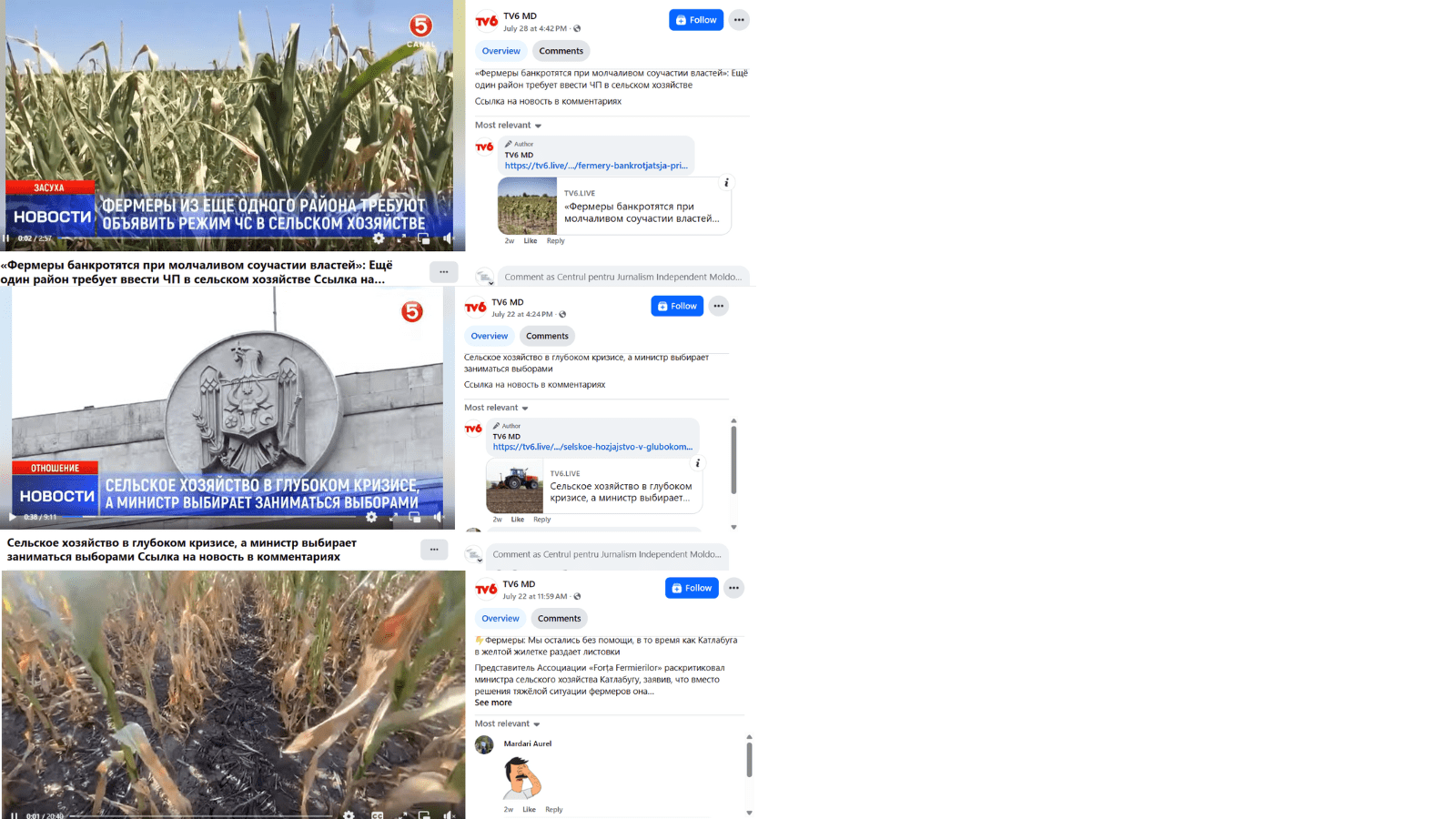
The messages about the collapse of agriculture are one of the recurring topics. For instance, the page of TV6, a channel with a suspended license, reports in a news item re-published from Canal 5, another previously closed TV channel, that “farmers are going bankrupt with the authorities’ silent consent” while covering a topic about another district which requested introducing a state of emergency in the sphere of agriculture. This same source published a message from a farmer, according to whom, those who work in this sphere were left without any assistance, while Minister Catlabuga “wearing a yellow vest distributes some leaflets and says what will be done in the next four years.” “Farmers from Causeni and Stefan Voda feel desperate; some of them already are about to go bankrupt. The authorities promised to provide some assistance, but, due to their incompetence, even free diesel from Romania did not reach its recipients on time. For this reason, hundreds of farms are encumbered with debts,” he says. Another report also taken from Canal 5 is accompanied by the following text, “Agriculture is in a profound crisis while the minister prefers to be involved in the elections.”
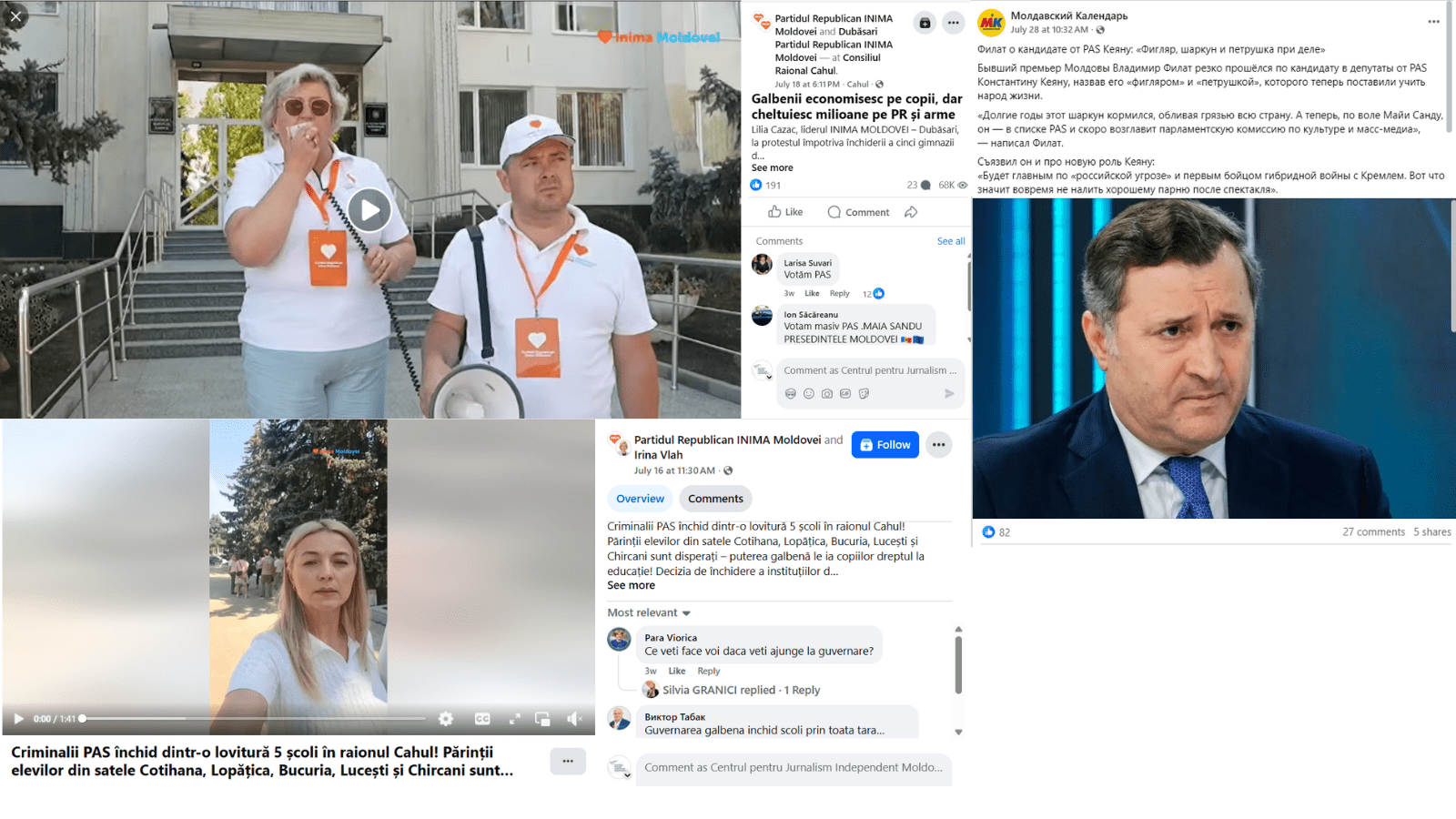
As to the sphere of education, the idea that the PAS keeps destroying the system intentionally is being promoted. Partidul Inima Moldovei (The Heart of Moldova Party) published a statement by Lilia Cazac, the political entity’s leader from Dubasari, from the protest against closing five gymnasiums in the Cahul District. She affirms that “the PAS governance finds excuses, claiming that ‘there is no money left for schools.’ The yellow ones, by means of their ‘optimization,’ steal children’s future.” In another post, the education reform offered by the PAS is presented as “intentional destruction of the country. The PAS criminals are closing five schools in the Cahul District in a single go! The yellow authorities deprive children of their right to education!” Ion Ceban, the leader of the National Alternative Movement Party, also writes on his page that “the level of education during the PAS governance has abruptly decreased.” In the group titled Молдова должна быть свободной! (Moldova Should Be Free!), the following message was published, “Dan Perciun, the Minister of Education and Research, fails to cope with his duties. Under his leadership, the Moldovan education system keeps facing multiple issues.”
Another disinformation tendency identified by us is discrediting the PAS candidates. The Молдавский Календарь (Moldovan Calendar) page published Vlad Filat’s statement about the candidate Constantin Cheianu, whom he describes as “a clown, a charlatan, and a dandelion trying to do some work.” In the group titled Приднестровье-наш общий дом, (Transnistria is Our Common Home), one of the users writes that “the country will be headed by people whose only working experience is playing the ball. It’s a farce. In the midst of poverty, war, and collapse, appointing an athlete for a state position is a slap in the face of those who still believe in changes.” “Do they want to stay in the Parliament and to decide the fate of retired people, ordinary citizens, and the entire country??? They’ve even failed to help their own parents who gave them life,” a user wrote about Anastasia Nichita on the Moldova grăiește! (Moldova Speaks!) page.
In Молдова за мир! (Moldova for Peace!), another user writes that “the entire PAS party is a club of the indefeasible ones who push each other into key posts. No experience. No shame. No conscience. A sauna instead of contests. Whores instead of diplomas. Alcohol instead of morality. This is the way the PAS promotes their own members among the leadership teams of the key government authorities.”
Another related narrative is that the governance keeps making up enemies in order to cover up their own internal issues; it is based on the conclusions drawn during the Supreme Security Council meeting and the speech by the head of the state regarding the basic methods of foreign interference in the electoral processes in the Republic of Moldova. The Свежие новости из Республики Молдова / Stiri din Republica Moldova (News from the Republic of Moldova) group shared a post from Молдавский связной (Moldovan Messenger) ridiculing Maia Sandu’s announcement regarding Russia’s interference with the elections: “Again, Maia Sandu has seen the ‘hand of the Kremlin’ – this time, it seems to be in every protest, in every Telegram channel and, probably, even in her own shadow.”
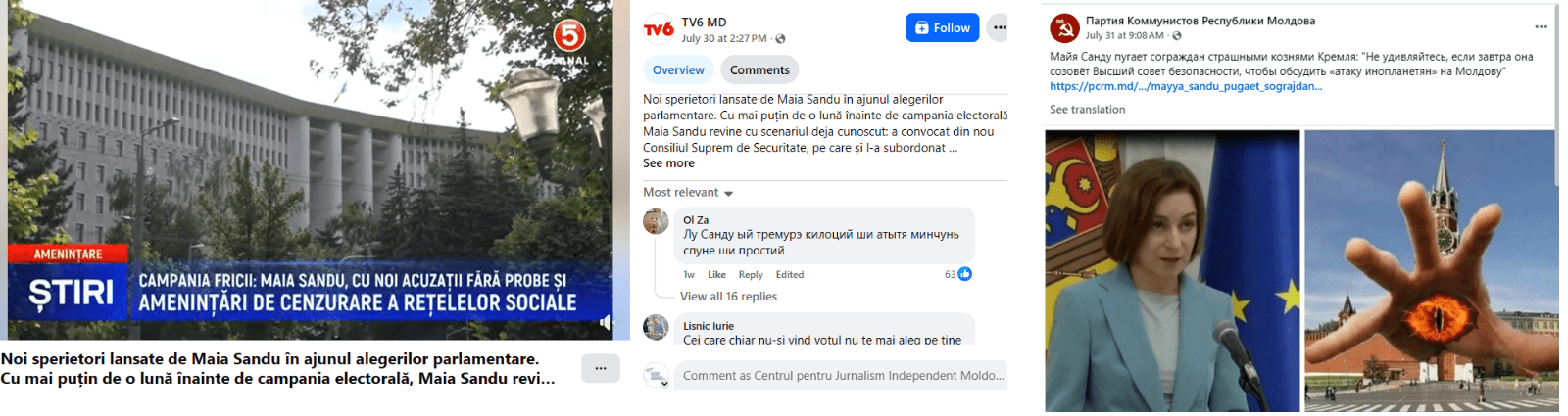
“New ‘campfire stories’ by Maia Sandu have appeared on the eve of the parliamentary elections” and “the fear campaign” are the phrases from the headlines on TV6. “Every time, before the elections, Maia Sandu and her team find another ‘enemy’ to threaten the country. Nowadays, it’s ‘Russian interference,’ tomorrow, it will be ‘paid protesters,’ and so on, and so forth. It has already become a classic strategy of the PAS: to cause fear, to stir emotions, and to disguise the governance’s failures by means of ‘foreign threats,’” a message published by the МОЛДОВА (Moldova) group says. While discussing the same topic, the Party of Communists ironically mentions on its official page that Maia Sandu tries to scare her fellow citizens with the Kremlin’s terrifying intrigues: “Don’t be surprised if she convenes the Supreme Security Council tomorrow to discuss an ‘extraterrestrial attack’ against Moldova.”
2. Election fraud with the assistance of the diaspora
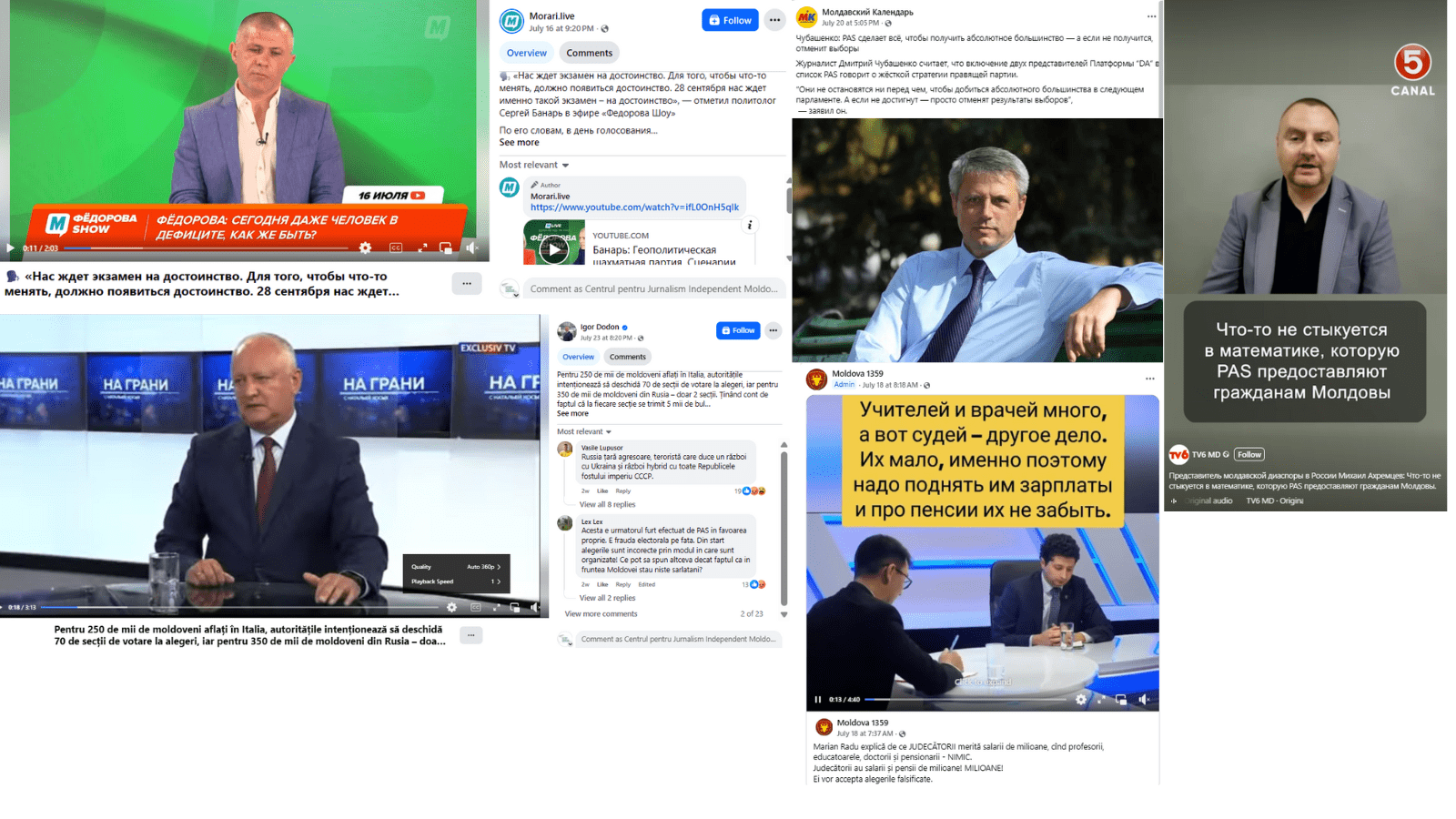
The topic concerning the number of polling stations to be opened abroad in the context of the parliamentary elections publicly discussed in the second half of July was used as an opportunity to resume the narratives about the election fraud within the diaspora. For instance, TV6 quotes an attorney named Igor Hlopetchi interviewed by Canal 5 who claims that “the PAS will try to fraud the parliamentary elections by means of the diaspora!” The Morari.live page published an interview with political scientist Serghei Banar who believes that, “on the election day, citizens will only be offered an illusion of the elections,” and the Moldova 1359 page shares an interview with deputy Radu Marian who explains why judges deserve salaries equal to millions. “They will accept falsified election results,” the author of the post concludes without providing any arguments. In a similar manner, the Молдавский Календарь (Moldovan Calendar) page quotes journalist Dmitri Chubashenco who affirms that “the PAS will do everything possible to gain an absolute majority in the next parliament. And if they fail to do so, they’ll simply annul the election results.”
During this period of time, the narrative regarding the election fraud was fueled by the discrepancy in the number of polling stations to be opened in the EU countries and in the Russian Federation. More exactly, out of the 294 polling stations the Central Electoral Commission (CEC) suggested to open abroad, only two are located in the Russian Federation, in Moscow, while Italy will have the largest number of them (73). The authorities explain their decision by the “security context” in view of the war in Ukraine, and the final decision is to be made no later than August 24.
The information that “the Moldovan authorities are planning a provocation to prevent opening the polling stations in Russia” was published on pages such as МОЛДОВА (Moldova). In an interview for Canal 5 shared by TV6, attorney Roman Zadoinov says that “justice is captive, and the votes from the diaspora are mere fraud,” and mentions that the Government is supposedly preparing to block the observation mission from the diaspora at any cost – by means of disconnections, bots, and concocted court cases. The same page publishes an interview with Mihail Ahremtev, a representative of the Moldovan diaspora in Russia, who says that “something is obviously wrong with the calculations the PAS offers to Moldovan citizens,” referring to the number of voters and polling stations in Russia. In a similar manner, socialist Igor Dodon affirms in an interview with the Exclusiv TV channel that “only 10000 persons are taken into account out of the 350000 residing in Russia. It’s a total aberration which makes the parliamentary elections in the diaspora look like a political circus. There is nothing left to say about any justice or fairness in this case.” Moldova 1359 describes it as “obvious discrimination against the diaspora in the East.” A post by Бельцы 24 in the Новости Гагаузии и юга Молдовы (News of Gagauzia and the South of Moldova) group includes a quote by Maria Zakharova, the spokesperson of the Ministry of Foreign Affairs of Russia: “Opening only two polling stations in Russia is a slap in the face of Moldovan citizens.”
3. NATO transforms Moldova into a bridgehead against Russia
Several groups, including Россия и Молдова ВМЕСТЕ, (Russia and Moldova Are TOGETHER), published the news item from Пятый канал Новости, according to which, NATO’s plan for Moldova had been unveiled in Russia: “Maia Sandu, acting under pressure from the West, keeps dragging the country into warfare with Russia. According to our foreign intelligence service, NATO transforms Moldova into another military battering-ram to be used against Russia. The conditions are ideal there. The head of the state who owns a foreign passport, such rebellious regions as Gagauzia and Transnistria, as well as hundreds of thousands of people who could be used as ‘cannon fodder.’”
Other alleged news items were also popular, including the one published by Независимое Приднестровье – информ (Independent Transnistria – Inform) regarding the same report by the Foreign Intelligence Service of Russia, according to which NATO intends to involve Chisinau in an eventual armed conflict with Moscow. “Moldova keeps increasingly falling under the influence of the North Atlantic Alliance. There are plans to transform the Republic of Moldova into the ‘alliance’s advanced bridgehead on the eastern flank, taking the advance of the Russian Armed Forces in Ukraine into account.’”
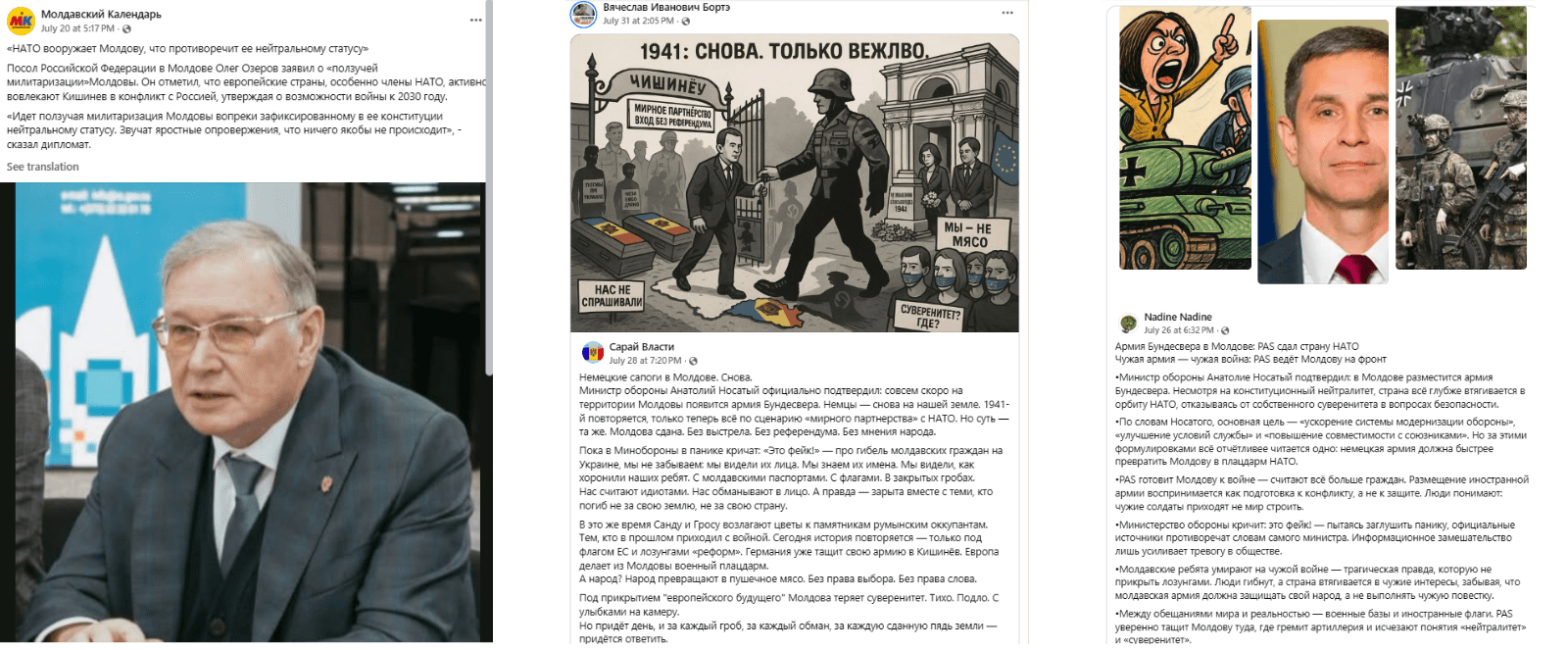
Молдавский Календарь, (Moldovan Calendar), in the context of this news item, quotes Oleg Ozerov, the ambassador of the Russian Federation to Moldova, who declares that Moldova is in the process of “progressive militarization which contradicts its neutral status,” and that the European countries, especially NATO members, keep actively involving Chisinau in the conflict with Russia, with an eventual outbreak of war by 2030.
On the Молдова за мир! (Moldova for Peace!) page, the announcement of the Moldovan Minister of Defense about adopting German military good practices was distorted and presented as an appeal to fear and a conspiracy theory which combines insinuations of an imminent loss of sovereignty and association of the deployment of the German army in the territory of Moldova with preparing for war: “The Bundeswehr Army in Moldova: the PAS has handed the country over to NATO. A foreign army means a foreign war: the PAS is taking Moldova to the frontline.” The message is based on negative associations and de-legitimization of the authorities by means of lies and manipulation, amplifying public anxiety and distrust in the state authorities.
The post reposted by Земля Молдавская! (Moldovan Land!) abounds in manipulative historical associations, it also contains an appeal to fear, combinations of comparisons with the occupation in 1941, insinuations regarding the loss of sovereignty, and emotional pictures of victims – all of these are meant to present military cooperation with NATO as an existential threat to the Republic of Moldova: “German army boots are in Moldova. It has happened once again. Minister of Defense Anatol Usatii officially confirms: the Bundeswehr Army will soon appear in the Moldovan territory. The Germans are again in our lands. 1941 is back again, but this time, it happens according to the scenario of a ‘peaceful partnership’ with NATO. But it all has the same essence. Moldova has been betrayed. Without a single blow. Without a referendum. Without asking the opinion of its people.”
4. The opposition and “inconvenient” voices are persecuted by the governance
This narrative is largely promoted by the persons subject to the EU sanctions and their entourage, and is also used in the context of the CEC’s refusal to register certain political parties for taking part in the elections.
“All those who struggle for the sake of people, the country, and sovereignty are under the sanctions,” according to Victoria Furtuna, the leader of the Moldova Mare Party; the same message is shared by the other pages and groups. The others ironically discuss the “European values” and insist that “Europe openly works for the PAS by eliminating the opposition! The sanctions against Furtuna and the rest of our supporters are a stab in the back of Moldovan democracy! The PAS feels it is losing the game and rushes to beg Brussels for assistance.”
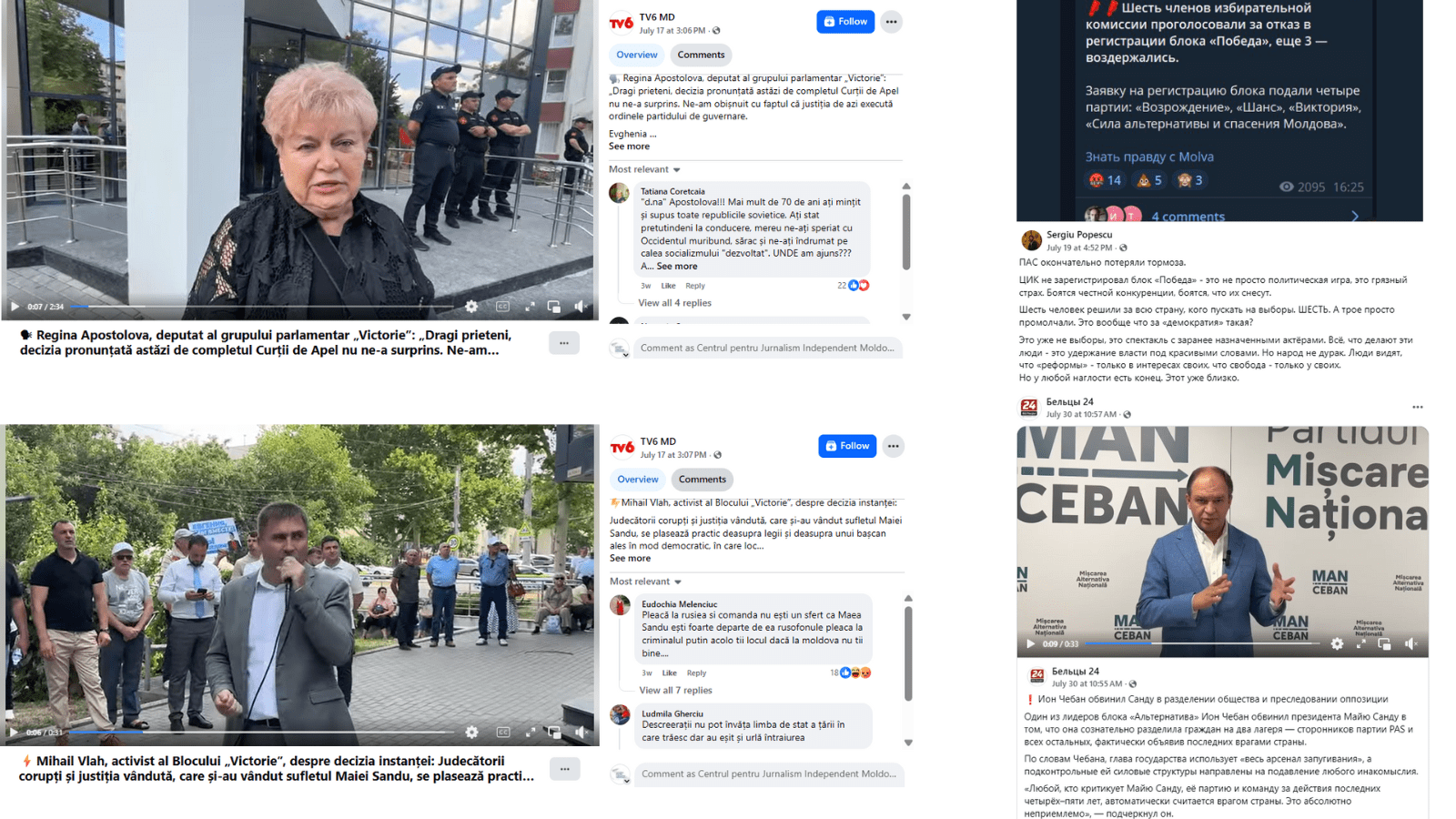
In the other groups, the refusal to register the “Victoria” bloc is described as a “show with preliminarily chosen actors instead of elections”: “The PAS has completely gone off the rails. It’s not just a political game, it’s a dirty fear. They’re afraid of fair competition, they’re afraid they’re about to be destroyed.” Россия и Молдова ВМЕСТЕ (Russia and Moldova are TOGETHER) publishes a video by Бельцы 24 in which Ion Ceban blames Maia Sandu for dividing society and persecuting the opposition; he also affirms that “anyone who criticizes Maia Sandu, her party, and her team for their activity of the recent four or five years is automatically regarded as an enemy of the country. It’s absolutely unacceptable.” On the other hand, Аргументы и Факты в Молдове (Arguments and Facts in Moldova) publish Igor Dodon’s message which is shared by a number of pages and groups: he says that “Maia Sandu introduces ‘thoughtcrime’ in Moldova. If you’re Eurosceptic, if you criticize the regime, or your opinion simply differs from that of Maia Sandu, you’re called a hybrid, a criminal, a foreign agent, an enemy, or a threat to society. Such an approach is unimaginable in a state that calls itself democratic. The authorities’ paranoia has reached a clinical stage.”
The trial involving Evghenia Gutul, the head of Gagauzia, was also used as a pretext to victimize the pro-Russian opposition and to diminish or to ignore the accusations brought against her. Regina Apostolova, a deputy of the “Victoria” parliamentary group, affirms, for instance, that the decision of the Court of Appeal did not surprise them, because they have “become used to the fact that the present-day justice system follows the orders of the governing party.” “The corrupt judges and bribed justice sold their souls to Maia Sandu,” Mihail Vlah also concludes.
5. The EU and the West undermine the sovereignty and the values of the Republic of Moldova
On July 16-31, messages presenting the European Union and the West as morally degenerate, dominated by progressive ideologies, and exercising foreign control over the Republic of Moldova were circulating on Facebook pages and in the groups in the Moldovan information space. Such messages were fueled by the MEGA (Make Europe Great Again) Conference held in Chisinau in late July; it was attended by a number of local and foreign conservative politicians and activists who discussed general topics related to the RM – EU relations, including the accession prospects and foreign influence on domestic political processes.
The day before the conference, at least three of its leading speakers were detained at the airport, and the Moldovan authorities later suggested that the reunion was a hybrid action. Some Facebook users interpreted this ban as evidence confirming that the current governance, in complicity with its foreign partners and the international organizations, restricts freedom of expression, marginalizes conservative voices, and promotes the policies which contradict traditional values and national interests of the Republic of Moldova.
The event was used as a focal point for several recurrent disinformation topics concerning censorship, loss of sovereignty, and threatened cultural identity. The tone of the posts is predominantly emotional, appealing to such feelings as fear, indignation, and solidarity against a “common enemy” (i.e. the current governance and its foreign partners).
The most widespread narratives which emerged during this period of time refer to limited access and “censorship,” participation restrictions were interpreted as evidence of a lack of transparency and political control, and the PAS governance was presented as equal to the “fear of dissent” and deliberate intention to exclude any critical voices.
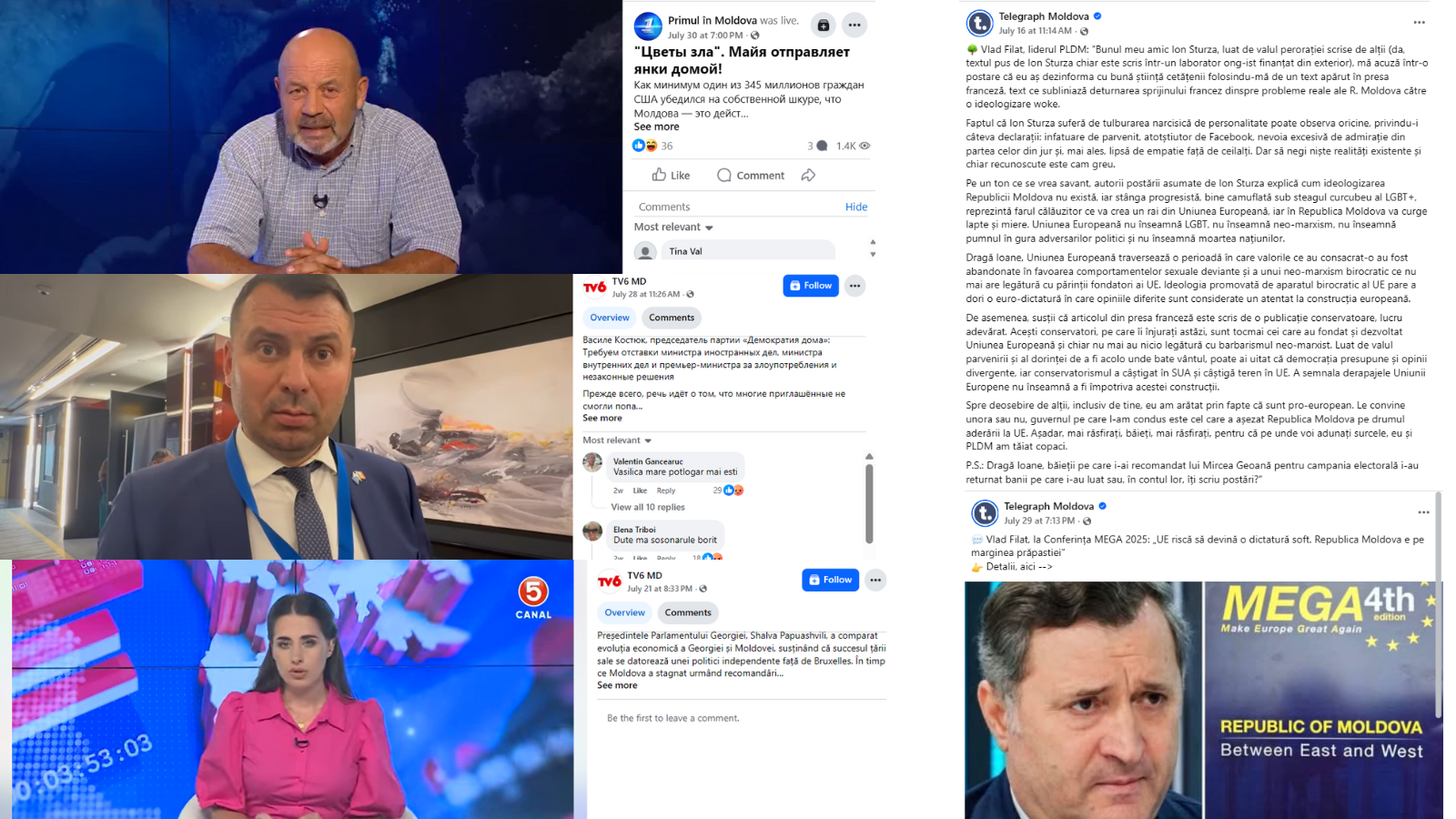
While covering the fact that Brian Brown, an American conservative activist, was banned from entering the country, Primul in Moldova promotes the following idea: “at least one of the 345 million American citizens learned from his own experience that Moldova is actually a bastion of dictatorship.” Бельцы 24 quote Victoria Furtuna who criticizes the authorities and accuses them of censorship: “It’s a dictatorship disguised as democracy! People were not allowed to visit the country just because they share conservative views, faith, and family values.” On TV6, Vasile Costiuc, President of the Democrația Acasă (Democracy at Home) Party, claims that this “abuse committed by the PAS, Maia Sandu, and Prime Minister Recean” is based on fear: “The answer is obvious – fear is the reason. The authorities are afraid of losing the elections and prevent the foreign guests from visiting Chisinau, so that they do not talk about democracy, the European path, or about the abuse committed by the authorities themselves: closing TV channels, censoring the Internet, criminal cases, and eliminating their opponents from taking part in the elections.”
The other related disinformation concerned alleged foreign control over Moldova, European integration as an illusion, and the EU as a threat to national identity. TV6, one of the monitored sources, published numerous posts containing such narratives. In a video reposted from Canal 5, Alexei Lungu, the leader of the Sansa (Chance) Party, is quoted: he claims that “the EU is the main stakeholder who interferes in the policy of the Republic of Moldova.” In another video, political scientist Alexander Korinenko mentions that “the EU’s actions in Moldova are just business.”
TV6 also published the message by Sergiu Ungureanu, an economic expert, who, in his speech for Canal 5 in the context of the MEGA conference, criticizes the officials in Brussels and says that the European leaders are trying to impose their rules on the other countries, without taking their opinions into account, and “the idea of ‘Making Europe Great Again’ demonstrates that more and more people are dissatisfied with the way the European Union functions nowadays. Ex-Prime Minister Vlad Filat quoted by Telegraph Moldova believes that “the EU risks becoming a soft dictatorship. The Republic of Moldova is on the verge of an abyss.”
In the same manipulative context, Shalva Papuashvili, President of the Georgian Parliament, was quoted: he compares economic development of Georgia and Moldova, stating that his “country’s success is due to the policy of independence from Brussels. While Moldova stagnates as a result of following the EU recommendations, Georgia enjoys growth and stability focused on its national interests.”
Telegraph Moldova shares a message by Vlad Filat addressed to Ion Sturza: among other things, he remarks that “the European Union is going through a stage where the values it regarded as sacred are abandoned in favor of deviant sexual behaviors and a bureaucratic sort of neo-Marxism which have nothing to do with the founding fathers of the EU. The ideology promoted by the EU bureaucratic machine seems to spread a Euro-dictatorship where different opinions are regarded as an attack against European construction.”
6. Detention of Vladimir Plahotniuc as the PAS’ electoral maneuver
The detention of the ex-leader of the Democratic Party in Athens announced by the Police on July 22 became another pretext on the public agenda: disinformation concerns its circumstances, motives, and purpose, and presents the governance and the state authorities negatively, even denigrating certain individuals. Vlad Plahotniuc left the Republic of Moldova in the summer of 2019, when the governance in Chisinau changed; his case related to the “theft of a billion” from the three Moldovan banks in 2014 was examined in court in his absence.
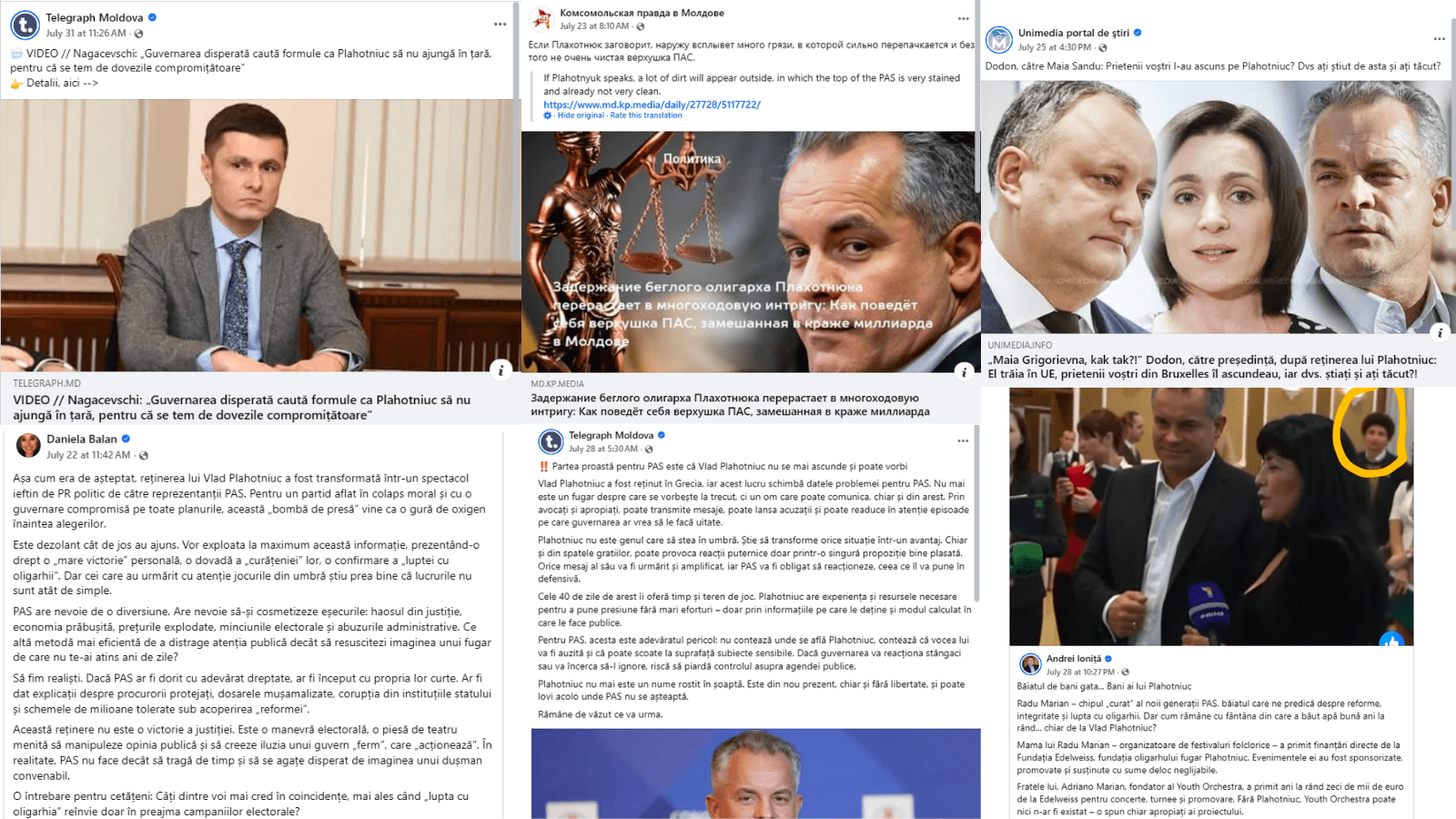
Upon his detention in Greece, we stated that Telegraph Moldova published the largest number of disinformation narratives on this topic among the sources monitored in the second half of July. According to one of them, the PAS is likely to suffer from the fact that Vlad Plahotniuc no longer keeps below the radar and can speak out, because “he can bring some sensitive issues to the surface,” and “he can touch upon the points the PAS does not expect him to.” Another narrative borrowed from Fadei Nagacevschi is that “the governance is desperately looking for some formulas to prevent Plahotniuc from entering the country, and they are afraid of compromising evidence.” Several posts mention deputy Radu Marian whose mother is depicted in a photo next to Plahotniuc, and the following characteristics: are provided: “Vlad Plahotniuc’s scholarship recipients” – “Radu Marian, can you recognize yourself?! Tell us how much your family has received from the ‘fugitive’s’ foundation?! Even your mother was glad, as we can see from these photos.” In another post, it is written that “there were the days when the mother of the PAS deputy Radu Marian would touch glasses of champagne with Vlad Plahotniuc, and go home with the money from the fugitive oligarch in the evening.”
In the МОЛДОВА (Moldova) group, a post by Andrei Ionita is shared: it describes how Plahotniuc’s foundation allegedly sponsored the cultural events organized by Radu Marian’s mother and brother, and speculatively concludes that “this is the reformed PAS: loud speeches deeply rooted in the corrupt past of this country. Radu Marian is not a symbol of change. He is merely a recycled product of the old system sold as a brand new one.” The same group also published the messages saying that, “as expected, Vlad Plahotniuc’s detention was turned into a cheap political PR show by the PAS representatives. For a party in the state of moral collapse whose governance has been compromised at all the levels, such a ‘press bomb’ is like a breath of oxygen before the upcoming elections.”
As to the news about Plahotniuc’s detention, the Unimedia editorial board highlights Igor Dodon’s accusing question against President Sandu, including in the title: “Maia Grigorievna, how could it be?! Dodon addresses the President after Plahotniuc’s detention: He was residing in the EU, your friends in Brussels were hiding him, and were you aware of this fact and kept quiet?!” Комсомольская правда в Молдове published a material with the headline: “The arrest of the fugitive oligarch Plahotniuc is being transformed into a multi-stage intrigue: how will the PAS leadership involved in the theft of the billion in Moldova act?”; the post is accompanied by the following text, “If Plahotniuc speaks up, many dirty things will emerge, and that will seriously stain the PAS leadership who are is not quite clean anyway.”
Morari.live provides a quote by Fadei Nagacevschi, ex-Minister of Justice, who said during a broadcast that he believed Plahotniuc had obtained some guarantees and, therefore, he was returning, and everything that was happening was a “fairytale no one believes in.” The same platform published an idea shared by Vasile Costiuc, a guest of the “Gonta Show” broadcast: he believes that Plahotniuc’s return is bad news for the PAS, and that “Plahotniuc has decided to return home on his own, because he is convinced he is not in danger here.”
On the page of Молдавские Ведомости (Moldovan Journal), Elena Zamura, Editor-in-Chief of the publication, publishes a text in which she explains “why Plahotniuc is not and has never been an oligarch.” “Where have you seen any ‘oligarchs’ in our country?” the author asks. “Maybe Sandu’s group and her media holding are merely using a propaganda cliché to stigmatize the persons our ‘good’ and ‘honest’ people are afraid of for some reason?” she concludes. The same source promotes an idea that “Platon was released on bail, and the same thing is about to happen to Plahotniuc in the future.”
Primul in Moldova published an interview on the same topic with Alexandru Muravschi; it highlights a question also asked in many other Facebook posts both by some users and the opposition politicians: “Have you ever wondered why Plahotniuc was detained exactly before the elections?” The same editorial board publishes a hypothesis suggested by the attorney Iurie Margineanu who believes that “Plahotniuc could provide some evidence of political persecution to the Greek justice system.”
CONCLUSIONS
1. Consolidating the narrative framework of the “PAS dictatorship.” The narratives about the “authoritarian regime” of the PAS governance were subsequently amplified by the reports about alleged institutional abuse, political control over justice, and restricted freedom of expression. Individual cases of investigations and sanctions were presented as evidence of a systematic campaign aimed at persecuting the opposition.
2. Conspiracy narratives in which geopolitical overtones prevail remain very popular; they present the EU, the US, and NATO as hostile parties involved in undermining the sovereignty of the Republic of Moldova.
3. Preparing the ground for contesting the outcome of the elections. Repeated accusations of imminent electoral fraud, manipulation using the diaspora votes, and falsified electoral lists have been circulating in the information space on Facebook. These messages can undermine public trust in the electoral process and create a narrative basis for eventual protests or refusal to accept the voting results.
The monitoring was carried out within the project “Resilient Media, Informed Voters: Safeguarding Moldova’s Elections from Disinformation”, funded by the Embassy of the Kingdom of the Netherlands in Moldova. The views expressed are those of the authors and do not necessarily reflect the position of the donor.
