


End of election campaign on TikTok: Disinformation has moved into clone accounts and continues post-election

TikTok has shown in the last days of campaigning and on voting day that social media cannot be silenced: despite several accounts that disseminated misinformation being blocked, messages continued to circulate through clone accounts and content migration. AT the same time, popular influencers have quickly reappeared, while the narratives remained the same, only repackaged: loss of sovereignty, limited vote, dependence on EU, anti-PAS mobilization and, ex-post, the thesis that the elections were falsified.
Around the time of the September 28 parliamentary elections, several TikTok disinformation and propaganda spreading accounts disappeared. However, the people behind them continued to make their messages visible: some created new accounts for themselves, while others continued to share their content using other profiles.
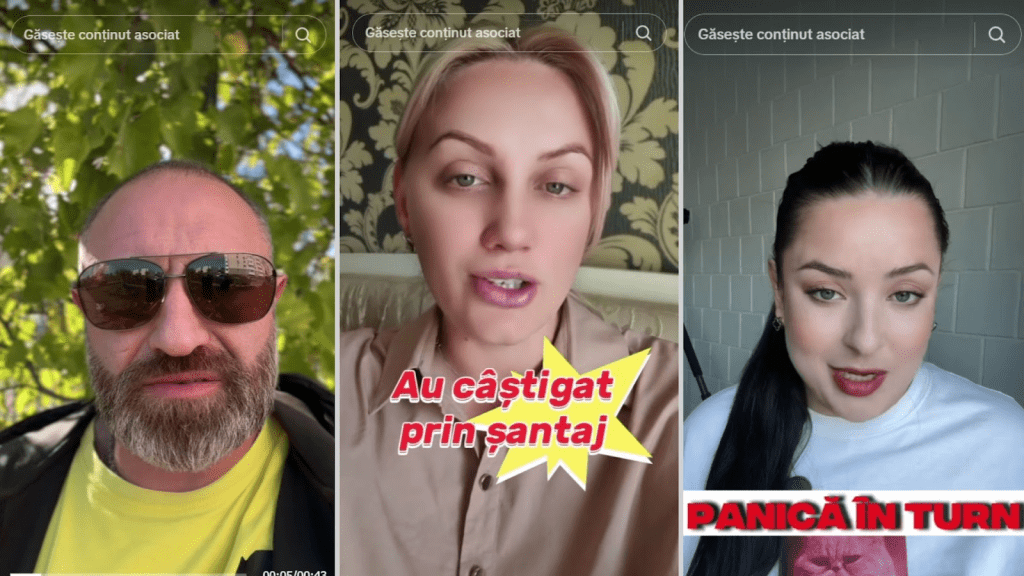
Among the channels that we monitored during pre-election and in the early campaign and which were blocked a few days before September 28 was @TV6.press which distributed the content produced by Canal5 and had over 160,000 followers, as well as @primulinmoldova, @latebuimistru2.0 by vlogger Dumitru Buimistr, @gagauzmoldova and a wide range of anonymous channels. Soon after, the content of Canal 5 “moved” to a “new home” – an account created on September 28, officially called @canal5moldova. Some videos have already been blocked there, too. Also, the content of @primulinmoldova reemerged on a new channel created on September 26, @primulinmoldova4.
In the case of bloggers we monitored, TikTok pages were blocked for Ion Ripa, aka King Kong Moldova, and Sergiu De Moldova. They also reappeared online shortly after. Tatiana Costa was also left without a page; however, videos featuring the tiktoker affiliated with Victoria Furtuna continued to appear on other pages.
| Read here about the accounts monitored and the content shared on TikTok during three weeks of pre-election. |
LAST PRE-ELECTION WEEK
The main narratives distributed a week before the election focused on topics already touched upon in this campaign. They highlighted the risk of losing Moldova’s sovereignty, limited right to vote in case of Moldovan citizens residing on the left bank of the Dniester and in Russia, and the idea that economic relations with the EU make us dependent on the accumulated external debt. “Manipulation agents” on TikTok kept saying that the ruling Action and Solidarity Party (PAS) had lost the population’s support. They also promoted the allegation that the elections would be falsified, often using out-of-context or completely false information.
A few clear messages were outlined during this period:
- Fear of Russians is unjustified
In a news story about Maia Sandu’s speech after exercising her right to vote, @canal5moldova presented the President’s words as a new attempt to scare the people of Moldova with Russian tanks and drones. Another news story on the same TV channel revealed the opinions of a number of Moldovans about the danger of a Russian attack. They all suggested that there is no real danger of an armed conflict and that, in fact, people are not afraid of a war with Russia. In a video broadcast as part of a TV show, Gheorghe Gonța also doubted that there is real danger coming from Russia. He mentioned that the Russian state still “cannot settle things with Donetsk and Donbass”, as “our brothers in Kiev bomb it day after day”. Moreover, he added that “Crimea has been subject, to this day, to weekly terrorist attacks from the Kiev brothers”. Therefore, according to Gonța, it would be absurd for Russia to attack NATO which would bring an end to it by merely pressing two buttons. It is thus suggested that NATO is a more dangerous military force than Russia.
2. Obvious mobilization to vote against PAS
The call to vote against PAS was a frequent message across multiple channels. In an editorial, a @primulinmoldova4 journalist directly urged people to vote for getting rid of the current power, criticizing the campaign and the fact that the governing party allegedly allows itself anything against its competitors, the voters and the country. She also warned that ignoring elections and inaction could lead to a much worse situation, even hinting at the risk of a war. Gheorghe Gonța also dedicated an editorial to calling on people to vote against PAS. Similar messages also appeared on an anonymous channel @moldova_mea16. This post, for example, said that “Every vote counts — PAS should not be in government”. Another post shared by the same anonymous channel on election day provided turnout data, while also making a reference to supposed preliminary results that the PAS were winning, therefore suggesting that voters needed to mobilize in the remaining hours to change the course of things.
3. Fraud and the impossibility of PAS winning the elections
PAS’s loss of popularity among Moldovan citizens was a narrative heavily promoted in the run-up to the elections, including through opinion polls.
For example, in a video that has garnered almost 90,000 views, Kristian Grăiește commented on a poll conducted by iData which indicated that the Patriotic Bloc was the most popular electoral competitor in Moldova. Thus, it claimed that “PAS is in agony” and suggested that an early election was possible. On the same day, quoting Mihai Bologan, iData Director, Ion Ripa concluded that “PAS will make a majority in Parliament when Moldovans take a taxi to Mars”. TikTok says the ruling party “can only save itself if it steals like in Codru”.
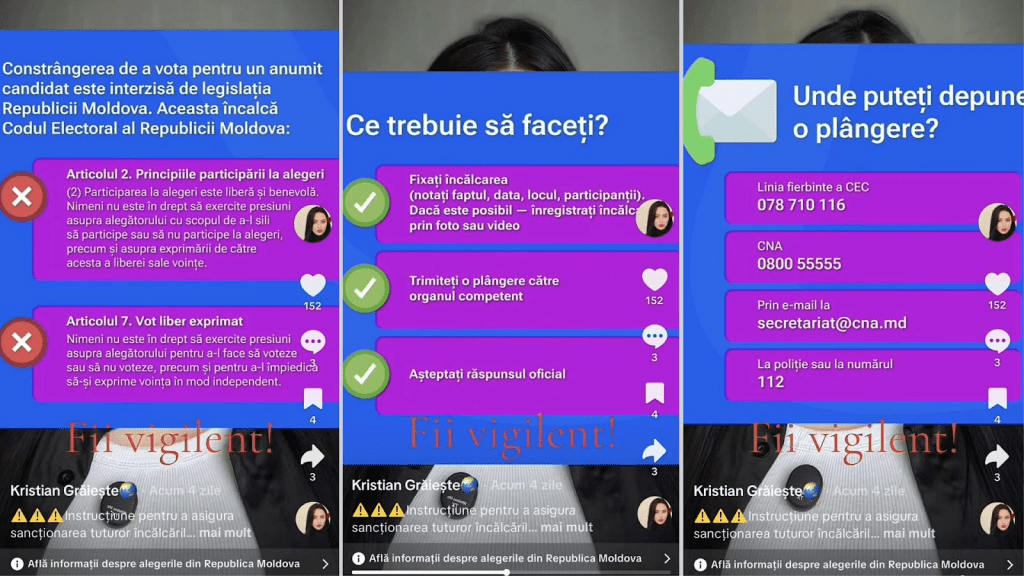
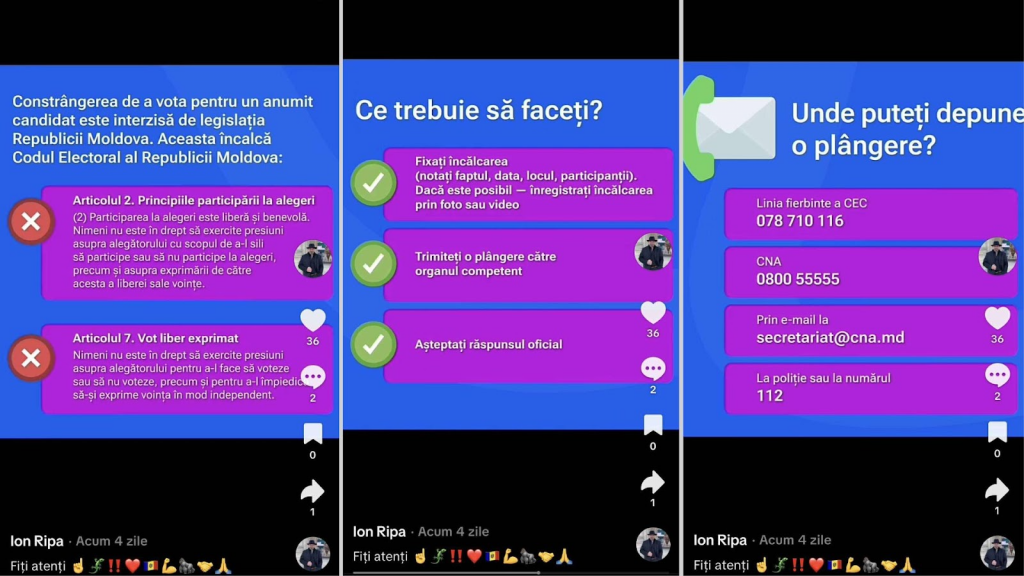
This is not the first time that Ion Ripa and Kristian Grăiește talked on the same subject. On September 27, the two tiktokers simultaneously published videos in which they claimed that PAS was preparing to fake the elections and provided a list of “rules” to follow if fraud was detected. The texts appear on the same informative images, inserted in both videos – an indication that the two either collaborate or receive materials from the same coordination center.
ELECTION DAY
Multiple posts appeared on the voting day, insinuating alleged frauds in polling stations for the diaspora, but also in the country, low turnout in polling stations in EU countries, high turnout in polling stations in Russia and Belarus, and restricted rights to vote on the left bank of the Dniester river. By promoting the idea of fraud, certain political forces have given themselves an excuse not to recognize election results.
This post published by @canal5moldova shows a polling station in Bucharest, with the comment suggesting the station is empty. Another news story posted by the same channel reports about alleged violations in Sibiu, claiming that several students were organized to vote. At the same time, it is said that, according to some Telegram sources, Sibiu residents noticed many Moldovans in the city on election day, suggesting the diaspora was organized to vote.
Mihaela Bargan also talked about election fraud, citing bomb alerts and “organized transportation of voters” from Moldova to Romania to “vote again” – something that is technically impossible because voters are registered in the system after voting the first time. The tiktoker also mentioned that the European diaspora’s polling stations were empty and wondered “where Maia Sandu got 200,000 voters”.
The same narrative was taken up by Ion Ripa who said that “there is a video on the web of a bus from Germany bringing people” to vote, while some observers were not allowed to monitor the process.
On the night of September 28, Sergiu_de_Moldova, was convincing his audience that PAS “had no chance to win the elections”, while the SIS and the police, aware that the government was about to change, were “destroying all documents so they wouldn’t be held accountable for the mess they’ve made”.
POST-ELECTION MESSAGES
On the Monday after the elections, the main messages that circulated on the monitored Tiktok channels summed up the fact that PAS lost the elections in Moldova again and that the result was due to the diaspora’s efforts. A news story on @canal5moldova explains that PAS won the majority thanks to the diaspora vote, “despite the majority of voters inside the country having cast opposing votes”. The story points out that “PAS will lead a state where the majority voted against it”.
There was also a message that the election was not genuine. In a show on @primulinmoldova4, Dumitru Ciubașenco commented that the electoral event was not a true democratic process, but rather an “exercise” to stay in power. He mentioned that the organizers created an atmosphere of terror and psychosis, a campaign of intimidation and panic, which strongly affected the general feel of the elections. A similar message was sent by Natalia Morari who compared the elections to “a psychological experiment” and said that, although people’s decision was respected, they did not vote freely because the elections were influenced by the state machine which served PAS, “which was not the case either in Plahotniuc’s time or in Voronin’s time”.
On the night of September 28, when it was not clear who would win the election, Пётр ON LINE also noted that the authorities were “destroying documents that could compromise them”. Later he said that the elections should be held again because of the blocked bridges over the Dniester, which somewhat limited the access of Transnistrian Moldovans to the suffrage.
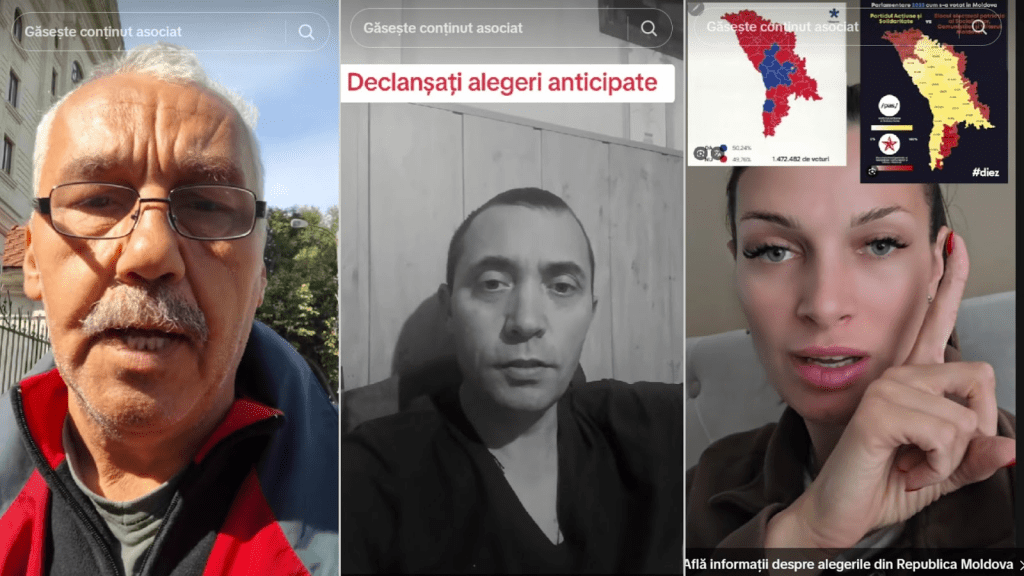
Ion Ripa dedicated several videos to the election results in which he said he did not believe in them, and Mihaela Bargan indirectly suggested that PAS’s support in Moldova could not have grown so much in 2025.
Although at first Sergiu_de_Moldova said that PAS’s victory “is not honest, but is still a victory”, later he returned with a video in which, quoting Victoria Furtună, he urged the opposition MPs to give up their mandates in order to force early elections.
Conclusion
This monitoring exercise revealed two major trends:
- Infrastructure resilience to disinformation. Blocking a few accounts has not stopped their messages from being shared by new clone accounts and then reshared, which means that misinforming networks adapt fast.
- Post-election persistence and mutation. The narratives did not stop after the suffrage. On the contrary, they regrouped within new frameworks: “PAS won only through the diaspora”, “the elections were not a genuine act, but an exercise of staying in power”, accompanied by calls for protests, re-election or extreme gestures such as renouncing mandates.
The monitoring was part of the project “Resilient press, informed voters: protecting elections in Moldova against disinformation” financially supported by the Embassy of the Netherlands in Moldova. The opinions expressed in the analysis belong to the authors and do not necessarily reflect the donor’s point of view.
