


Pre-election misinformation narratives on Facebook: “dictatorship”, “fraud”, “war” and other recurring topics

In the pre-election period, numerous Facebook pages and groups in the Moldovan information space are showing a concerted stepping-up of recurring misinformation narratives, adapted to the local context and emotionally calibrated to influence public opinion.
- A monitoring of 73 pages and public groups from July 1 to July 15 showed that they often use emotional and alarmist rhetoric with nationalist or anti-Western overtones and frequently resort to manipulation.
- The most prominent narratives aim at delegitimizing the government and the electoral process, discrediting European partners and promoting a feeling of systemic crisis, political persecution and imminent loss of national sovereignty.
WHAT WE MONITORED
We analyzed the content shared on 73 public Facebook pages belonging to several parties and party leaders, media sources and influencers, as well as thematic public groups with audiences ranging from 1,000 to more than 88,000 followers.
Of the 338 posts identified as harmful content and analyzed, 222 are original and the rest are reposts shared by various monitored players. The posts in question have accumulated at least 17,700 views.
Most of the analyzed messages were shared on the TV6 MD page, followed by the Молдова за мир! group (22.3K followers) and Россия и Молдова ВМЕСТЕ (5.2K followers).
Here is an overview of the most prominent narratives found in the content shared by the monitored pages and groups:
- PAS, led by Maia Sandu, is an enemy of the people – they have taken over and impoverished the country
A recurring pre-election narrative focused on directly challenging the governance by the Action and Solidarity Party (PAS) and President Maia Sandu, portraying them as the main sources of the country’s problems: “the PAS government brought the country to the brink of social collapse”, “the PAS dictatorship”, “the PAS fascist regime”, “globalists destroy family and religion”.
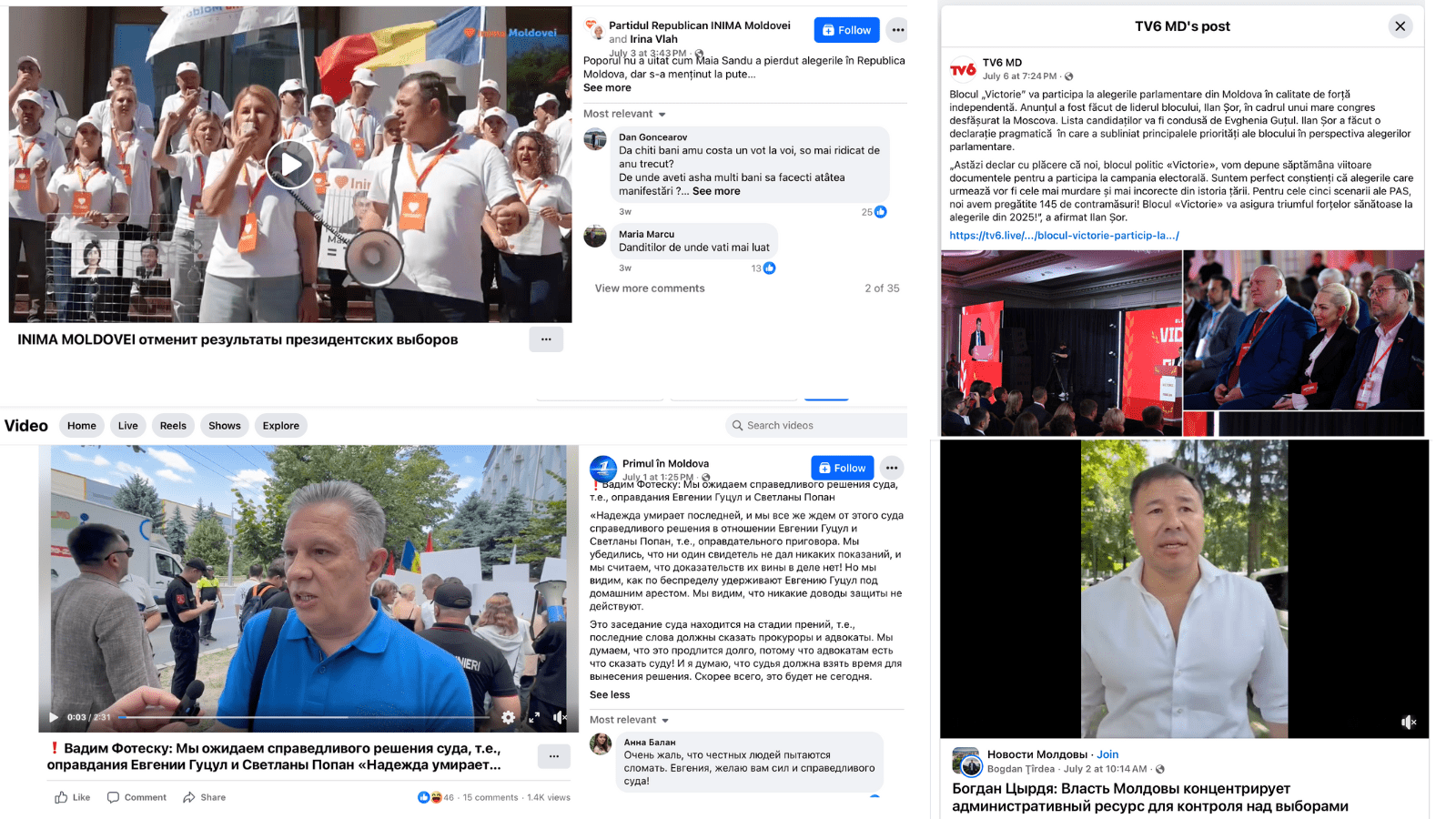
Россия и Молдова ВМЕСТЕ shared a statement by Maxim Morosan, the leader of PSRM Balti: “After four years of PAS government the country is on the verge of extinction”. He claims that the PAS legacy includes “ruined families, beaten priests and an empty country”. These claims were later picked up and shared by Молдова за мир! and Россия и Молдова ВМЕСТЕ.
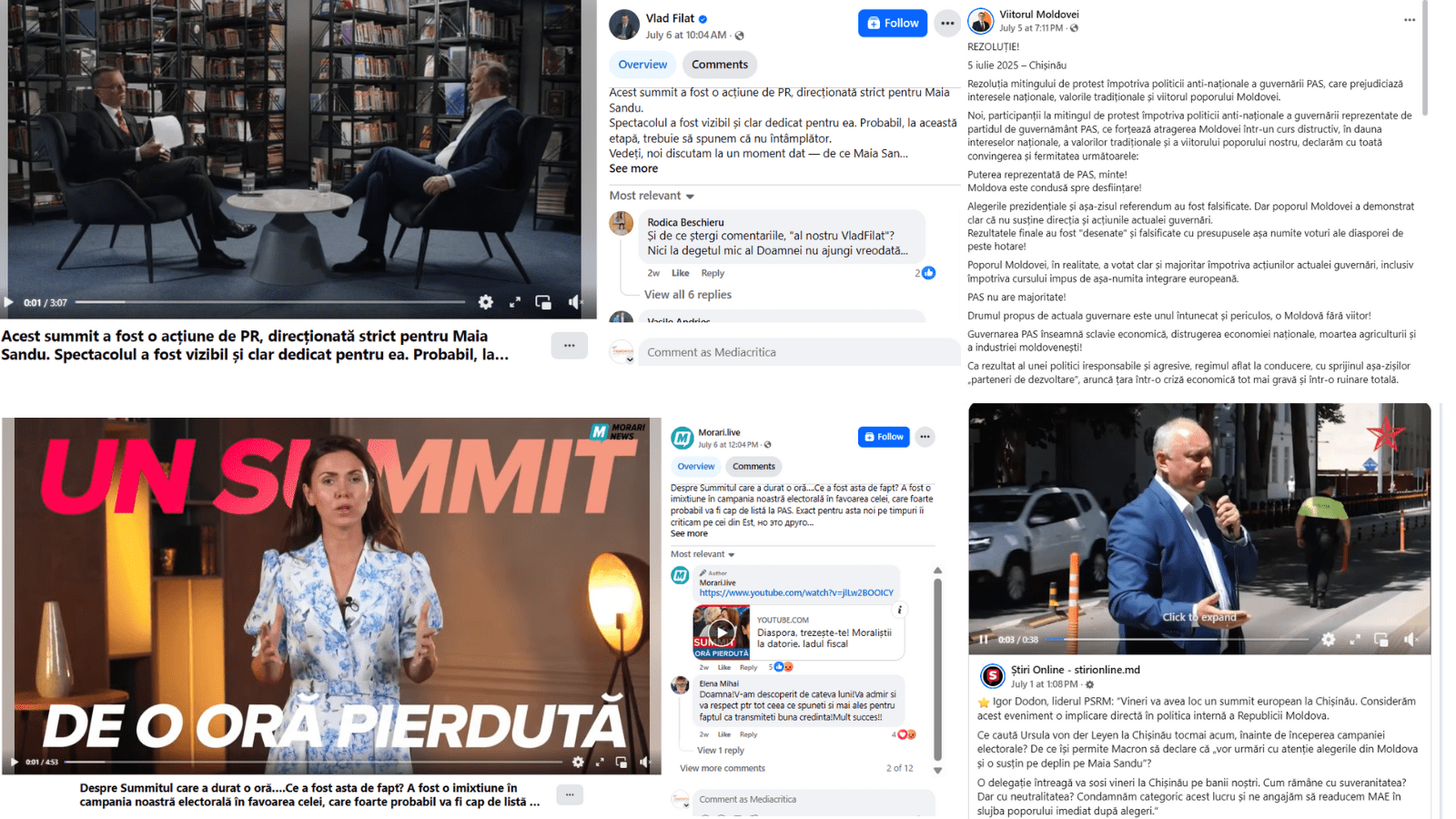
Vlad Filat says on his official web page that, in four years, Maia Sandu “took full power in the Republic of Moldova”, listing key institutions, from the President’s office to the media, as “taken over”. In an official review, the Communist and Socialist Bloc (BCS) faction calls the current legislature “inefficient” and says that “PAS destroyed the economy, took over institutions and broke its promises to the people”.
The Молдова за мир! page posted a video with Veaceslav Jucov who calls the current Parliament “the most shameful in the history of Moldova”, and the country – “weakened, abandoned and controlled from the outside”.
In a protest resolution published on the Viitorul Moldovei page, the PAS government is accused of leading the country to “economic slavery” and “the death of agriculture”, while international partners are described as “accomplices in ruining Moldova”.
On the same line, Diana Rosipanu from INIMA MOLDOVEI, a Balti organization, claims that the government “intentionally destroys education”, while Olga Gorban, speaking in the context of alleged electoral frauds, says that PAS “took over all state institutions in order to stay in power”.
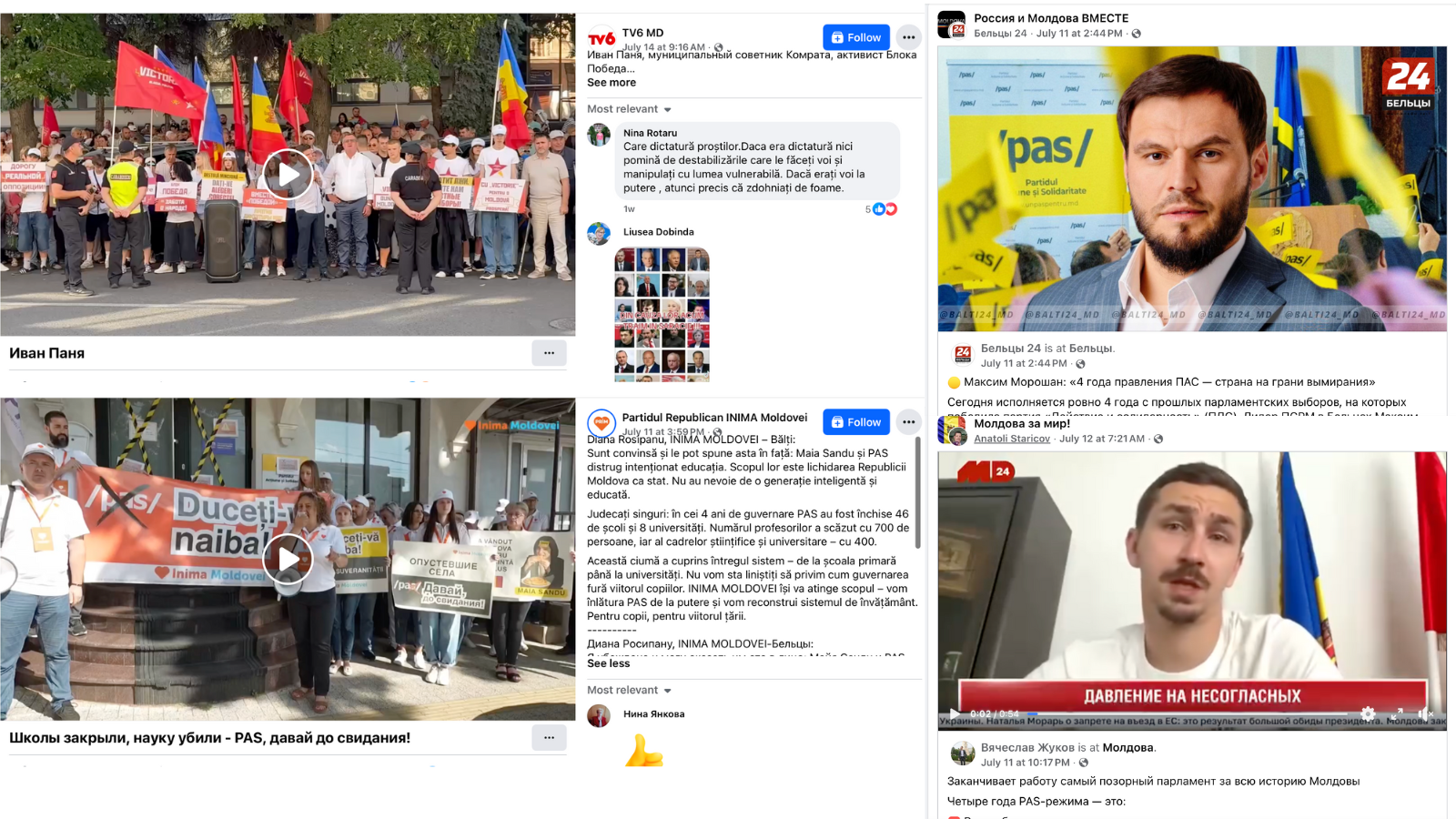 “The PAS dictatorship” and controlled institutions
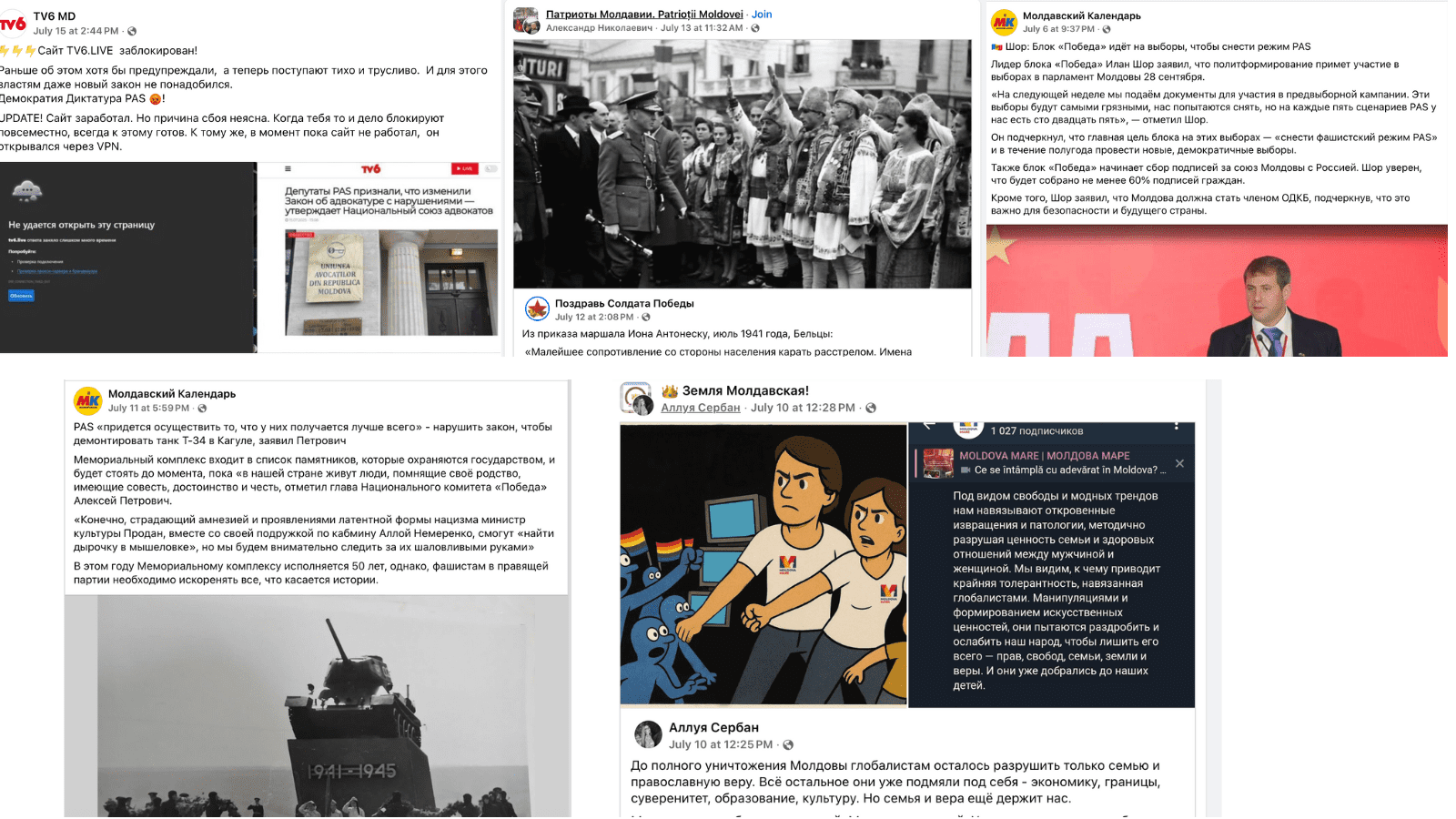
This narrative is also supported by TV6, a TV channel previously shut down by the authorities, which claims that the blocking of its website was orchestrated by PAS. Ivan Panea (Victoria Bloc) says in a post that it’s time to “put an end to the PAS dictatorship”, while Adela Raileanu (PSRM) publicly calls: “Down with the PAS dictatorship, down with censorship!”.
PAS is also accused of “taking over the state” and having political control over justice. In a video message posted by the PSRM, Vlad Batrincea criticizes the changes in the activity of law firms, saying these changes “continue the ruling party’s policy to establish political control over the legal system”. Vasile Tarlev adds in an interview published by Viitorul Moldovei that the appointment of Constitutional Court judges is “a clear signal that the state institutions have been taken over in a dangerous attempt to validate manipulated, falsified elections and to keep control at all costs”.
PAS and “fascism”
Ilan Shor announces in a post on Молдавский Календарь that the goal of the Victoria electoral bloc is to “overthrow the fascist PAS regime”. On the same page, the head of the Victoria Committee accuses the government of demolishing historical symbols, such as the T-34 tank in Cahul. Another video makes reference to Maia Sandu, ironically depicting her as “crying alone, honoring fascists and banning Victory Day”.
The Патриоты Молдавии page associates Maia Sandu with the figure of Antonescu, deriding her for allegedly hesitating to strongly condemn his regime.
“Globalists destroy family and religion”
This narrative claims that the authorities, in complicity with external players, destroy the fundamental values of the Moldovan society. A post shared on Земля Молдавская! says that “globalists have enthralled everything – the economy, borders, education – but still have not succeeded in destroying the family and the Orthodox faith”.
- The opposition is persecuted before the elections
One of the most frequent narratives pushed during the analyzed period concerns the alleged persecution of the opposition by the PAS government in the electoral context. The European Union’s announcement of sanctions imposed on a group of Moldovan politicians close to Ilan Shor who are accused of undermining Moldova’s democracy and sovereignty, as well as the ban on entering Romania imposed on Ion Ceban, mayor of Chisinau, were interpreted in a conspiratorial manner and generated a wave of disinformation messages on the monitored Facebook groups and pages.
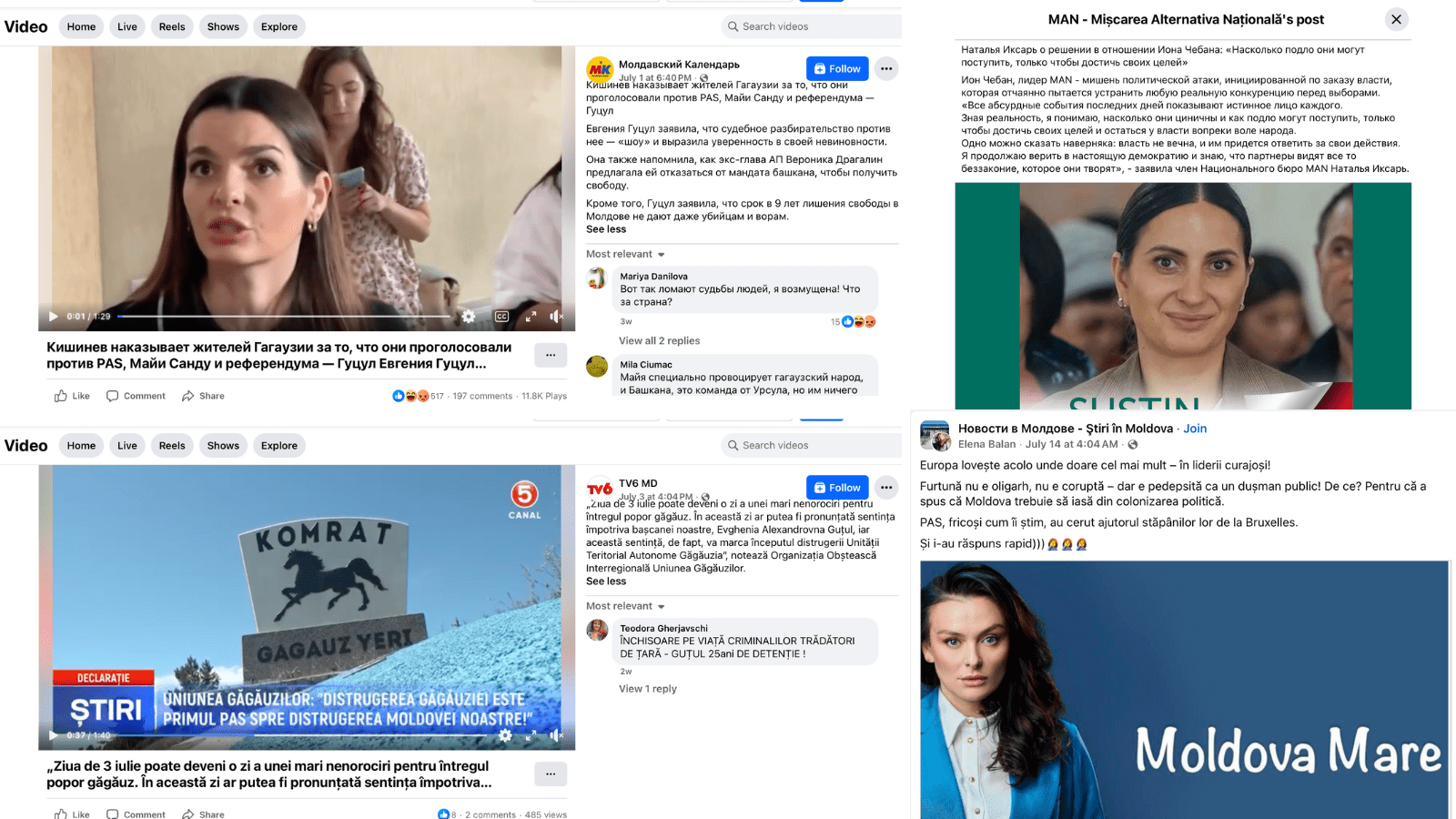
Former President Igor Dodon called these events “a signal of degrading democracy” and said that “any abuse of the PAS government against the opposition has found and finds support in the cabinets of Brussels and other Western capitals”. Stanislav Pavlovschi, a guest on a Canal 5 show that was broadcast on the TV6 MD page, suggested that sanctions are directed against those who “do not think like Ursula von der Leyen or Maia Sandu”. On the Новости в Молдове – Știri în Moldova page, user Elena Balan wrote that “Europe hits where it hurts the most – in brave leaders!”, presenting sanctions against Marina Tauber as an act of punishment for “the courage to oppose political colonization”.
Ion Ceban said on his Facebook page that the decision to ban him from entering Romania is “purely political”, made “at the direct indication of Maia Sandu and Nicusor Dan”. Natalia Ixari, a member of MAN, described the action as an “ordered political attack” aimed at eliminating any electoral competition.
Another wave of manipulative messages was fueled by the trial of Evghenia Gutul, the Governor of Gagauzia, who was accused in the case of illegal funding of the former Shor party. The case was presented in a one-sided manner, without reference to specific case facts, with a focus on the Governor’s victimization and the allegedly political nature of the accusations.
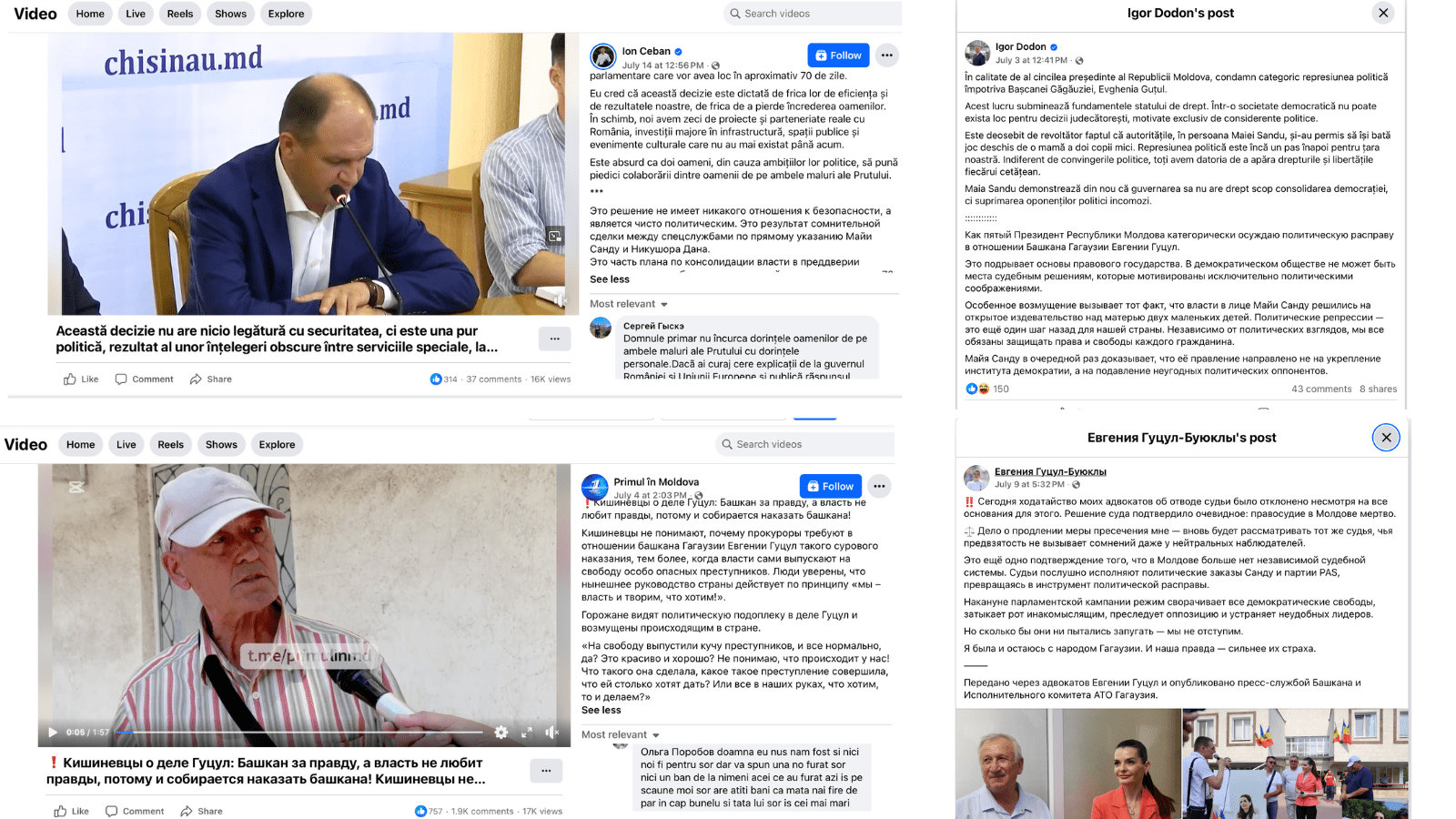
In several posts, Gutul claims that the trial is a “politically motivated invention” and that judges execute the government’s orders. In a post she states that “the regime rejects all democratic freedoms, persecutes the opposition and gets rid of inconvenient leaders”. In a video posted by TV6 MD, her lawyer Sergiu Moraru described the case as “an artificial creation of the prosecutor”.
Former President Igor Dodon said that “the political repression against the Governor of Gagauzia is another step back for our country” and criticized President Maia Sandu in the context. In the same line of thought, former socialist MP Vasile Bolea said that “all repressive mechanisms of the state “are directed against Evghenia Gutul and the Victoria Bloc.
The Primul in Moldova channel published the opinions of Chisinau residents, all favorable to the Governor, which reiterate the key message of the narrative: Gutul is persecuted for “speaking the truth” and “the current government does what it wants”.
In addition to victimizing the person, the narrative extended to cover Gagauzia as a whole. Gutul said in a video posted by Молдавский Календарь that “Chisinau is punishing Gagauzians for voting against PAS, Maia Sandu and the referendum”. MP Vadim Fotescu said in an interview on the Primul in Moldova page that “the ruling party wants to decapitate Gagauzia before the elections”. The same page shared a message from the Union of the Gagauz, Interregional Public Organization, warning that the day the sentence against Gutul will be delivered could become “a day of great misfortune” and that “it will mark the beginning of destruction for the Autonomous Territorial Unit of Gagauzia”.
This narrative appeals to emotion, regional solidarity and fear of “an authoritarian regime”, presenting any legal action taken by state institutions as an attempt to eliminate opposition and suppress local autonomy.
- PAS is preparing for election fraud
The narrative that PAS is preparing to rig votes is created through a series of recurring messages claiming that PAS is controlling the main state institutions, especially the Central Election Commission (CEC), that the electoral process is manipulated through diaspora votes and that the legal framework is being changed in favor of the ruling party.
On his Facebook page, Igor Dodon says that “the Ministry of Foreign Affairs has turned into a subsidiary of PAS”, accusing it of an “unjustified” distribution of polling stations abroad – more in the West than in the East – aimed at “a new election fraud, just like last year”. At the same time, he claims there is “an obvious foreign interference in the electoral process in Moldova”.
Similar messages come from MP Bogdan Tirdea in a video shared on several pages, in which he claims that the authorities use their administrative resources to control the electoral process. He argues that, in the event of a defeat, PAS could annul the election result using its “controlled” institutions, such as the Constitutional Court or the CEC. Moreover, Tirdea refers to the “manipulation” of diaspora votes and to changes in the legal framework (Electoral Code, Prosecutor’s Office Law, Audiovisual Media Services Code), which, in his opinion, suggests a deliberate concentration of power in the hands of PAS and President Maia Sandu.
The page of the Republican Party “INIMA Moldovei” shares a message by Irina Vlah stating that “people have not forgotten how Maia Sandu lost the elections in the Republic of Moldova, but stayed in power through manipulations in the diaspora”. In the same message, she claims that PAS “is preparing new vote rigging in parliamentary elections”.
The technical transfer of the Alegeri Information System from CEC to the Special Information and Communication Technology Service (STICS) was another topic used to fuel suspicions related to electoral fraud. The pages in question treated the topic in a one-sided manner, giving only accusations against the authorities, without providing the official positions of responsible institutions. For example, TV6 MD wrote that “the European Commission takes digital control over Moldova under the pretext of combating cyberattacks, even before the elections”, suggesting that the infrastructure transfer would call into question the legality and transparency of the electoral process.
The news published by Unimedia, accompanied by the message “PAS wants to steal the elections. We will not let it happen!”, contains a statement attributed to PSDE, being subsequently shared on various pages without additional context.
Similar messages also appear in a post by MP Victoria Furtuna, stating that “CEC is no longer an independent structure. It has become a Department of PAS”, a statement reposted on several pages, suggesting institutional takeover of the electoral process.
Земля Молдавская! shares a message signed by Valeriu Renita, who ironically comments on diaspora voting and on the number of voters: “And when polling stations close in Moldova, “All Hallows’ Eve” starts abroad. PAS knows: the dead are their most loyal voters. As you are reading this post, ballots are already being printed somewhere for those who have long been in a better world”. He concludes with a conspiratorial statement: “On September 28, we can once again see Soros’ “triumph” of the dead”.
- Moldova under dictatorship and external control from the EU
- NATO is actively preparing Moldova for an armed conflict with Russia

The narrative that NATO or the European Union are trying to draw Moldova into a war, especially in the context of the Ukrainian conflict, is a central pillar of Russian propaganda. With the Russian invasion of Ukraine in 2022, this rhetoric intensified, claiming that the West is pressuring Moldova to become part of a regional military confrontation. In parallel, polls show that the fear of war is the main concern among Moldovans, which makes this type of narrative take root easily.
In the context of the monitored period, this topic came fully unfolded towards the end of the period – by July 14-15.
More precisely, on July 14, the Foreign Intelligence Service of the Russian Federation (SVR) issued a statement accusing NATO of preparing to draw Moldova into an armed conflict with Russia. According to SVR, the West intends to turn Moldova into a “military bridgehead”, modernizing the strategic infrastructure and directly involving the Moldovan authorities in its war plans. The press release was accompanied by direct accusations against President Maia Sandu who was claimed to execute “any order” coming from the West. SVR presented the rapprochement with NATO as an existential threat to Moldova, warning that the population could be sacrificed in the event of an open conflict.
Posts with the following text started to appear on certain monitored popular pages: “NATO wants to turn Moldova into cannon fodder in its conflict with Russia. Information has been revealed that the North Atlantic Treaty Organization plans to turn Moldova into an “advanced bridgehead” for a war with Russia. What is happening right now:
- The Moldovan army is invaded by NATO instructors;
- Military warehouses and logistic centers are being built;
- Airfields are being prepared for NATO’s combat aircrafts;
- The railways are being adapted to the European standard for transporting troops.”
Another message, in Russian, published shortly after SVR’s announcement, mentions that Maia Sandu wants to drag Moldova into a foreign war. “Phrases such as “exchange of experience” or “support for Ukraine” would hide the terrible truth – that our soldiers are already dying. We do not want to die, and we do not want our country to become a NATO base under the motto of “peaceful assistance””.
Both posts were shared from accounts that look like “message amplifiers” – messages traditionally and actively distributed to a wide range of opponents of the Moldova’s current leadership.
- Sale or loss of sovereignty and attack on Moldovan identity
The narrative about the loss of Moldovan sovereignty to the European Union is recurrent in the information space and has been intensively reactivated in recent years, often doubled by a Moldovan nationalist, anti-Romanian element which exploits the fear shared by a significant part of the population that Moldova could be “occupied by Romanians” or absorbed by Romania. The fear of “identity loss” is often enhanced along with the idea of sovereignty loss to the EU, presenting European integration as a bulwark for unification.
In this context, one can observe that Moldovan nationalist ideas and antagonistic feelings towards Romania and the Romanian language are made to persist in the public space.
On July 1-15, one of the central elements of the narrative was the announcement about Romania’s acquisition of the Giurgiulesti International Free Port. Though it refers to partial acquisition of an already privatized company, the deal is not analyzed in detail but is used as a useful tool by several websites with an anti-European or anti-government agenda. Victoria Furtuna speaks about “a port sold stealthily, without any shame”, while others fuel the narrative by saying that “Moldova’s only port has been sold to Romania”.
After 2021, the Russian narrative about the “Moldovan” language was revitalized as well, as the decision on officially using Romanian in Moldova’s institutions has been enforced. This propaganda discourse exploits the identity tensions left over from Soviet times. Moldovan online platforms, as well as pro-Russian political parties, began to actively promote messages that present the Romanian language as a foreign element imposed by external forces, especially by Romania and the European Union. This narrative thread is often used to suggest that the Moldovan authorities act against the “national interest”, yielding to a presumed unionist or pro-European agenda.
“Moldova 1359”, among others, remained active during this period and shared messages such as “Moldova is our home: history is its foundation, the people are its walls, and the Moldovan language is the roof that protects us from foreign winds”, although it did not link the message to political reality.
In the same context, Земля Молдавская! wrote that “unionists steal our past to control our future more easily. First they took our Moldovan language, then our books; our whole culture is next”.
“We are increasingly called Romanians instead of Moldovans. Our outstanding personalities disappear from school textbooks, and foreign tunes resound instead of traditional Moldovan songs. It is no accident. It is an intentional action to replace our cultural identity”, Victoria Furtuna’s party, Moldova Mare, writes in a post of the same period.

CONCLUSION
- Discrediting the authorities through labeling and association with authoritarian regimes
The monitored period (July 1-15) showed that disinformation sources systematically use strategies to delegitimize the government through extremist labels, resort to toxic historical analogies and create a picture of total economic, social and institutional collapse. This narrative line aims to polarize the audience and undermine trust in state institutions and democratic processes.
- Victimizing the opposition as a way of legitimization and emotional mobilization
The opposition is systematically portrayed as politically persecuted. Emotions such as fear, anger and regional solidarity are exploited, while judiciary and regulatory institutions are described as instruments of political repression.
- Delegitimizing the electoral process
A substantial part of the disinformation discourse aims to discredit the parliamentary elections in advance by using accusations of electoral fraud, total institutional control and manipulation of the diaspora vote. Recurring topics – “controlled diaspora”, “taken-over institutions”, “ballots for the dead” – are used to undermine citizen trust in fair elections and to justify eventual post-election protests.
- Integrating geopolitical narratives about the EU and NATO as hostile forces
The narratives about the “European dictate”, the “NATO-imposed war” and the “loss of sovereignty” were intensely reactivated and contextualized locally through references to the Moldova-EU Summit or the Giurgiulesti Port acquisition. These topics are used to associate European integration and strategic partnerships with existential risks, compromised national identity and abandoned national interests in Moldova.
The monitoring was carried out within the project “Resilient Media, Informed Voters: Safeguarding Moldova’s Elections from Disinformation”, funded by the Embassy of the Kingdom of the Netherlands in Moldova. The views expressed are those of the authors and do not necessarily reflect the position of the donor.
