


Rhetoric that dominated Facebook in the last 2 weeks of the campaign: the West is falling, they’re selling our country, the elections have been stolen

In the last two weeks of campaigning for the parliamentary elections in Moldova, electoral disputes were also felt on Facebook as an identity and geopolitical confrontation. The narratives of the West in decline, the sale of the country and the imminent war dominated, while the voting day added a few more about illegalities and restricted citizen access to the polls, thus calling into question the very legitimacy of the election.
- The pre-election rhetoric, beyond the candidates’ campaign agendas, has relied heavily on fears.
- On election weekend, certain single incidents were served up as if there was a real fraud machine in action. This was meant to prepare the public for the idea of challenging the result, with calls for protest resounding even before the final results were issued.
- Thousands of comments on multi-member pages and groups worked as an enhancer of toxic messages.
| WHAT WE ANALYZED We targeted content shared on 117 public Facebook pages owned by multiple parties and party leaders, media sources and influencers, as well as dedicated public groups with audiences ranging from 1,000 to over 88,000 members. The most popular public pages were: Democracy at Home (over 531,000 followers) Renato Usatii (over 338,000 followers), Point.md (219,000 followers), Igor Dodon (over 192,000 followers), Typical Moldova (190,000 followers), TV6 (178,000 followers), Unimedia (137,000 followers), Morari.live (132,000 followers), and Primul in Moldova (125,000 followers). The most popular public groups were: Wake Up, Moldova! (about 89,800 members), Fresh News from Moldova (88,500 members), ADOPT A VOTE! (almost 80,000 members), and News from Moldova (37,000 members). |
In the second half of the campaign, political parties and politicians registered in the race continued to promote their electoral agendas, including on public Facebook pages, insisting on alternative political options to the ruling party. Some spoke of changes and solutions that can be implemented independently, at home, “without being “taken” to Europe” and without Moldova “tying its future solely to external promises”. Others used a blunter rhetoric, making references to the “yellow dictatorship”, the “regime that wants to draw us into war”, serving NATO interests or turning the country into a Soros colony.
A good part of these messages was borrowed directly or served as a pretext for other actors on Facebook to spread and amplify them: from Russian-affiliated media or those with a pro-Russian editorial policy to anonymous pages posing as “news” aggregators and users who recycled messages by reposting them to various groups. Of the more than 3,300 thematic posts identified, about 600 contain hints of electoral and related misinformation.
MAIN NARRATIVES IDENTIFIED
1. The West is, in fact, in decline
In mid-September, long, apocalyptic posts about the collapse of the Baltic countries or the “end of Europe” circulated through several media pages and local news groups. “Given the current trends, Latvia, as a viable state, will cease to exist within 30 to 40 years. The conclusion was made by AI based on population decline, economic decline and political paralysis”, one of the messages says. In pursuit of this idea, another post reads: “The only solution would be shock therapy: a government of national unity, leaving the EU and NATO, declaring a national demographic emergency and restoring relations with Russia and Belarus”.
The alleged information, distributed in Russian, Latvian and English, was extrapolated — “the West will collapse in 5 to 10 years”, planting the idea that the “Europeanization” of Moldova is doomed to failure. Statements such as “the EU economy is in collapse”, “the Western diaspora will flee”, “the Baltics are proof that integration is a fiasco”, “Moldova will suffer if it follows the EU” were preparing the ground for delegitimizing the voters’ pro-European bias on voting day.
2. The Government is selling the country
Portraying the collapse of the West and European integration as an existential threat, another group of posts suggested that the ruling party would “sell” the country’s resources and sovereignty to the EU and NATO: “we’re losing our language and traditions”, “NATO is taking our children”, “Brussels dictates”, “Do Europeans win in Moldova? (…) Each of us has something to lose if they do”. A video of Victoria Furtună shared in groups even claims “life sentence for Maia Sandu and her accomplices”.
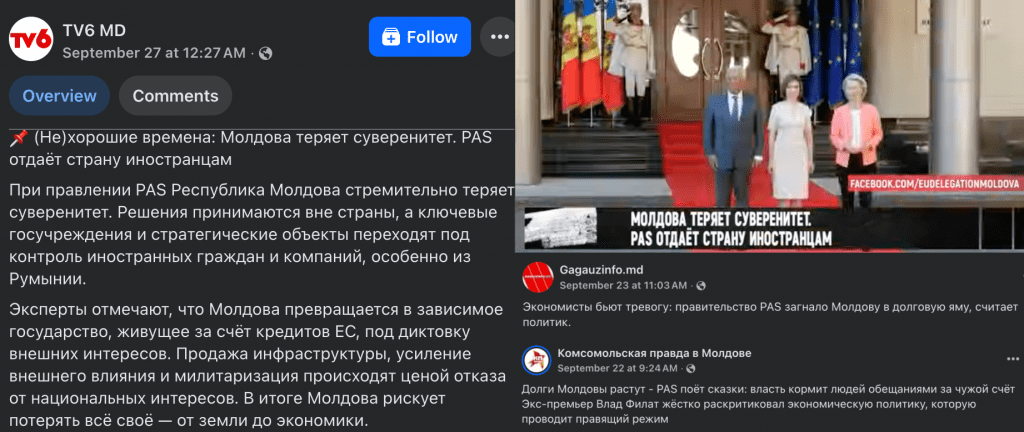
In fact, numerous posts that appeal to emotions, shared through different groups during this period, have “tallied” the failures of the four years of PAS in power — which is perfectly legitimate, but only until they are explained by conspiratorial allegories with shadow agents and “Soros’s puppets and innovators”. It has been claimed that Moldova’s government is a Soros-backed party, part of a declining globalist system, instead of a genuine European entity. Examples of posts in this spirit, in Romanian and Russian, were shared for several days a few dozen times in a number of groups with tens of thousands of members.
3. Dictatorship and opposition persecution
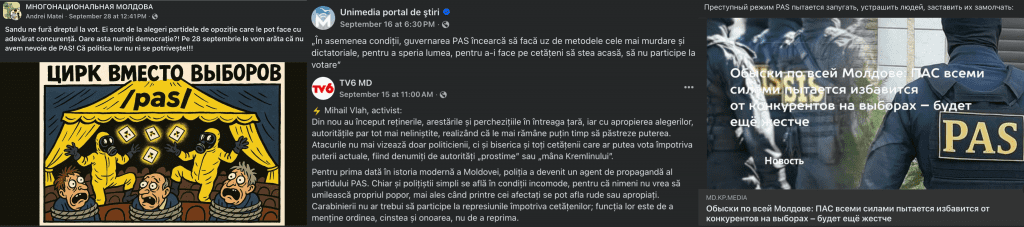
Along with the alleged sale of the country, the government is accused of two other major things, according to several sources that promoted misinformation: establishing dictatorship in the country and persecuting the opposition. In the first case, the slogan “The voice of the people is stronger than dictatorship”, launched by the socialist camp, was used repeatedly in calls to vote, marches and live shows, and various sources — from politicians and experts to citizens — were quoted in journalistic materials and posts referring to an autocratic regime (“controlled press”, “bans on protests”, “overtaken institutions”). “With their hysterical propaganda, searches and invented cases, they turned the country into a political prison. This is no longer a government; it’s a DICTATORSHIP!” In this line of thought, election day was encouraged to be perceived as a “moment of liberation”.
The narrative about opposition persecution has been dominant especially due to the Central Election Commission’s decisions to remove the Heart of Moldova Party and the Greater Moldova Party from the race and the actions of law enforcement officers who conducted raids and searches. Respectively, social media pages and groups pushed in various formats the idea that state institutions allegedly have dirty campaigns and orchestrate lawsuits and “lynchings” against certain anti-government vectors. “Two days before the elections, Maia Sandu’s dictatorial and hypocritical regime removed two opposition parties from the race. (…) They would do anything out of fear, even resort to open swindling, such as taking their contestants out of the game”, one of the posts read, while another one amplified the message: “The regime is in agony and freaking out. Today PAS strikes the opposition — on September 28, we, the citizens of this country, will strike the final blow at this dictatorship!”.
The narrative of government persecution has also been pushed through the clerical realm. An example is the appeal of Archbishop Marchel to US Vice President in which he presented the Church as the leadership’s direct target and warned that, should PAS win, “pressures could turn into a complete ban on activity”. His message linked religious identity to political stakes: allegedly, family, faith and Christian education are reasons for pressure, while traditional values are threatened across society.
4. Elections will be rigged
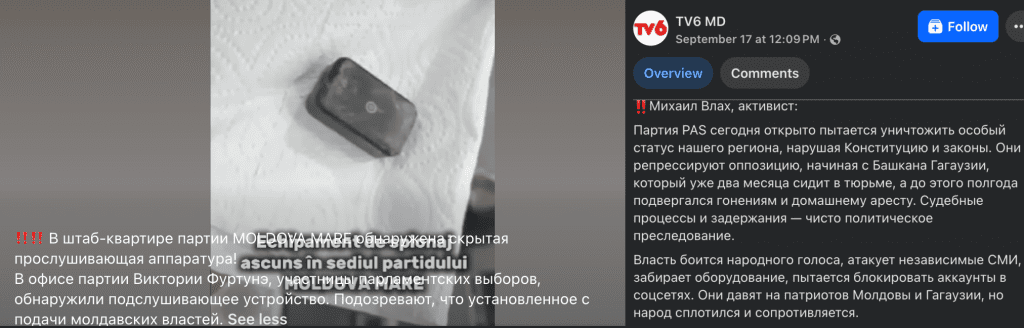
On voting day’s eve, several sources alarmingly reported about insufficient ballots for Transnistrian citizens (“Transnistrian residents were practically declared second-class people”, according to Transnistria News), “arranged” polling stations or “spying devices” found in offices (“Surveillance device in Greater Moldova office. Furtună accuses PAS”, according to TV6).
5. Moldova is drawn into war
During the same period, Maia Sandu and the ruling party were intensely accused on Facebook of preparing Moldova for a war with Transnistria and Russia, being influenced by the West, and if this does not happen in the immediate days after the elections — as has been insinuated since the pre-election period — then it will surely follow in 2026. “If PAS remains in power, the Soros’ minions will force Sandu to attack Transnistria together with Zelenskiy and to open a second front there in aid of Ukraine and against Russia. They tried to force the Georgians to open a second front against the Russians — without success. Moldova is next, and Maia Sandu has already made plans”, said Igor Dodon in a dialogue with Gheorghe Gonța, later quoted by several news portals.
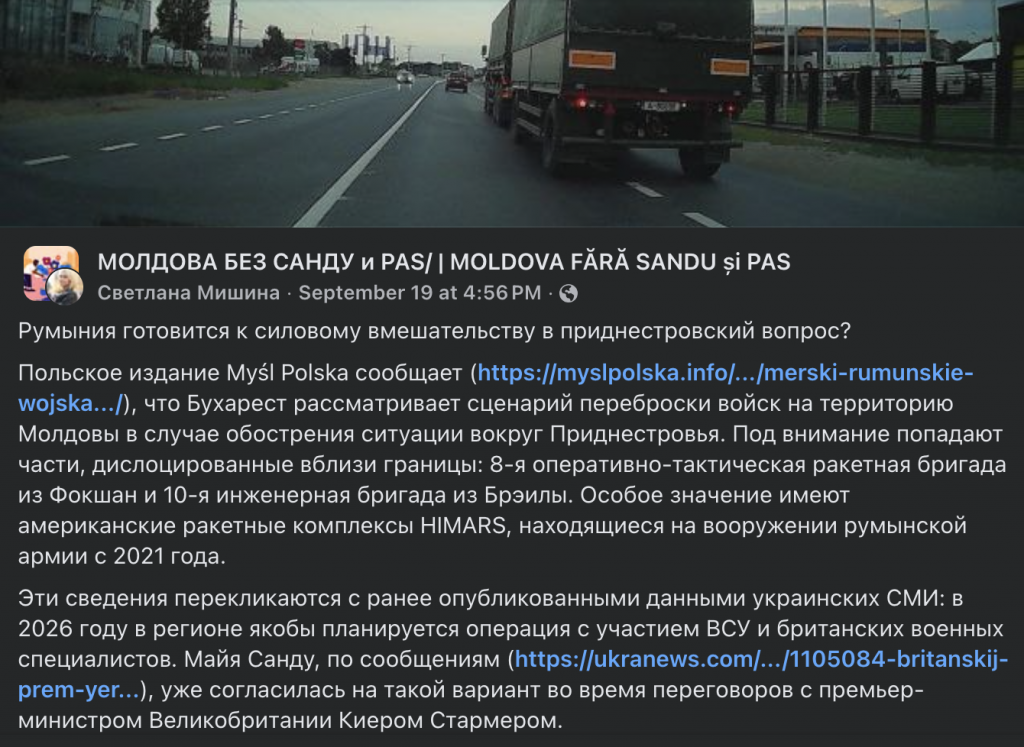
Facebook also saw photos shared across groups, allegedly proving that Romania was preparing a military intervention in the Transnistrian region in case of an escalation during the elections, falsely originating from several anonymous Telegram channels which made a reference to an article that appeared in the Polish Myśl Polska and which Mediacritica previously warned about.
Another opportunity to serve up the message of an impending conflict for Moldova was the press release of the Russian Foreign Service, which stated that “Europe is preparing to occupy Moldova”, with “a concentration of NATO forces in Romania”, a “landing force” in the Odessa region “to intimidate Transnistria” and even “the arrival of the first group of French and British troops in Odessa”. The message announced a “possible intervention”, also in the context of the alleged Transnistrian elections of November 30, intending to turn the rumors into a “schedule” of escalation and blaming Brussels of wanting to “keep Moldova at all costs”.

COMMENTS AS AN AMPLIFYING FACTOR
The slightly more than 3,300 posts identified during the monitoring period of September 15-28 gathered almost 23,500 comments, and a quarter of them contained misinformation and perpetuation of toxic messages, which means about four comments with a manipulative narrative thread per post. Thus, comments not only reflect, but also reinforce certain perspectives outlined in the posts, and they do so by repeating slogans, expanding geopolitical narratives, and normalizing “dictatorship” and “fraud” vocabulary.
One of the observed trends is the strong polarization, significantly framed in the false “us versus them” or “pro versus anti” dilemma. Comments often come down to short, repeated messages, calls to action such as “let’s vote massively…” or “down with…”, and much less look like a reasoned debate. Examples include: “Down with the traitors! Let’s all vote so they don’t steal from us again!”; “Never let anyone mock Moldova and the Orthodox Moldovan people”; “Let’s defend our country, our nation and our Orthodox faith!”.
On the other hand, a consistent number of comments is geopolitically contextualized: EU, NATO, war, Russia/Kremlin. They link the election directly to issues of security and identity, often using labels (“Nazis”, “propaganda”, “traitors”) and accusations of “subordination” to the West. Examples include: “It’s just their propaganda! Open your eyes, don’t be manipulated!”; “They manipulate us with the EU and NATO to sell our country”.
In addition, comments frequently reiterate labels such as “dictate/dictatorship”, “lie”, “stolen”, “manipulated”, and “corruption”. Government authorities and institutions are presented as “captive” and “abusive”, and the electoral process as “a masquerade”. These messages validate the distrust already set in the posts. Examples include: “Down with the yellow dictatorship! They’ve lied to us and stolen enough!”; “Censorship everywhere: their televisions lie all day long”; “Blatant fraud! Our votes go to them; it’s all a masquerade”.
FACEBOOK ATMOSPHERE ON CAMPAIGN SILENCE DAY AND ELECTION SUNDAY
Analysis of pages and groups on election weekend shows that Saturday was also a day of stakeholder silence on Facebook. With some exceptions, the main parties and party leaders abstained from massive campaigning. Instead, some politically affiliated media sent certain messages by quoting various politicians in news and other materials shared among generalist information about Sunday’s elections, the latest preparations of the authorities, etc. The Facebook page owned by the former TV6 channel was the most active source of all.
Misinformation, however, intensified on voting day. Half of all thematic posts identified on the analyzed sources during the two days contained misinformation narratives, distributed predominantly on Sunday and focusing on two major issues: fraud at the polls and limited voting possibility in Transnistria.
On election day, the narrative about prevented vote for Transnistria residents was a keynote pushed with phrases like “violated rights” and “blocked access”, combining accusations of logistical restrictions with examples of single difficulties, meant to suggest a coordinated strategy. Early in the morning, prominent posts cited “systemic obstacles” and “restricted citizens’ rights” which referred to measures such as “number of polling stations reduced from 30 to 12” and “number of ballots limited to 23,000”. “This is how the administrative resources of authorities in the neighboring Moldova work”, some concluded. The narrative then attached itself to local incidents, with direct accusations against certain entities: “Floresti police prevent suffrage for Transnistrian voters. D for democracy!”, while interim turnout figures were used as “proof” of deterrence: “According to CEC, barely 8,260 Transnistrian region residents voted by 15:00”.
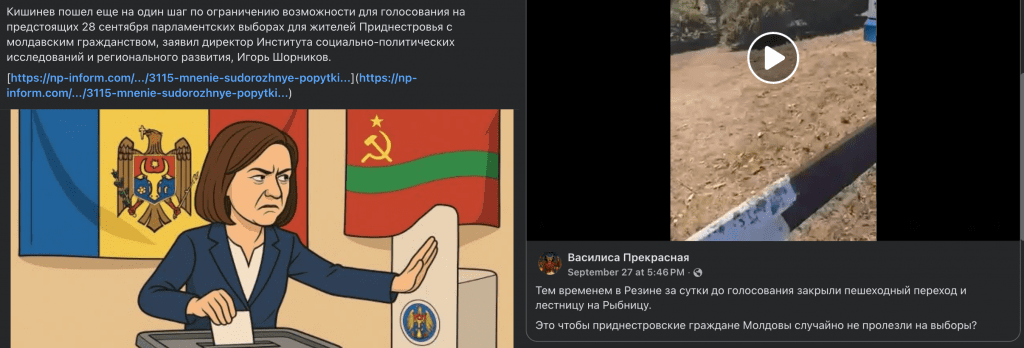
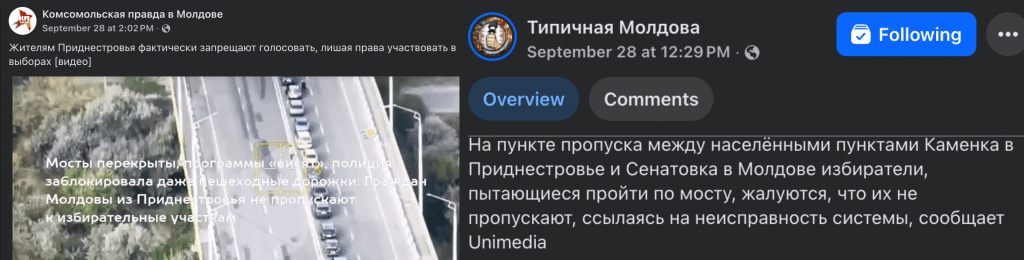
Bomb alert cases were exploited, when “dozens of people spent several hours stuck on the bridge over the Dniester River, between Ribnita in Transnistria and Rezina in Moldova”, changing in polling station locations and thorough citizen checks. The speech was reinforced by a statement of the so-called Minister of Foreign Affairs of the self-proclaimed region, shared by several media sources and groups, about “attempts to limit the rights of residents”: “We continue to find cases facts of expanded restrictive measures, many of which have already been used against Transnistrians during last year’s elections in neighboring Moldova”.
Overall, these messages have turned a series of logistical difficulties and controversial episodes into a common idea about a “remotely controlled” vote — Transnistrians are denied, in a programmed manner, equal participation in the elections.

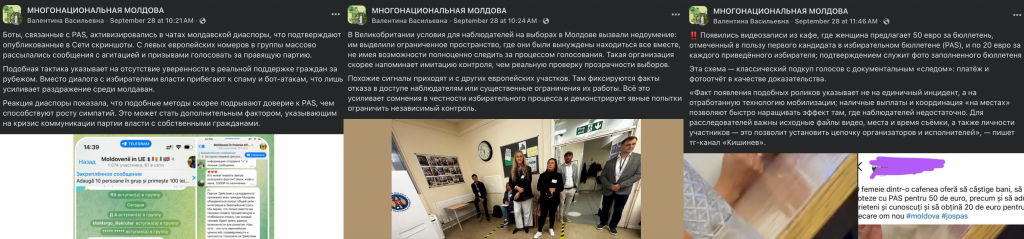
In parallel, it has been suggested many times about vote rigging. The idea at the core of this narrative is that the process is deep down flawed, with observers kept behind the doors, “hidden” ballots, “vote buying” and arbitrarily enforced procedures. The message reinterprets isolated episodes as evidence of an organized mechanism, suggesting that the outcome has been “pre-arranged”. The records contain published statements such as “Scandal in elections: observers not allowed to enter polling stations. (…) Polling station chairpersons abroad block the possibility of observation…” or remarks with a stake of political culpability: “… after the elections, political experts will probably have a dirty and tough job to do”. In contrast, some politically affiliated sources tried to manipulate the “huge queues” at the two polling stations in Moscow against insufficient ballots that citizens allegedly have complained about.

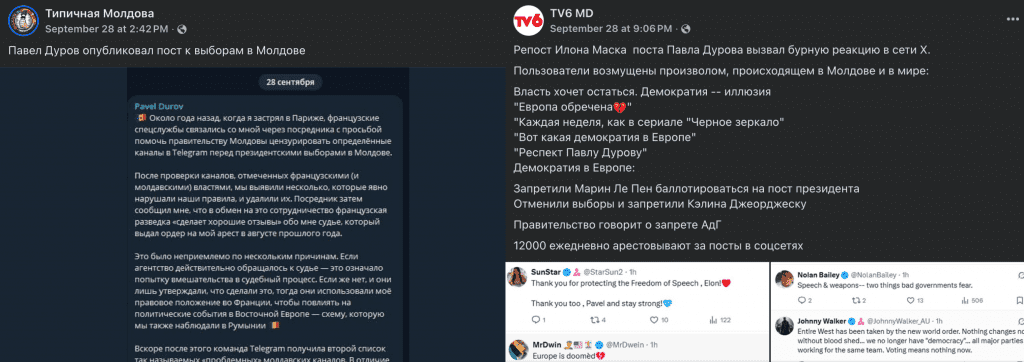
Telegram founder Pavel Durov’s message in which he claims that French intelligence services asked him to censor certain channels in Moldova was quickly instrumentalized, fueling narratives about external interference and censorship, especially through comments.
That same evening, the legitimacy of the electoral process was called into question before the vote count was completed. The initial source of the challenge was Igor Dodon, one of the leaders of the Patriotic Bloc: “Tomorrow, at 12:00 (…) we will hold a protest in front of the CEC headquarters”, several sources quoted him saying. Later, the message was reinforced by the statement that “the results have been falsified. (…) We will organize a peaceful protest and defend our victory”.
