


Media Education: Keeping up with Trends
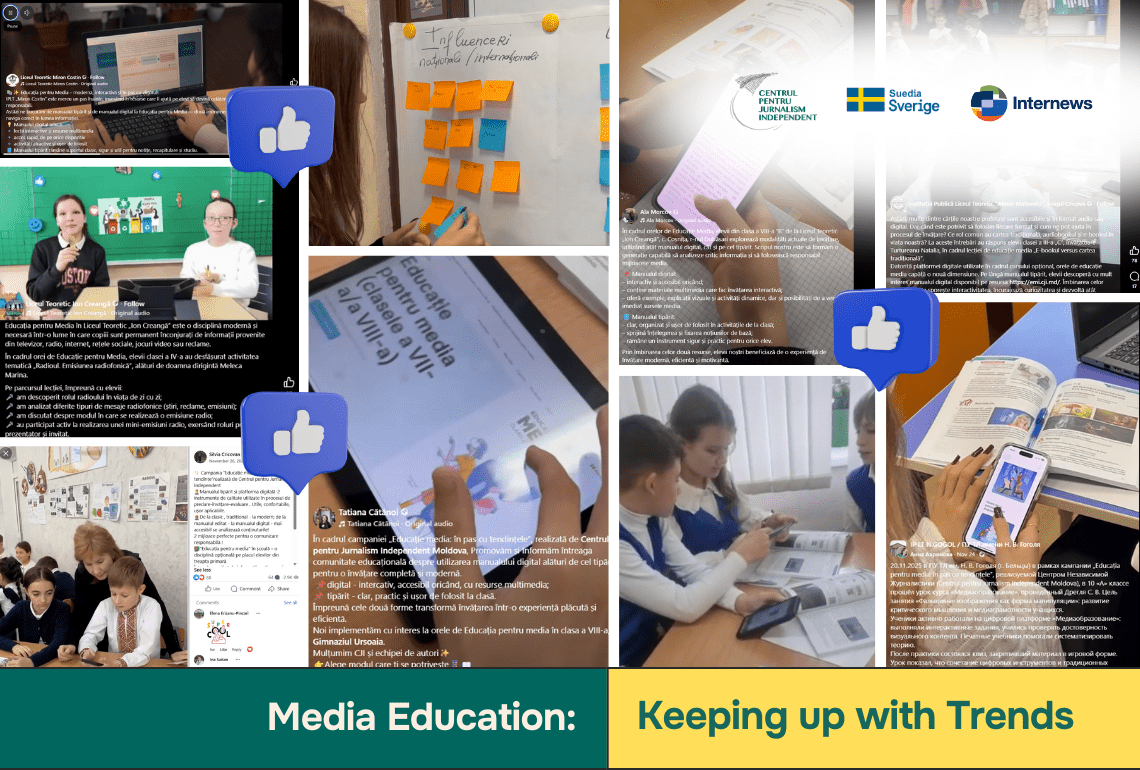
Between November and December 2025, the Independent Journalism Center (IJC) continued the campaign “Media Education: Keeping up with Trends,” aimed at promoting the updated Media Education textbooks and the digital platform of the same name, both used in Media Education lessons in schools across the Republic of Moldova.
Through videos and posts made by teachers who teach the optional course Media Education at primary, middle, and high school levels, the campaign “Media Education: Keeping up with Trends” showed how the printed and digital textbooks can be effectively integrated to make the learning process more interactive and connected to current information realities.
Primary school: first steps in understanding the media world
At the primary school level, the Media Education course contributes to the development of basic skills related to conscious information consumption, curiosity, and critical thinking, adapted to the age group.
In Media Education lessons, Natalia Turtureanu, a teacher at the “Alexei Mateevici” Theoretical High School in Cricova, compared traditional books, e-books, and audiobooks. Third-grade students discovered when and how different reading formats can be used, and the use of the Media Education digital platform brought more interactivity and motivation to the lessons. “In addition to the printed textbook, students are very interested in the digital textbook. The combination of the two formats increases interactivity, encourages curiosity, and develops both students’ digital skills and critical thinking, transforming the learning process into a more attractive and motivating experience,” says the teacher.
At the “Ion Creangă” Theoretical High School in Coșnița village, Dubăsari district, teacher Marina Meleca discussed radio and radio broadcasting with fourth-grade students. The students analyzed types of media messages, discussed the role of radio in everyday life, and actively participated in creating a mini-program. “The proposed activities demonstrated that Media Education can be attractive and practical even in primary school. This discipline prepares students to become informed citizens, capable of making the right decisions in a complex digital world,” said the teacher.
Silvia Cricovan, a teacher at the “Alexandru Ioan Cuza” Theoretical High School in Chișinău, emphasized in her lessons the importance of using both printed textbooks and digital platforms. According to her, the two tools “facilitate the transition from traditional to modern approaches and support the development of responsible communication from an early age.” “Media Education is an optional subject that primary school students enjoy. In a world full of information, knowing is no longer enough. It is important to know what is true, what is useful, and what can influence us,” the teacher notes.


Middle school: a boost for the development of critical thinking
At the secondary school level, Media Education becomes a key skill for understanding complex information phenomena such as fake news, propaganda, or manipulation through images and video.
Svetlana Barboș, a teacher at the Universul Theoretical High School in Scoreni village, Strașeni district, highlighted the role of printed textbooks and the digital platform in supporting seventh-grade students in the process of analyzing media content. The lessons focused on recognizing false information and everyone’s responsibility in creating a safer information space. “In this context, media education becomes an essential skill for the formation of the modern citizen. In the internet age, fake news, propaganda, truncated information, images, and videos circulate very easily. Printed textbooks and the digital platform provide tools for understanding misleading content,” says the teacher.
At Ursoaia Gymnasium in Ursoaia village, Căușeni district, teacher Tatiana Cătănoi has promoted the use of digital and printed textbooks in media education classes in the eighth grade. “The digital textbook, with its multimedia and interactive resources, complements the classic textbook, providing students with a more effective and engaging learning experience,” says the teacher.
Another example comes from the “Ion Creangă” Theoretical High School in Coșnița, where Ala Morcov demonstrated how the advantages of both textbook formats can be used. Students worked with multimedia materials, checked media sources, and reinforced theoretical concepts with the help of the printed textbook. “By combining the printed and digital textbooks, our students benefit from a modern, effective, and motivating learning experience,” says the teacher.


High school: a call for reflection and responsibility
At the high school level, media education focuses on freedom of expression, online responsibility, and the impact of viral content.
Cristina Cernei, a teacher at the “Onisifor Ghibu” Theoretical High School in Chișinău, addressed sensitive topics with her students, such as freedom of speech, aggressive behavior in the online environment, the role of influencers in shaping public opinion, and the need to argue one’s opinions. The lessons encouraged empathy, communication, and critical analysis. “Children are not to blame for seeing the world in black and white. It’s also their age, and it’s our responsibility, as teachers and parents, to explain to them how things really are,” says the teacher.
At the “Miron Costin” Theoretical High School in Florești, teacher Rodica Bogdan highlighted the benefits of printed and digital textbooks as complementary tools. “Interactive and accessible online resources, alongside traditional support, contribute to the development of informed, aware, and prepared students for the challenges of the future. “Printed and digital textbooks for media education are two essential tools for navigating the world of information correctly,” says the teacher.
A relevant example comes from the “N. Gogol” Theoretical High School in Bălți, where teacher Svetlana Dreglea discussed with high school students about fake images as a form of manipulation. The 10th-grade students worked on the digital platform, verified the authenticity of visual content, and consolidated their theoretical knowledge with the help of the printed textbook, demonstrating the effectiveness of combining the two educational resources. “The lessons showed that the combination of digital tools and traditional resources makes learning dynamic, engaging, and effectively develops critical thinking,” says the teacher.


Media Education – an investment in critical thinking
The materials developed by the teachers involved in the “Media Education: Keeping up with Trends” campaign confirm that updated textbooks and the digital platform are important tools in the education process. Used complementarily, they support the development of critical thinking, media skills, and responsible behavior in the face of the flow of information.
This activity is part of the project supported by Sweden “Media Literacy Advancement and Support to Moldovan Media” and implemented by Internews, which aims to contribute towards the growth of a diverse, independent and financially viable media landscape in Moldova, and to empower Moldovan youth to navigate their complex information environment.
